


New Study Maps Hotspots and Urges Action
 KRC TIMES Desk
R.K. Neetusana
Dengue fever, a mosquito-borne disease caused by the Aedes aegypti mosquito, is spreading at an alarming rate across Manipur, according to a recent study conducted by our research group which used advanced GIS mapping tools to track its spread in different time periods. The study which was carried out between 2021 and 2024, reveals how certain areas of the state have become a consistent “hotspots” for the disease, with cases multiplying more than twelvefold over just three years.
The disease, sometimes called “breakbone fever” because of its severe joint pain, can range from mild to life-threatening. In India, dengue cases are monitored by the National Centre for Vector Borne Disease Control (NCVBDC), and Manipur reports data through four sentinel hospitals — RIMS, JNIMS, Churachandpur District Hospital, and Thoubal District Hospital.
The factors such as climate change, rapid urban growth, poor waste disposal, and irregular water supply are creating the perfect breeding conditions for dengue-carrying mosquitoes.
Using Geographic Information System (GIS) technology, we mapped where dengue cases occurred each year and looked for any spatial patterns. We examined climate data, population density, literacy rates, land use, and vegetation cover, as well as infrastructure issues like waste management and water supply.
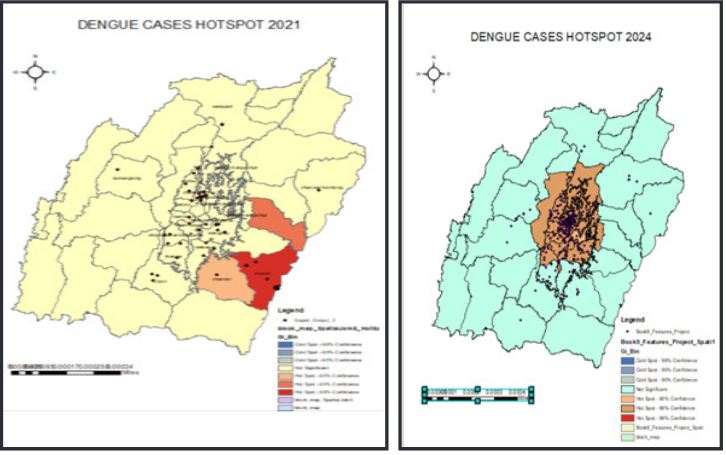
The results and findings were striking. To summarize, in the year 2021, Manipur recorded 203 dengue cases. That number rose to 503 in 2022 — a 2.5-fold jump. But in 2023, cases exploded to 2,548, more than twelve times the 2021 total. In 2024, the disease’s spread became even more concentrated in certain districts as discussed in subsequent section.
Hotspot analysis revealed how the geography of dengue changed over time. In 2021 and 2022, only a few areas, such as Tengnoupal and Porompat, showed significant clustering of cases. By 2023, eleven blocks — including Bishnupur, Lamphelpat, Lamsang, Lilong, and Thoubal — were marked as hotspots, most of them in the valley districts where population density is highest.
The study also confirmed that climate plays a critical role. Higher rainfall, elevated humidity, and warmer temperatures all contribute to mosquito breeding. Poor waste disposal and irregular water supply allow stagnant water to collect, providing ideal breeding grounds for Aedes aegypti.

Researchers believe that the maps and models from such research study can be turned into an early warning system, helping health officials and policy makers to focus on various strategic and control efforts before the dengue outbreaks spiral out of control. We must focus and stress to the need for a long-term improvements in sanitation, drainage, and water management in every hot spots region in various districts.
We should see to it – “The spread of this disease isn’t just a health issue — it’s an environmental and infrastructure challenge”. “If the decision makers address the root causes, the number of these cases can be reduced drastically and can save many lives.”
With dengue season in Manipur, which normally peaks during the monsoon months of June to October every year, every citizen of the region must be given proper eduation and awareness about the do’s and don’t about this disease. As the state braces for another rainy season, the message from this study is clear: dengue can be fought — but only with targeted action, smart planning, and community cooperation.
R.K. Neetusana, PhD Scholar & Prof. Dr.Ing. Oinam Bakimchandra, NIT Manipur
Promotional | North East Integration Rally