

Dream and dilemma
 KRC TIMES Desk
Atul Sehgal
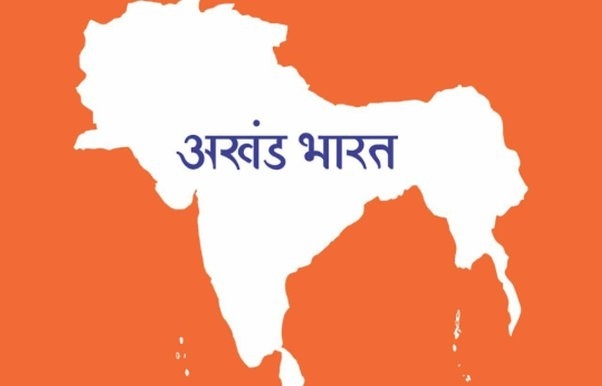
The idea of Akhand Bharat a united subcontinent evokes both nostalgia for a shared past and controversy over its modern-day feasibility, rooted in ancient Bharatavarsh and revived during the freedom struggle as a counter to the two-nation theory
The idea of Akhand Bharat, or “United India,” is one of the most evocative and contested concepts in South Asia. Rooted in ancient history and rekindled during the anti-colonial struggle, it envisions a subcontinental nation encompassing the territories of modern-day India, Pakistan, Bangladesh, Nepal, Myanmar, Afghanistan, Tibet, Sri Lanka, and the Maldives.
For some, it symbolises cultural continuity and civilisational grandeur; for others, it is a utopian dream with little chance of becoming reality. Between nostalgia and controversy lies a debate that blends history, politics, and geopolitics in equal measure. The concept of a unified cultural space called Bharatavarsh can be traced back to ancient Indian texts.
This vision was not always political in nature but rather civilisational an acknowledgment of shared traditions, religions, and exchanges across the subcontinent. The Mauryan Empire under Chandragupta and Ashoka came closest to achieving political unity in the 3rd century BCE.
Ashoka’s reign, marked by both conquest and the spread of Buddhism, is often invoked as an early precedent for Akhand Bharat.Centuries later, during India’s freedom struggle, the notion resurfaced in response to the demand for Partition.
Leaders like Vinayak Damodar Savarkar articulated Akhand Bharat as a counter-idea, rejecting the two-nation theory that ultimately shaped the 1947 division. Partition, however, redrew the map, birthing Pakistan and eventually Bangladesh, and institutionalising political fragmentation. For many, that moment extinguished the dream of unity.
Yet organisations like the Rashtriya Swayamsevak Sangh (RSS) have kept the ideal alive, framing it as both a cultural memory and a political aspiration. To them, Akhand Bharat symbolises not merely geography but the recovery of a civilisational whole. The modern-day hurdles to Akhand Bharat are formidable. Foremost is the sovereignty of established nation-states.
Pakistan, Bangladesh, Nepal, and others are independent countries with their own constitutions, national identities, and geopolitical orientations. Any attempt at annexation or absorption would constitute aggression under international law. The backlash over a mural in India’s new Parliament building in 2023, interpreted by neighbours as depicting Akhand Bharat, underscored the sensitivity of the issue. Demographics present another obstacle.

A reunified South Asia would dramatically reshape the religious balance, with Muslims forming a much larger share of the population. Sceptics argue this could inflame sectarian divisions rather than heal them, given the violent legacy of Partition and the persistence of communal tensions. Critics also emphasise that, over the past 75 years, religious and cultural divides have deepened, making consensus-based unification highly unlikely.
Yet this scepticism rests partly on political manipulation. Religious fault lines, critics suggest, are often exploited by political elites and foreign powers. On the ground, people across the region share customs, languages, cuisines, and music. Seen through this lens, civilisational unity remains intact, even if political unity appears distant. The geopolitical context adds further complexity. India and Pakistan’s rivalry entrenched by wars, terrorism, and the Kashmir dispute makes even the thought of integration appear dangerous.
Analysts caution that any push for forced reunification could destabilise the nuclearised region. However, proponents of Akhand Bharat counter that the abrogation of Article 370 in 2019, the decline of cross-border terrorism, and India’s military assertiveness illustrated in later operations against Pakistan have changed the balance of power.
They argue that the nuclear threat is less of a deterrent than it once was, and that peaceful economic integration could bring shared prosperity.If political unification remains elusive, cultural and economic cooperation offers a more realistic path.
Instead of seeing Akhand Bharat as a territorial project, it can be reimagined as a civilisational and cultural framework. South Asia’s nations share more than borders: they are bound by cricket, cinema, literature, folklore, and cuisine. These shared elements can become the foundation for greater trust and regional harmony.
Institutions like the South Asian Association for Regional Cooperation (SAARC), though underperforming, demonstrate the potential for collective action on issues such as poverty alleviation, climate change, and trade. Strengthening such platforms could allow countries to pursue common goals without threatening sovereignty. Enhanced trade corridors, student exchange programmes, and cultural festivals could gradually weave together a sense of regional identity.
Seen this way, Akhand Bharat is not about conquest but cooperation. It need not be imposed by force or framed in terms of territorial expansion. Rather, it can evolve organically through economic interdependence, cultural revival, and people-to-people connections. Over time, such integration might pave the way for closer political alignment, though that remains a long-term possibility rather than an immediate goal.
Akhand Bharat remains an emotive ideal, oscillating between nostalgia and controversy. Politically, its realisation appears improbable in the near future, given entrenched national identities, religious divides, and international boundaries. Yet as a cultural and civilisational vision, it holds resonance.
By shifting focus from annexation to cooperation, South Asia can reclaim aspects of its shared past while building a more peaceful and prosperous future. The challenge, then, is to separate myth from possibility. The dream of political reunification may never materialise in its literal form, but the essence of Akhand Bharat a recognition of common heritage can still inspire regional collaboration.
The nations of South Asia, by embracing their shared roots and respecting their differences, can turn division into dialogue and rivalry into partnership. Such a future may not carry the dramatic weight of empire, but it promises stability, prosperity, and dignity for over a billion people.
The author is a management consultant based in New Delhi
Promotional | North East Integration Rally