


The BNP at a Crossroads in Bangladesh’s Uncertain Political Future
 KRC TIMES Desk
MK PANDEY
The death of Begum Khaleda Zia marks the end of an era in Bangladeshi politics. For decades, she was not merely the chairperson of the Bangladesh Nationalist Party (BNP) but one of the two towering figures-alongside Sheikh Hasina-who defined the country’s political life through rivalry, confrontation, and occasional convergence.
That she had been gravely ill for some time made her passing less unexpected, yet the national response to her death underscored just how deeply she remained embedded in Bangladesh’s political consciousness.
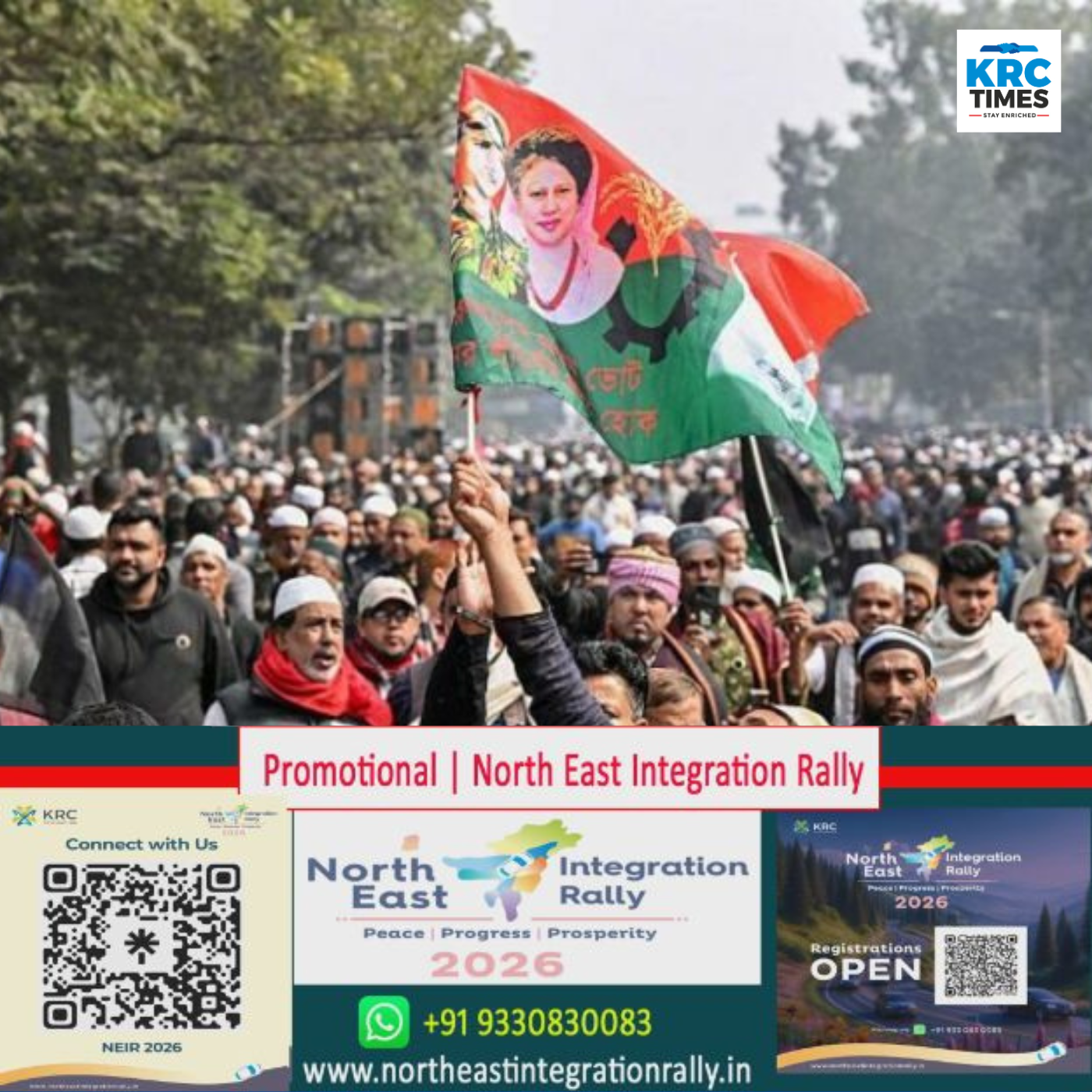
In the days following her demise last Tuesday, tributes flowed in from across the political spectrum, reaffirming her stature as a former prime minister and a central actor in the country’s post-independence history. One gesture, in particular, stood out.
Former prime minister Sheikh Hasina, Khaleda Zia’s long-time political adversary, publicly expressed her condolences and personally telephoned Tareque Rahman to convey her grief. In a polity long accustomed to bitterness and zero-sum politics, the gesture was widely seen as magnanimous and deeply humane.

For many Bangladeshis, Hasina’s act transcended partisan divides. It suggested that, at moments of loss, the shared human experience could override entrenched political hostility. Commentators noted that the respect shown to the late BNP leader seemed to open a wider emotional space-one that momentarily lifted the conversation above the acrimony that has so often characterised Bangladesh’s public life.
Yet that moment of collective restraint and dignity was short-lived. At Khaleda Zia’s funeral, senior BNP leader Nazrul Islam Khan issued a statement on behalf of the party accusing the Awami League government-and Sheikh Hasina personally-of responsibility for the steady deterioration of Khaleda Zia’s health. The accusation struck many as jarring, coming as it did at a solemn occasion when the country appeared inclined toward reflection rather than recrimination.
To be sure, there is no shortage of public sympathy for Khaleda Zia’s ordeal in her later years. Large sections of Bangladeshi society, including some who are otherwise politically aligned with the Awami League, have long expressed discomfort over the manner in which she was treated by the state.
Her incarceration in the old Dhaka central jail, the repeated denial of permission to travel abroad for advanced medical treatment, and the broader atmosphere of humiliation surrounding her final years left many citizens uneasy. These episodes became emblematic of the harshness that had come to define Bangladesh’s winner-takes-all politics.

Still, timing and tone matter. At a moment when the nation is increasingly vocal in its demand for the end of Muhammad Yunus’ unconstitutional regime and the holding of a credible, inclusive election, the BNP’s decision to revive the language of blame at a funeral puzzled and disappointed many.
It raised an unavoidable question: why reopen old wounds precisely when the political context demands coalition-building, restraint, and strategic clarity?
Blame, after all, cannot be placed solely on one individual. Nazrul Islam Khan spoke on behalf of the BNP; the statement reflected a collective decision. That choice is difficult to explain, particularly when the BNP today finds itself in a precarious and, in many respects, lonely position on the national political landscape.
Arrayed against the BNP are not only the forces associated with the Yunus regime but also Jamaat-e-Islami and several other Islamist parties, along with the National Citizens Party. These groups have shown little interest in seeing the BNP return to power.
Indeed, the return of Tareque Rahman to Bangladesh after seventeen years of exile in the United Kingdom appears to have unsettled Islamist forces rather than reassured them. Signals from these quarters suggest a clear priority: preventing a BNP electoral victory whenever elections are eventually held.

This reality poses a stark challenge for Tareque Rahman and the BNP leadership. If the party’s long political exile is to end, it must confront the strategic implications of its isolation. The question is no longer simply how to oppose an illegitimate regime, but how to build a broad-based political consensus capable of neutralising anti-democratic and anti-liberation forces.
This inevitably brings the Awami League back into the equation. Whether the BNP likes it or not, any credible plan for a return to constitutional democracy will require a working understanding-if not a formal alliance-between the country’s two major political forces.
An election in which the Awami League and its substantial support base remain disengaged would lack legitimacy from the outset. With an estimated 35-40 per cent of voters traditionally aligned with the Awami League, their absence from the polling booths would render any electoral exercise hollow and contested.
From this perspective, it is in the BNP’s own interest to ensure that the Awami League participates fully in the electoral process. That requires more than tactical silence; it demands political maturity and a willingness to rethink old habits of confrontation.
The priority for the BNP leadership should be twofold: internal reorganisation and external reassurance. The party must demonstrate that it is not only capable of contesting elections but also prepared to govern responsibly-potentially in coalition with pro-liberation, democratic forces.

An informal understanding between the BNP and the Awami League, however unpalatable it may seem to hardened partisans, may be unavoidable if the objective is the restoration of proper democracy and constitutional legitimacy. History offers a precedent.
In the 1980s and early 1990s, Sheikh Hasina and Khaleda Zia led rival alliances-the former heading a fifteen-party combine, the latter a seven-party front-in a sustained struggle against the military autocracy of General Hussein Muhammad Ershad. Despite their differences, that joint pressure ultimately succeeded.
The present moment arguably calls for a similar, though differently shaped, convergence. The challenge today is not military rule but an anti-liberation, unconstitutional regime imposed in August 2024. Removing it will require coordination among forces that may distrust one another but share a larger interest in democratic restoration.
In this context, the burden of initiative rests heavily on the BNP. With Khaleda Zia gone, the party can no longer rely on her charisma or symbolic authority. Tareque Rahman and his colleagues must navigate a far more complex political terrain, one in which missteps could prove fatal.
If the BNP stumbles, its rightist and Islamist rivals are well positioned to capitalise. If it fails to articulate a credible, inclusive election strategy, the broader political crisis will only deepen.

There are, however, tentative signs of recalibration. The recent visit of Indian External Affairs Minister S. Jaishankar to Dhaka to convey condolences from the Indian government has been widely interpreted as a signal of New Delhi’s interest in seeing constitutional order restored in Bangladesh. Jaishankar’s meeting with Tareque Rahman, in particular, has been read as an indication that India is open to engaging constructively with a future BNP leadership.
Equally significant is the BNP’s recent restraint in avoiding anti-India rhetoric-a notable departure from past patterns. This suggests a recognition within the party that regional stability and diplomatic pragmatism are essential, not optional, components of responsible governance. Such shifts, if sustained, could contribute to a healthier political environment both within Bangladesh and across South Asia.
All of this underscores the delicacy of the moment. The ground beneath the BNP remains slippery. Progress will require careful, patient politics rather than emotional reflexes. The central national task today is the holding of an inclusive election-one in which all major parties, including the Awami League, participate freely and competitively.
Adding to the pressure on the Yunus regime to accept this necessity must become the BNP’s overriding objective. That pressure will be effective only if it is principled, inclusive, and anchored in a clear commitment to democratic norms.
The passing of Khaleda Zia closes one chapter of Bangladesh’s political history. Whether it opens the door to a more constructive future depends largely on how the BNP chooses to act in her absence. The memory of past struggles-when bitter rivals found common cause in the defence of democracy-offers both a lesson and a possibility. The question now is whether today’s leaders are prepared to learn from it.
Promotional | North East Integration Rally