Loktak Lake: Where Floating Forests, Endangered Wildlife, and Manipur’s Living History Converge
 North East Integration Rally
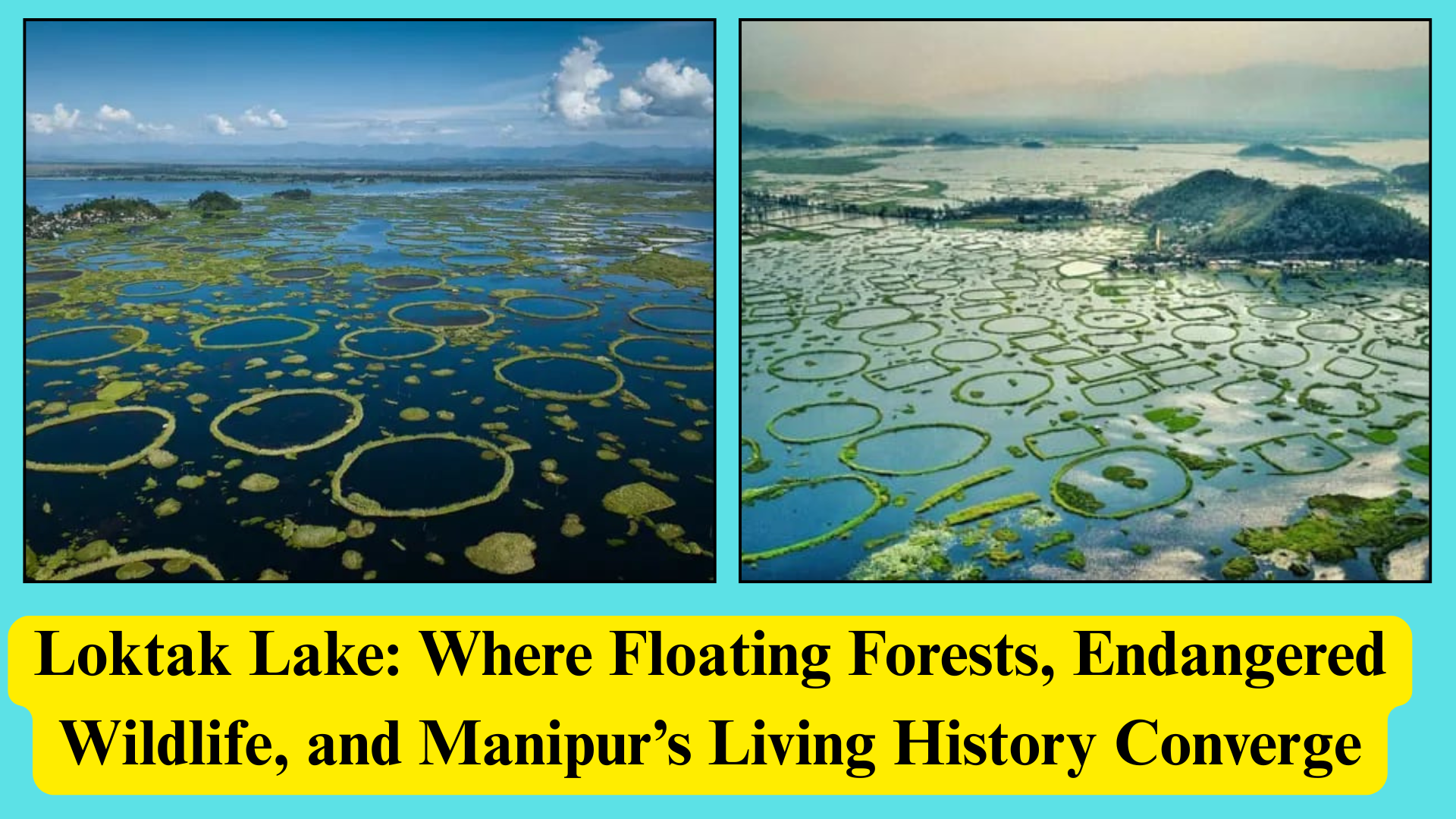
Loktak Lake does not announce itself quietly. It spreads out, shifts shape, breathes with the seasons, and refuses to stay still. Near Moirang in Manipur’s Bishnupur district, about 48 kilometres from Imphal, it holds the distinction of being the largest freshwater lake in Northeast India. But size is the least interesting thing about it.
What makes Loktak singular is its surface. Floating across the water are phumdis, thick, spongy masses of soil, vegetation, and organic matter that drift, settle, break apart, and re-form. Some are small and transient. Others are vast enough to support huts, fishing platforms, and even forests. These floating islands are not decorative accidents of nature. They are the lake’s living architecture.
At the heart of this architecture lies Keibul Lamjao National Park, the world’s only floating national park. Spread across the southwestern part of Loktak, it rests entirely on phumdis. This is not a metaphor. The park literally floats. And within it survives the Sangai, the brow-antlered deer, known locally as the dancing deer for its delicate gait on the yielding surface. Endangered and deeply symbolic, the Sangai is inseparable from Loktak’s fate. If the phumdis weaken, the park sinks. If the park sinks, the Sangai disappears.
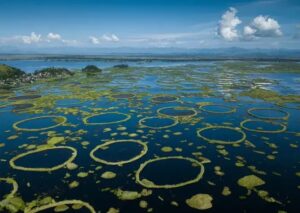
Loktak is a Ramsar wetland of international importance, with its area fluctuating between 250 and 500 square kilometres depending on the season. That fluctuation is natural, or at least it used to be.
The lake once expanded and contracted freely, fed by multiple rivers and drained by the Manipur River system. The phumdis followed this rhythm, absorbing nutrients during floods and regenerating when waters receded. This cycle sustained fish populations, water birds, and the livelihoods of thousands.
Fishing here is not an industry imposed from outside. It is a way of life shaped around the lake’s movements. Phumsangs, floating huts anchored to phumdis, dot the water. Families live on them, fish from them, raise children on them. Nets are cast at dawn. Canoes glide through narrow channels cut between floating masses. The lake feeds, shelters, and employs.
Loktak also powers. The Ithai Barrage, built for hydropower and irrigation, altered the lake’s natural cycle by maintaining a high water level year-round. The consequences have been profound. Phumdis no longer touch the lakebed often enough to regenerate. They thin. They fragment. Fish breeding patterns change. What was once a breathing ecosystem risks becoming a stagnant one.
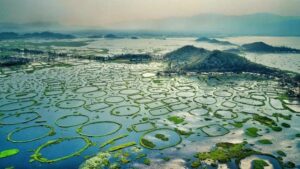
This tension between development and ecology defines Loktak’s modern story. The lake supplies water for agriculture across the Imphal Valley. It generates electricity. It supports fisheries. At the same time, these interventions threaten the very processes that make the lake viable. Conservation here is not about freezing the lake in time. It is about restoring its ability to change.
Beyond ecology, Loktak carries deep cultural weight. It is sometimes called the Lake of Tears, a phrase rooted in local legends of loss, longing, and survival. Stories passed down through generations tie the lake to identity and memory. This is not a backdrop. It is a participant in Manipur’s emotional landscape.
History, too, runs along its shores. In nearby Moirang, the Indian National Army hoisted the tricolour in 1944, a moment that still resonates in the national imagination. Loktak watched that moment unfold, as it has watched centuries of change, conflict, and continuity.
Tourism has found its way here, cautiously. Sendra Island offers sweeping views of the lake’s floating geometry. Thanga village provides a glimpse into lake-based life. Ithing and other spots attract visitors drawn by the quiet drama of water and sky. But Loktak resists spectacle. It rewards patience more than cameras.
To understand Loktak is to accept complexity. It is a wetland, a home, a power source, a cultural symbol, and a political question. It cannot be reduced to a postcard or a single narrative. Its phumdis remind us that stability can be flexible, that roots do not always go downward, and that survival sometimes depends on floating rather than standing firm.
What happens to Loktak in the coming decades will say a great deal about how we choose to balance need and care, ambition and restraint. The lake has adapted for centuries. The question now is whether those who depend on it can learn to adapt as well.
Promotional | North East Integration Rally