A Soldier, Historian’s Journey from the Mahabharata to Modern Battle Lines
 KRC TIMES Desk
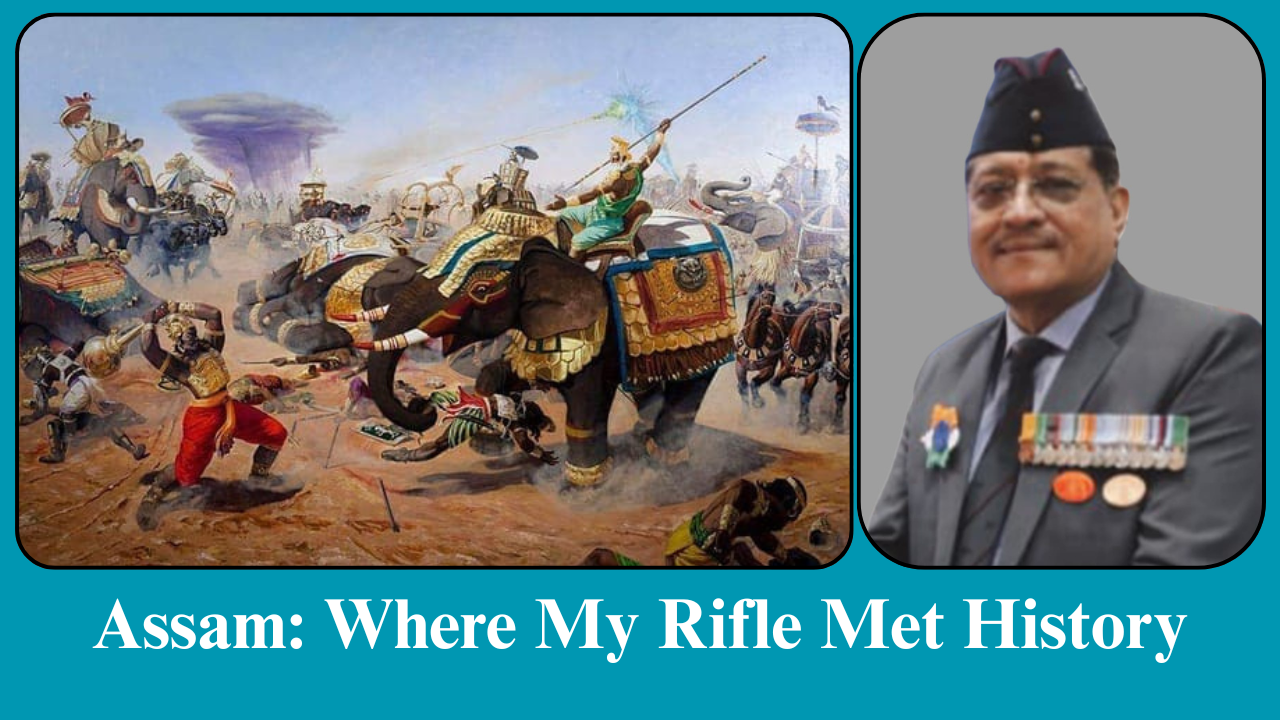
Col (Dr.) Ashwani Kumar, M-in-D, VSM (Retd)
I first arrived in Assam not as a pilgrim or a scholar, but as a young soldier posted between 1992 and 1993, when the region was tense, restless, and unforgiving.
The Brahmaputra still flowed wide and calm, as it must have in the age of Bhagadatta of Pragjyotisha, but the forests whispered differently then. Somewhere beyond the tea gardens and railway lines, insurgents watched, waited, and vanished into the same jungles that had sheltered warriors for millennia.
That was when I understood, Assam does not merely appear in Indian history. It continuously tests it.
Pragjyotisha: When the East First Took Up Arms.
As a soldier with a historical bent, I often reflected on the Mahabharata during long nights of duty.
This land, then known as Pragjyotisha sent Bhagadatta, son of Naraka, to Kurukshetra with elephant divisions and hill fighters trained in terrain warfare. His army came from forests, rivers, and high ground the same tactical challenges we faced centuries later.
When we planned jungle domination exercises or river crossings, I realised we were not inventing doctrine. We were inheriting it.
Kamarupa: Where Learning and Defence Walked Together.
Between patrols, I visited ancient temples and broken stone inscriptions swallowed by vegetation silent witnesses to Kamarupa, the early historical kingdom of Assam. Founded by Pushyavarman (c. 350 CE) and elevated under Bhaskaravarman (7th century CE), Kamarupa stood as a civilisational bridge between mainland Bharat and Southeast Asia.
The Chinese pilgrim Xuanzang, who visited in 643 CE, described a learned land, disciplined administration, and spiritual depth. In 1992, I saw the same character, quiet dignity in villages Deep respect for uniform.
An intuitive understanding of land and survival. Civilisation here had never been ornamental, it had always been functional.
Kamakhya: Where Even Armed Men Speak Softly.
During one night as a duty officer, I went to Kamakhya Temple. I had carried weapons for months, but there I felt no need to assert strength. The power of the place was not in stone or ritual, but in silence.
Kamakhya one of the greatest Shakti Peethas has anchored Assam’s spiritual life for centuries. It preserved India’s Tantric traditions when much of the subcontinent faced repeated invasions. Every soldier who has served in Assam understands this unspoken truth, Faith here is not loud. It is steady like the land itself.
Ahoms, Lachit, and the Warrior’s Code.

In military circles in Assam, one name is spoken with reverence Lachit Borphukan. The Ahom dynasty (1228–1826) ruled for nearly six centuries, defeating Mughal invasions repeatedly. At Saraighat (1671), Lachit’s riverine tactics crushed a superior Mughal force. During our jungle warfare training and river patrols, instructors often reminded us:-
“This terrain defeated empires. Respect it.” Lachit’s discipline, his insistence on duty over blood ties, resonated deeply with every soldier posted here.
1992–93: Modern War in an Ancient Land.
The Assam of 1992–93 was not peaceful. There was real fear, physical, and constant. There was courage quiet, disciplined, and unspoken. We moved through, Tea gardens, beautiful and deceptive, where mist hid both sunrise and threat. Railway stations, lifelines of movement and intelligence. Dense jungles, where insurgents blended with terrain and night. Jungle warfare here was not textbook. It was instinctive,
Listening more than speaking,Reading broken twigs and displaced leaves.Trusting local inputs Knowing when not to fire Operations were followed by long silence.
And then there was Silchar.
Ass a soldier it was a tough life for anyone. To speak to my wife and family, I would sometimes travel 50 kilometres or more, just to make a phone call. There were no mobiles, no quick messages only patience and longing we used to wait for the letters a big craze, many times a jawan used to get his letter more than an officer one used to feel jealous, but that was a life. Standing in a queue, carbine slung, heart elsewhere, I realised: This is also soldiering waiting, missing, enduring.

Colonial and Post-Independence Assam: The Tested Frontier.
The British entered Assam in 1826, extracting tea, oil, and timber. Resistance followed, quietly and persistently. After Independence, Assam became critical during the 1962 war. It bore the brunt of insurgencies. It emerged as India’s eastern military anchor. I saw firsthand how formations, convoys, and air support moved through Assam often unnoticed, always essential.Assam does not demand attention.
It delivers stability.
Third Generations, One Land.
My connection to Assam is not limited to a single posting. Three generations of my family have served this land, in uniform and in duty. What I write is shaped by, Ground visits over decades. Operational experience. Memorials without names in newspapers. Conversations with soldiers who never complained
This story is not nostalgia. It is acknowledgment.
Why Assam Matters: A Soldier’s Concluding words.
Assam matters because,
It defended Bharat before the idea of India existed
It blends spirituality with strategy
It absorbs conflict without losing soul
It teaches soldiers humility before terrain and time.
Closing Reflection.
History calls Assam a frontier.
A soldier knows better.
Assam is India’s eastern conscience ancient, alert, and unyielding.
When the evening light settles over tea gardens and the Brahmaputra mirrors the sky, I remember those long nights of duty and understand why this land has never fallen.
Author Profile: Northeast India.
Ashk Machhanvi is a retired Indian Army officer and soldier historian whose understanding of Northeast India is rooted in direct operational service and long-term engagement with the region. He served in Assam and Northeast during the formative years of 1992–93 and has revisited the Northeast on multiple subsequent assignments officially and on personal visits, allowing him to develop a layered and longitudinal perspective on its security environment, cultural complexity, and civilisational depth.
His work reflects a nuanced understanding of Assam and the wider Northeastern states, shaped by close interaction with local communities, terrain familiarity, and an appreciation of the region’s historical role as India’s eastern civilisational gateway.
Writing as a curative historian, Machhanvi integrates military ethics, historical memory, and cultural demography to counter fragmented or externally imposed narratives about the Northeast. Rather than viewing the region solely through a security lens, his scholarship emphasises continuity linking ancient routes, temple traditions, border cultures, and modern strategic realities.
Drawing upon both military experience and lived social exposure, he writes with authority on the resilience of frontier societies, the complexities of identity in borderlands, and the enduring civilisational links between the Northeast and the broader Bharatiya tradition. All operational references in his work are non-sensitive and reflective in nature, intended to provide context and understanding rather than tactical detail.
Promotional | North East Integration Rally