

Revive heritage and spotlight the Northeast
 KRC TIMES Desk
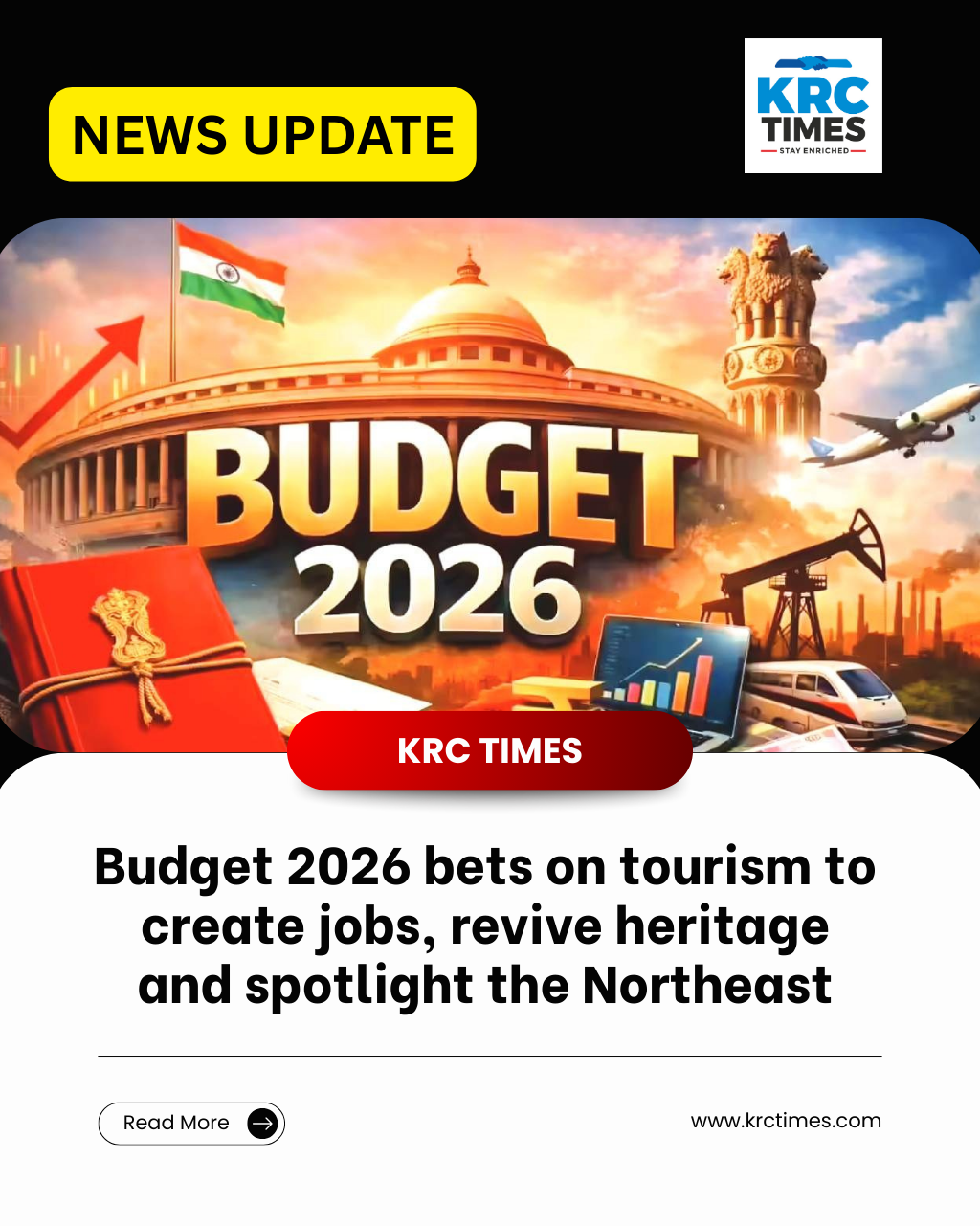
The Union Budget for 2026–27 has placed tourism at the centre of its jobs story. The government sees travel not just as leisure, but as work, skills, culture and local income tied together. From training tourist guides to restoring ancient sites and building green trails, the budget sketches a wide plan to turn tourism into a steady source of employment.
Presenting the Budget in Parliament, Union Finance Minister Nirmala Sitharaman said tourism has strong potential for job creation, foreign exchange earnings and local growth. The proposals aim to spread benefits beyond big cities and reach smaller towns, heritage sites and remote regions.
One of the key announcements is a pilot scheme to upskill 10,000 tourist guides across 20 iconic destinations. These guides will undergo a standardised 12-week training course. The programme will run in hybrid mode and be designed in collaboration with an Indian Institute of Management. The idea is to improve skills, knowledge and communication, while also ensuring better visitor experience.
To support long-term capacity building, the government also plans to set up a National Institute of Hospitality. This will be done by upgrading the National Council for Hotel Management and Catering Technology. According to the Finance Minister, the institute will act as a bridge between academia, industry and the government. It is expected to train professionals who can meet global standards in hospitality and tourism services.

A major digital push has also been announced. The Budget proposes the creation of a National Destination Digital Knowledge Grid. This platform will digitally document places of cultural, spiritual and historical importance across the country.
The initiative is expected to open new work opportunities for local researchers, historians, content writers, filmmakers and technology partners. It also aims to preserve knowledge while making it accessible to visitors and planners.
Special attention has been given to the Northeast, a region rich in culture and natural beauty but still underexplored by many travellers. To boost tourism here, the government has proposed the development of Buddhist circuits across several northeastern states.
These include Arunachal Pradesh, Sikkim, Assam, Manipur, Mizoram and Tripura. The scheme will focus on preserving temples and monasteries and highlighting the region’s deep spiritual roots. Officials believe this can attract both domestic and international visitors, while also generating local jobs.
The Budget has also announced plans to develop 15 archaeological sites into vibrant and experiential cultural destinations. These include well-known sites such as Lothal, Dholavira, Rakhigarhi, Adichanallur, Sarnath, Hastinapur and Leh Palace.
Visitors will be able to explore excavated landscapes through curated walkways. Interpretation centres, conservation labs and trained guides will support the experience. The government also plans to use immersive storytelling tools and new technologies to bring history alive.
Alongside heritage, the Budget has made space for nature and sustainability. It announced the development of eco-friendly tourism trails to offer world-class trekking and hiking experiences.

These include mountain trails in Himachal Pradesh, Uttarakhand and Jammu and Kashmir, trails in Araku Valley in the Eastern Ghats, Podhigai Malai in the Western Ghats, turtle trails along nesting sites on the Odisha, Karnataka and Kerala coasts, and bird-watching trails around Pulicat Lake on the Andhra Pradesh–Tamil Nadu border. The focus is on protecting fragile ecosystems while creating livelihoods for local communities.
Despite the ambitious plans, the overall budget allocation for tourism has seen a slight dip. The allocation for 2026–27 stands at Rs.2,438 crore, down from Rs.2,541.06 crore in 2025–26. The revised estimate for 2025–26 was Rs.1,310.30 crore. While the cut is marginal, it has raised some questions within the industry about funding support for large-scale promotion.
The hospitality and tourism industry has largely welcomed the direction of the proposals. Rajiv Mehra, general secretary of the Federation of Associations in Indian Tourism and Industry, said the focus on guide training, adventure trails, use of technology and the reduction in Tax Collected at Source on overseas travel were positive steps. He called them progressive moves for the sector.
At the same time, industry voices pointed to gaps. Mehra said the Budget lacked a clear allocation for international tourism promotion. He stressed that stronger global branding and visibility are essential to boost inbound tourism and compete with other destinations in Asia.
Overall, Budget 2026 signals a shift in how tourism is viewed. It is no longer seen only as travel and hotels, but as a chain of skills, stories, culture and nature. If the plans are carried out well, tourism could become a steady engine of jobs, especially for youth and local communities, while also helping India protect and present its rich heritage to the world.
Promotional | North East Integration Rally