

An IKS-Based Solution to Climate Litigation
 KRC TIMES Desk
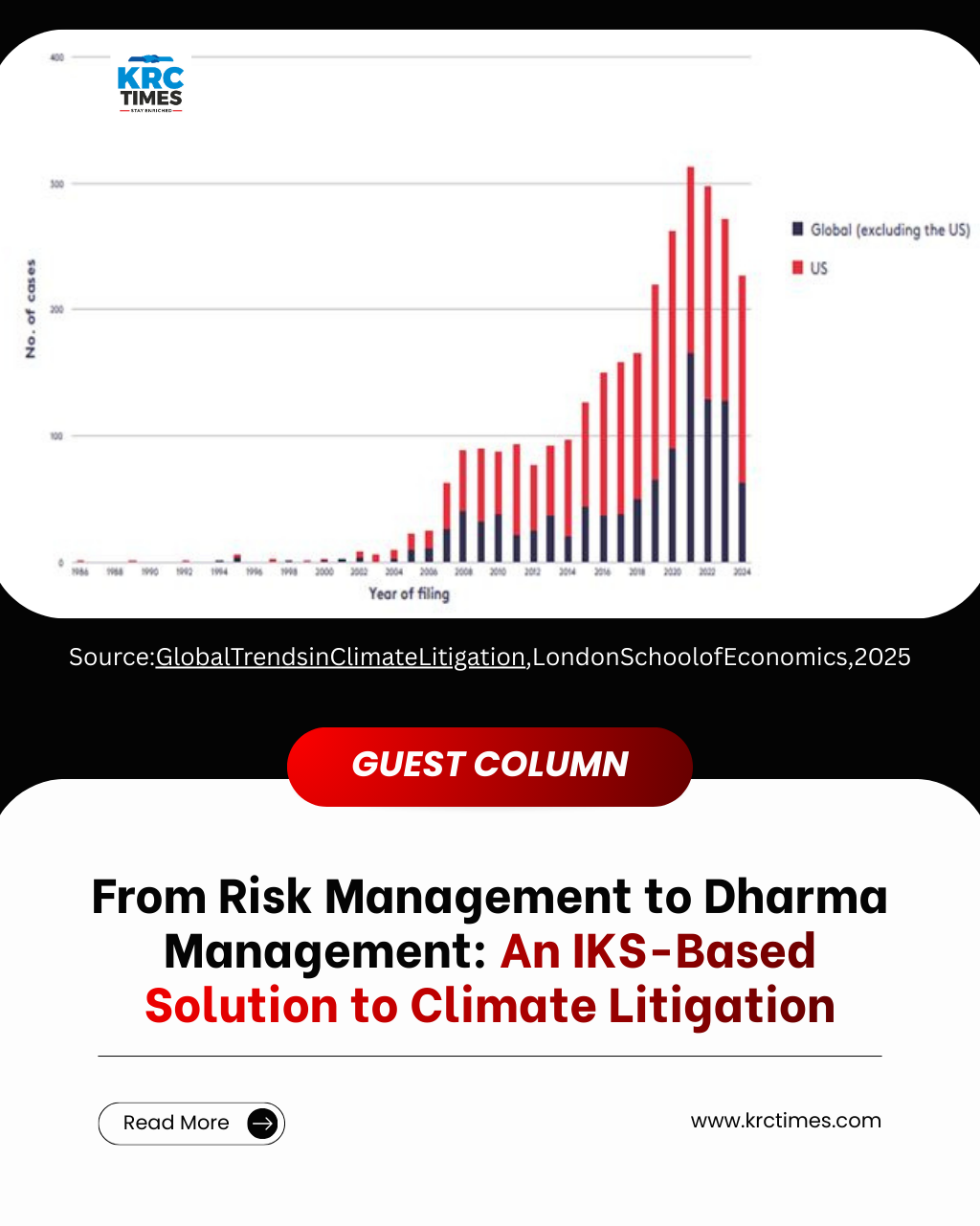
Climate change litigation has grown in a manner that has made finance a concern for businesses. There have been close to 3,000 Climate change-related lawsuits filed in over 60 nations. Climate change lawsuits reached a point where they ceased being a symbolic way for people to show dissatisfaction. The lawsuits generate a measurable loss of market value, litigious costs, increase the capital budget, and impact the way businesses think about finance.
As part of PhD research on corporate finance and climate risk, I (Dr Anand Kumar) examine the impact of climate litigation on firm financial defensiveness strategies. Even when cases do not end in conviction, they carry weight. Research revealsthat firms targeted by climatelitigation suffer an average stock market decline of 0.4%; however, this decline further increases to 1.5% for heavy emitters, which means that the size of emissions, and not just the fact of litigation, matters. Beyond the immediate reputational damage, the financial costs are also significant.
For example,simply defending a case costs an average of USD3 million inlegalbills.Yetthe real impact is more subtleandfar-reaching:climate litigation drives afundamental shift in how companies manage their cash.
Analyzing US-listed companies from2004 to 2023,reveals that firms involved in climate-related lawsuits increase their cash holdings by an average of 23 per cent relative to peers. Importantly, this is not a one-off response. The effect persists for up to four years after the lawsuit is filed.Why?
Because climate litigation is slow-moving and uncertain and oftent akes years to resolve (typically taking around three years to reach a decision), with firms unsure whether they will be hit with penalties, forced operational changes, or reputational damages.

This phenomenon reveals a deeper crisis that cannot be solved through legal compliance or financial engineering alone. At its core, climate litigation exposes a structural mismatch between modern corporate logic and ecological sustainability. It is here that Indian Knowledge Systems (IKS) offer not merely an ethical perspective, but a systemic solution.
Climate Litigation as a Symptom, Not the Disease
Traditional policy frameworks view climate litigation as one more manifestation of transition risk, joining the club with carbon pricing and regulatory change. Corporations respond correspondingly, solidifying their legal defenses, building up liquidity, and firming up investment criteria. Yet, all of these responses are symptoms.
From an IKS point of view, climate litigation points to a deeper adharmic imbalance, a disturbance of the natural order which is ṛta in Vedic culture. Where economic action disrupts ecological boundaries, social trust is lost and society resorts to courts as agents of rectification. Litigation in this way is a response of society to moral and ecological failure, not merely to illicit non-compliance with the law.
The modern corporate accountability mechanisms work externally – regulation, fines, and litigation. In contrast, the IKS places accountability internally through dharma understood not as religion but svabhāva-based duty. In Bhagavad Gita Krishna elaborates that the sustainable action is an offshoot of performing one’s rightful duty with awareness and restraint.

As applied to corporations, this would mean that companies need to conduct their activities in accordance with their natural purpose in society. Responsibility internalized toward nature, communities, and future generations earns compliance as a product of proper conduct, not an arm-twisted duty.
From Accumulation to Balance: Reimagining Arth
At the heart of corporate cash hoarding is a narrow understanding of arth as mere wealth. Indian Knowledge Systems offer a broader and more meaningful view of arth—not just money, but all resources essential for sustaining life, guided by balance, restraint, and purpose.When businesses accumulate cash out of fear of future penalties, this money becomes a cost of doing business that produces no real value. Idle cash does not drive innovation, nor does it support the green transition.
Indian Knowledge Systems challenge this fear-driven behaviour through the principle of aparigraha, or non-hoarding. True security, from an IKS perspective, comes not from accumulating excess cash, but from maintaining balance and acting with clarity of purpose.
The definition of Vaishya dharma in the Gita as Krishi GaurakshyaVaanijyam – Balancing the five mahabhutas, with earth, and Vaishya dharm Swabhawjam – Balancing the definition of Vaishya dharma in the Gita as ‘Krishi gaurakshyavanijyam’ – Balancing the Five mahabhis, with earth, and Vaishya dharma Swabhawjam – Balancing the definition of Vaishya dharma in the Gita as ‘Krishi gaurakshyavanijyam’ – Balancing the Five mahabhis, with earth, and Vaishya dharma Swabhawjam – Balancing the definition of Vaishya
Dialogue over Disputes: Preventing Litigation through Engagement
IKS traditions prioritisesamvāda (dialogue) above confrontation. Most climate cases emerge as an outcome of the exclusion of communities and stakeholders from the decision-making process. Companies that visibly engage with local ecologies, provide transparent revelations about climate impact, and begin to act in concert with transition planning stand less chance of going to court. Litigation in that sense is a failure of dialogue. The reinstatement of participatory mechanisms reduces social conflict as well as legal risk.

Beyond that, financial regulators and central banks should look beyond climate litigation as purely a legal or transition risk. It needs to be recognized as an ethical risk with financial consequences. Stress-testing frameworks and disclosure norms, as well as risk assessments, will have to consider litigation-driven cash hoarding and its inefficiencies in the macroeconomic context.
Conclusion: From Risk Management to Dharma Management
“Climate litigation is not aberrational activism gone awry. Rather, it is corrective justice needed due to economic imbalances. This increasing financial defensiveness of companies, which is being expressed by piling up cash, is actually an indication of the absence of trust between the corporate sector and nature and society.”Indian Knowledge Systems provide an avenue out of this impasse.
Through the redefinition of arth, reinstatement of dharma, and integration of dharman with economic activities, IKS transforms the corporate strategic approach from fear management to resilience through purpose.
In the end, the best way to shield oneself from climate litigation risks is not to maintain the kind of balance sheet that is climate-proof, resilient, and strong today, tomorrow, and always, but to build business that is future-proof and strives to live in harmony with both society and nature, not because they fear consequences