

The global community need to not only engage in an in-depth conversation but also take action to repair the recent crises rapidly reshaping the geopolitical order
 KRC TIMES Desk
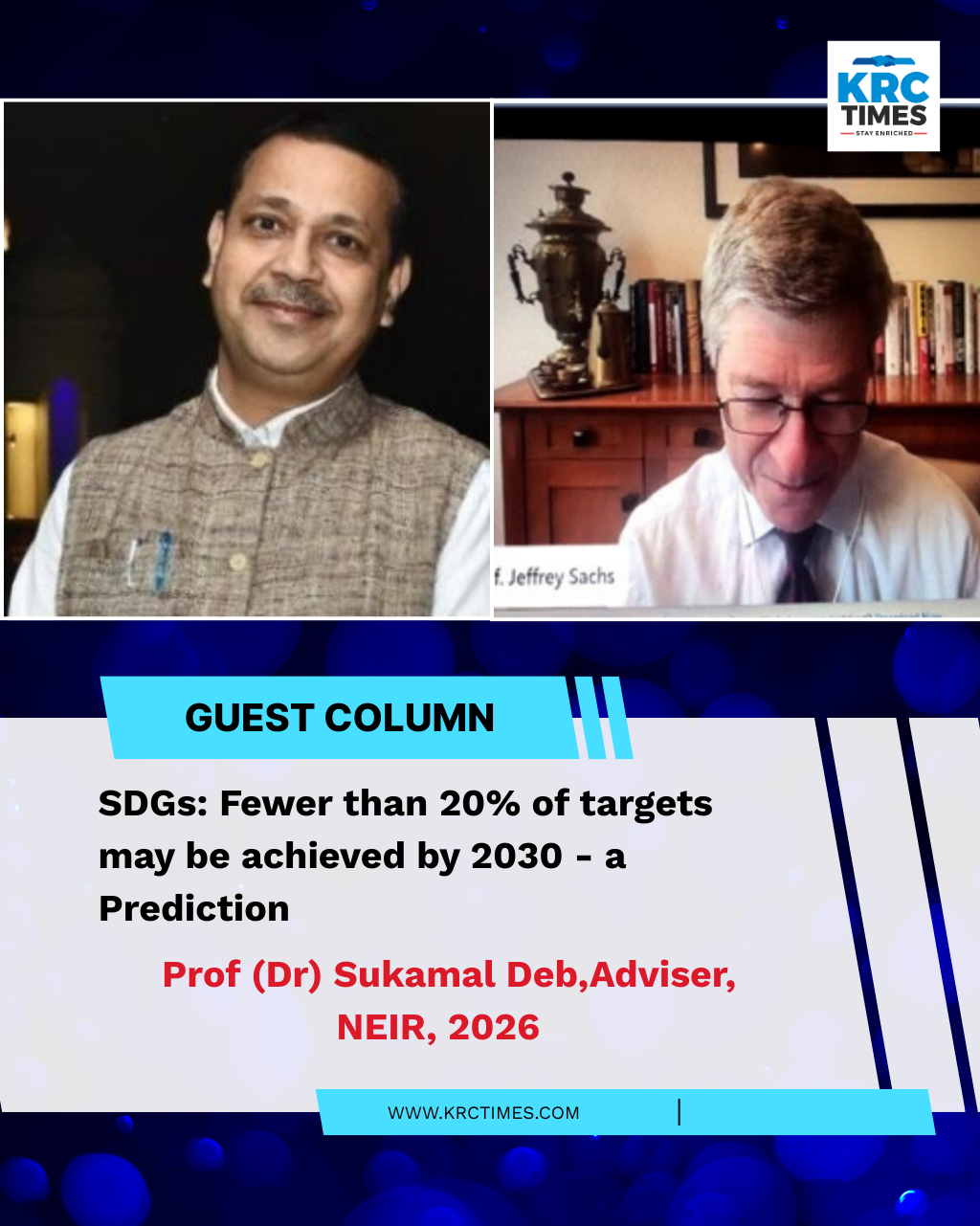
Prof (Dr) Sukamal Deb
Resist, and hope could be the new strategy for peace and achieving the SDGs, the webinar organised by the UN Sustainable Development Solutions Network (SDSN) emphasised. On 2nd Feb 2026, I participated in the webinar on the geopolitics of war and peace. The in-depth discussion was around the dichotomy of the geopolitics of war and peace, the slow progress of SDGs, and the impediments.
Our world is grappling with more obstacles to sustainable development than ever before. Mounting pressures, including rising climate change impacts, escalating global conflicts, intense power competition and technological races, persistent human rights violations, economic fragmentation, chronic underfinancing, and societal polarisation, are contributing to the rapid reshaping of the geopolitical landscape.
The global community need to not only engage in an in-depth conversation but also take action to repair the recent crises rapidly reshaping the geopolitical order. We need a universal blueprint for addressing poverty, inequality, climate change, and the long-term viability of our planet. In 2015, 193 UN Member States committed to achieving them, yet, more than eleven years later, they remain significantly off track.
Fortunately, the UN Sustainable Development Solutions Network (SDSN), a global initiative launched by the United Nations in 2012 to promote sustainable development and implement the SDGs,is exploring strategies to accelerate SDG progress, including regional integration, reforms to the global financial architecture, and improved planning.

It has over 2000 member institutions worldwide, including universities and research organisations, with expertise in developing practical solutions for sustainable development. The webinar was a spontaneous flow of wisdom moderated by Professor Jeffrey Sachs, President of the SDSN.
I have a special connection with him. On seeing him on the live screen, after a long time, my enthusiasm for active participation shot up. Prof. Jeffrey Sachs, an erudite, World-renowned Economist, Professor, and President of the UN SDSN,was my teacher when I pursued my specialisation in Sustainable Development, the Degree name “The Age of Sustainable Development,” from Columbia University in New York City in 2020.
My Prof Sachs was then the Director of the Earth Institute at Columbia University, NY, who contributed immensely to understanding sustainable development and economic development.From 2001 to 2018, Professor Sachs was a special advisor to the UN SecretaryGeneral. Until 2016, he held a similar advisory position related to the Millennium Development Goals (MDGs), eight internationally sanctioned objectives to reduce extreme poverty, hunger, and disease by 2015.
Sachs has written several books and received several awards. His views on economics, on the origin of COVID-19, and on the Russian invasion of Ukraine have garnered attention and criticism. To be a student of such towering wisdom has been a rare gift to my life.
I am profoundly grateful to my professor, who repeatedly made us reflect through his teachings that we, the human beings, the new name Anthropocene, may not survive as we are rapidly crossing the planetary boundaries. In 2020, his online late-night classes, spread over a period of six months, when the COVID-19 pandemic was looming around, kept me inspired on the intrigued by the subject, with deep admiration for his wisdom and the unique simplicity of teaching.

The speakers in the webinar were H.E. Miguel Ángel Moratinos, Under Secretary General, High Representative for the UN Alliance of Civilisations, H.E. Ms Maria Fernanda Espinosa,President of Cities Alliance and Executive Director of Global Women Leaders for Change and H.E. Vuk Jeremi?, former President of the UN General Assembly.
In attending the webinar, listening to the eminent speakers, I was made to reflect upon whether the world order has been quickly rupturing with the geopolitical recession. Global Governance for Peace and the SDGsmakes sense in today’s rapidly evolving global challenges. In one way, humanity should strive to achieveSDGs, and on the other, to identify solutions for sustainable development beyond 2030.
Against this backdrop are the 17 Sustainable Development Goals (SDGs), a universal blueprint for addressing poverty, inequality, climate change, and the long-term viability of our planet. The webinar highlighted concerns thatSDGs remain significantly off track, with fewer than 20 per cent of targets expected to be achieved by 2030.
In addition, the UN faces deep political, operational, and financial challenges, but remains critical for fostering cooperation, establishing global norms, and overcoming the complex geopolitical obstacles we face. Understanding the geopolitics of war and peace, while the need is for acceleration of SDG implementation, has become a critical learning for people sensitive about the present and future of the planet. And we know, the present lays the foundation of the future.
Prof. Sachs taught us that sustainable Development has four major dimensions – economic development, social inclusion, environmental sustainability, and good governance. We live in a complex, crowded world today, with 7.2 billion people, ten times the population since the start of the industrial revolution.
The Planetary Boundaries and Anthropocene are the concepts that have become so important in the age of climate change. Both these concepts, Planetary Boundaries and Anthropocene, signify that humanity has become so numerous, our 7.2 billion people and rising, and so effective, one could say, so productive in the capacity to mine and extract resources, that we are endangering ourselves and our coming generations.
To transform resources for production in industry, to consume, we have suddenly, unprecedentedly, as a species, hit these planetary risks and even dead ends if we’re not care
It’s a time of historical importance to ponder over: What are the major challenges coming from humanity’s impact on the physical environment? Can we identify those challenges? Can we quantify them?
Can we identify what would be safe limits for human activity so that we can begin rather urgently, because we’re late to this? To redesign our technologies and our economic growth dynamics so that we can have economic improvement while staying within the planetary boundaries.
Even if late, we can begin to look deeply at the question of how to reconcile growth and these various environmental threats, Prof Sachs instil theses questions in us while teaching high scholarly sustainable development.
As 2026 begins amid complex and evolving geopolitical developments, the SDSN has remained steadfast in its commitment to advancing sustainable development and supporting evidence-based solutions to global challenges. This is where the ray of hope emerges. Let us, as a single humanity, reflect our sustained commitment to the 2030 Agenda under the SDGs and look beyond.
Promotional | North East Integration Rally