

Officials indicated that the deliberations explored mechanisms to ensure long-term stability through enhanced Centre-State cooperation
 KRC TIMES Manipur Bureau
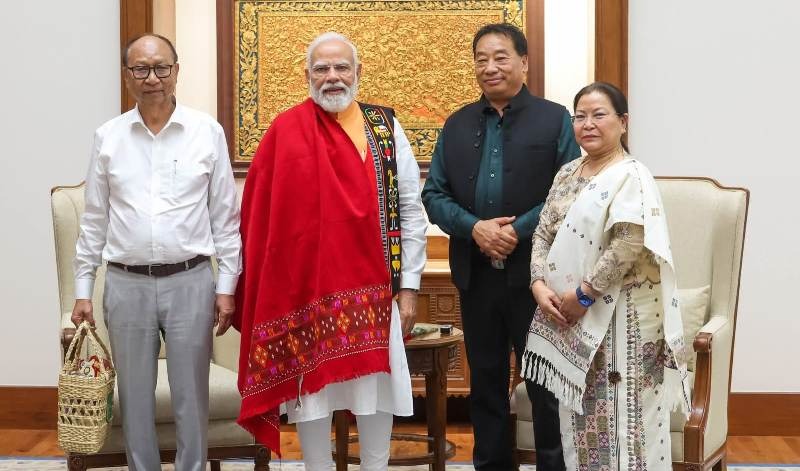
IMPHAL/NEW DELHI : In a high-level engagement aimed at reinforcing stability in strife-hit Manipur, Chief Minister on Tuesday met Prime Minister Narendra Modi in New Delhi, seeking sustained central support for peacebuilding, rehabilitation of displaced families and development-led normalcy across the state.
The Chief Minister was accompanied by Deputy Chief Ministers Nemcha Kipgen of the BJP and Losii Dikho of the Naga People’s Front (NPF). The meeting, held at the Prime Minister’s official residence at 7, Lok Kalyan Marg, marked Singh’s first formal interaction with the Prime Minister since assuming office earlier this month.
According to sources, the discussions centred on strengthening coordination between the Centre and the State to stabilise both hill and valley districts that have witnessed prolonged unrest.
Singh briefed the Prime Minister on measures initiated by his government to restore law and order, improve security deployment, and fast-track rehabilitation in violence-affected regions. He underscored the need for a calibrated approach combining security vigilance with economic revival and infrastructure development.

Officials indicated that the deliberations explored mechanisms to ensure long-term stability through enhanced Centre-State cooperation, particularly in intelligence-sharing, border management and community outreach initiatives.
The Chief Minister is also understood to have sought central backing for women empowerment programmes, stressing that inclusive growth and equitable opportunities across communities remain essential to rebuilding trust.
The rehabilitation of internally displaced persons (IDPs) featured prominently in the talks. Thousands remain displaced following ethnic violence that disrupted normal life in several districts.
In a significant development earlier in the day, Union Agriculture and Rural Development Minister Shivraj Singh Chouhan approved the construction of 5,000 houses under the Pradhan Mantri Awaas Yojana-Gramin (PMAY-G) for violence-affected IDPs in Manipur. The move is being seen as a crucial step toward permanent resettlement and restoring dignity to displaced families.
State officials described the housing sanction as a “major milestone” in transitioning from temporary relief camps to long-term rehabilitation.
Another key proposal discussed during Singh’s New Delhi visit was the raising of a Territorial Army battalion for Manipur. The idea, officials said, is to augment local security capabilities while generating employment opportunities for youth.
During his visit, the Chief Minister also met Union Defence Minister Rajnath Singh and Finance Minister Nirmala Sitharaman to press for greater logistical and financial support for stabilisation measures. Discussions reportedly included resource mobilisation for infrastructure rebuilding and economic revival in affected districts.

Singh further called on BJP national president J. P. Nadda as part of what officials described as a broader round of consultations to consolidate governance and party support during a sensitive period.
In a symbolic gesture reflecting the state government’s intent to deepen engagement with the Centre, Singh and his deputies extended a formal invitation to Prime Minister Modi to visit Manipur.
Observers view the invitation as both political and strategic, signalling confidence in the state’s gradual return to normalcy while also seeking to reinforce the Centre’s visible commitment to peace efforts.
The meeting comes amid ongoing efforts to stabilise Manipur following months of unrest that have strained administrative systems and displaced thousands. While security conditions have shown incremental improvement in some areas, sporadic tensions persist.
Government sources emphasised that the Centre remains committed to assisting Manipur in restoring order and accelerating development initiatives. Tuesday’s meeting is being seen as part of a continuum of high-level engagements designed to align policy, funding and security strategies.
As the state embarks on what officials describe as a “recovery and reconciliation phase,” the success of rehabilitation measures, restoration of livelihoods and sustained security coordination will be critical in determining the pace of lasting peace.
For now, the Centre-State dialogue signals a renewed push to move beyond crisis management toward rebuilding confidence across Manipur’s diverse communities.