


Manipur’s Crisis and the Constitutional Failure of Representation
 KRC TIMES Desk
Nila Konsam
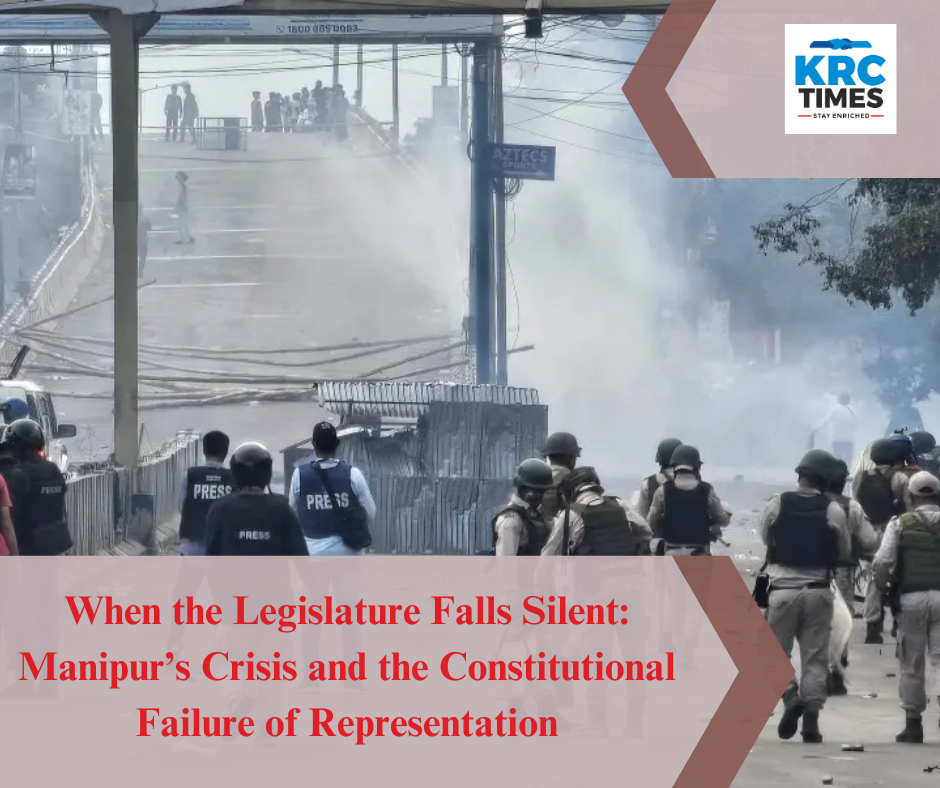
Manipur today is not merely facing unrest. It is confronting a deep constitutional crisis—one that tests the very purpose of democratic institutions under the Constitution of India.
What is unfolding in the state can no longer be reduced to routine “law and order” challenges. Allegations of narco-terrorism, cross-border infiltration, and demographic anxieties have intensified mistrust. Large tracts of agricultural land remain abandoned due to insecurity, eroding livelihoods. Entire communities face restrictions on movement.
Access to healthcare, in practice, has become exclusionary for some. Thousands continue to languish in makeshift relief camps, unable to return to their homes. Ethnic polarisation simmers, unresolved and increasingly entrenched.
These are not isolated administrative lapses. They strike at the core of constitutional guarantees—equality before law, freedom of movement, and the State’s obligation to ensure life with dignity.
In such circumstances, the role of the Legislative Assembly becomes paramount.
An MLA, within the constitutional framework, is not a contractor, not a patron, and certainly not a dispenser of personal charity. The Constitution envisages a legislator as a lawmaker, a guardian of public finance, and—most critically—a watchdog over the executive.
The Assembly is meant to be the arena where crises are confronted, governments are questioned, and accountability is enforced. These principles are embedded in the logic of the Westminster system that India has adopted.

And yet, across seven sessions of the 12th Manipur Legislative Assembly, these existential issues have not received the seriousness, depth, or continuity they demand.
This silence is not procedural. It is constitutional.
When legislators do not rigorously question the executive, when debates do not reflect the gravity of ground realities, and when oversight mechanisms are underutilised, the architecture of accountability begins to erode. A legislature that does not actively engage in moments of crisis ceases to function as intended.
The consequences are visible across Manipur.
A humanitarian crisis persists without structured legislative intervention. Economic disruption deepens without coherent policy scrutiny. Administrative actions go insufficiently examined. Most dangerously, public faith in institutions begins to fray.
What makes this failure more troubling is the distortion of public discourse. Even as the state confronts profound challenges, narratives continue to celebrate MLAs for minor development works, project inaugurations, or claims—sometimes explicit—that public works were executed “from personal funds.” Such portrayals are not harmless exaggerations. They fundamentally misrepresent governance.
Public money is not private charity. Development works are funded by the exchequer, authorised through legislative processes, and executed by the executive. To project them as personal achievements is to blur the line between public office and private patronage, fostering a feudal imagination of democracy where elected representatives appear as benefactors and citizens as recipients.
This inversion of roles carries a cost. It shifts incentives away from legislative performance toward visible, localised interventions. It weakens scrutiny, dilutes accountability, and fragments governance into piecemeal actions driven by political visibility rather than systemic need.

And yet, within this broader silence, there have been important—if limited—assertions of constitutional responsibility.
It was encouraging to see Shri Ranjit Singh raise critical concerns on the floor of the House. His intervention on the collapse of law and order following the killing near Kakching directly addressed the State’s fundamental obligation to protect life and maintain order.
His red-flagging of anomalies in public health insurance schemes such as the Chief Minister-gi Hakshelgi Tengbang (CMHT) and the Pradhan Mantri Jan Arogya Yojana (PMJAY) pointed to deeper concerns of transparency and delivery.
Similarly, Shri Okram Ibobi Singh highlighted the subdued representation from legislators of hill districts—many of whom sit on the treasury benches. In a state defined by ethnic and geographic complexity, such muted participation raises serious questions about whether all sections are being meaningfully represented within the legislative process.
Notably, the Chief Minister’s response appeared measured and receptive, suggesting that space for constructive engagement within the Assembly still exists.
These moments matter. They demonstrate that the legislature has not entirely abdicated its role. They show that when MLAs choose to act within their constitutional mandate—raising questions, scrutinising schemes, and articulating concerns—the Assembly can still function as an instrument of accountability.
But they also underscore a deeper truth:
Isolated interventions cannot substitute for sustained legislative engagement.
Manipur’s crisis is systemic, not episodic. It demands continuous debate, rigorous oversight, and collective responsibility. A few voices, however significant, cannot carry the burden of an entire institution.
The framers of the Constitution of India did not design legislatures to be spectators in times of crisis. They envisioned them as the central forum where power is questioned and responsibility enforced.
When that forum falls silent, the crisis ceases to be merely administrative or political. It becomes constitutional.
Manipur today stands at that threshold.
It does not lack constitutional tools.
It does not lack institutional mechanisms.
What it risks lacking is the consistent will to use them.
The question, therefore, is no longer about the scale of the crisis. It is about the response of those constitutionally entrusted to confront it. Will the legislature rise to its role—or remain a silent witness?