

A Conflict Redefining Global Power
 KRC TIMES Desk
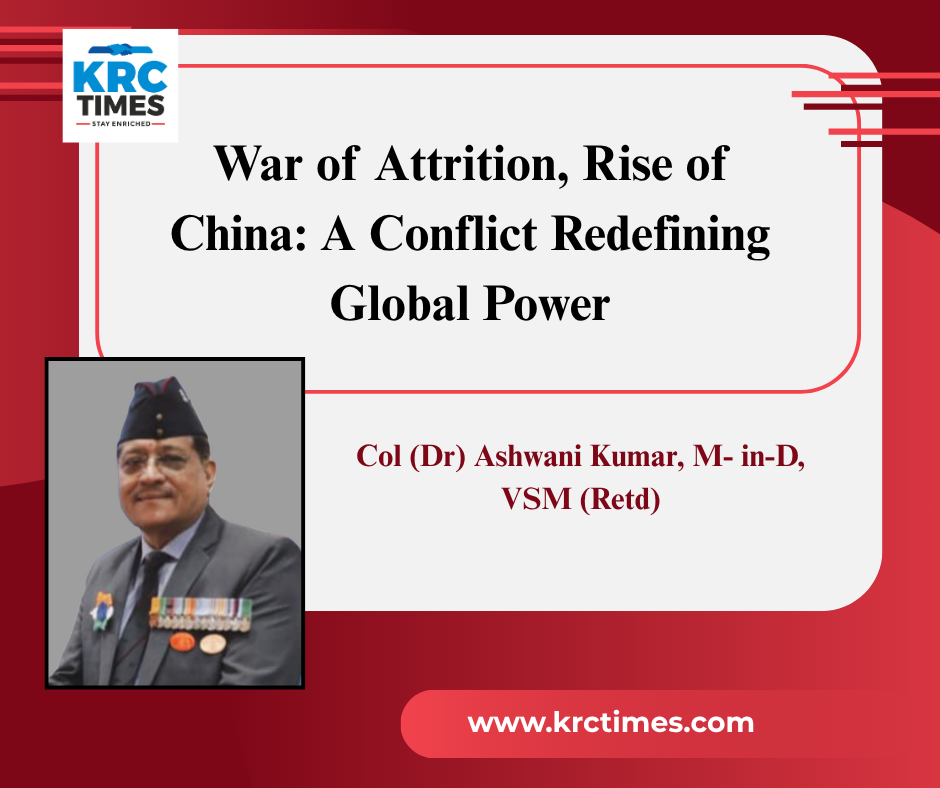
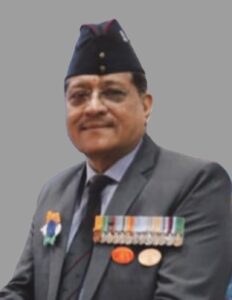
Col Ashwani Kumar, MiD, VSM (Retd).
History teaches us that great powers rarely fall on the battlefield – they erode in the long shadow of prolonged wars.’
The ongoing Iran – US – Israel conflict is no longer merely a regional confrontation, it is evolving into a defining moment in global geopolitics. What began as a calculated military strike has transformed into a war of endurance one that is quietly redrawing the map of power, influence, and strategic control across the world.
At first glance, the conflict appears to revolve around three actors, Iran, the United States, and Israel. Yet, beneath the surface, a far more consequential shift is underway. While missiles strike and alliances are tested in the Middle East, other global powers most notably China and Russia are observing, adapting, and positioning themselves for long-term advantage.
This is no longer just a war. It is a test of endurance, strategy, and global relevance.
A War Without Quick Victory.
Modern warfare has moved beyond decisive battles and swift conclusions. The Iran conflict exemplifies this transformation. Iran, fully aware of its conventional limitations, is not seeking outright victory against a militarily superior United States. Instead, its objective is far more pragmatic to survive, to resist, and to impose sustained costs on its adversaries.

Through a mix of missile strikes, drone warfare, cyber capabilities, and proxy networks, Iran has effectively expanded the battlefield without engaging in direct large scale confrontation. This strategy allows it to stretch the conflict over time, increasing both economic and political pressure on its opponents.
However, endurance comes at a price.
Iran’s economy, already strained by sanctions, faces further stress from war related disruptions. Infrastructure damage, declining revenues, and internal pressures may gradually limit its ability to sustain high-intensity operations.
The likely trajectory, therefore, is not collapse but controlled persistence, a prolonged, low-intensity conflict that continues for years without decisive resolution.
The United States: Power Under Pressure.
The United States remains the world’s foremost military power. Its technological superiority, global reach, and alliance network provide unmatched operational capability. Yet, the real challenge before Washington is not one of strength, but of strategy.
Every extended engagement carries costs financial, political, and psychological. The experience of past conflicts has shown that even overwhelming military superiority does not guarantee strategic success. The absence of a clearly defined end-state risks turning tactical victories into long-term liabilities.
If this war continues without a decisive outcome, the United States may face a familiar dilemma, winning battles while struggling to conclude the war. Such a scenario does not diminish its power outright, but it gradually erodes its global image as a decisive and unchallenged superpower.
China: The Silent Gainer.
While the world’s attention remains fixed on the Middle East, China is emerging as the most significant indirect beneficiary of this conflict.
Beijing’s approach is deliberate and restrained. By avoiding direct involvement, it escapes the immediate costs of war while leveraging its consequences. As the United States diverts resources and attention toward the Middle East, China gains strategic space in the Indo-Pacific region.
Moreover, global uncertainty enhances China’s economic relevance. Disruptions in energy supplies and trade routes increase dependence on stable manufacturing and supply chains, areas where China holds considerable influence.
China’s rise in this context is not dramatic or confrontational. It is gradual, calculated, and structural. This war may not make China the sole superpower overnight, but it significantly strengthens its position in an emerging multipolar world.
Russia: The Strategic Opportunist.
Russia’s role in this conflict is subtle but important. Unlike China, which focuses on long-term economic and geopolitical positioning, Russia operates with a sharper strategic edge.
For Moscow, the conflict presents multiple opportunities:
Diversion of Western attention away from Eastern Europe
Rising global energy prices, strengthening its economic position
Reinforcement of strategic partnerships, particularly with countries opposed to Western dominance
Russia has consistently demonstrated its ability to operate effectively in environments of instability. By maintaining a careful balance supporting anti-Western narratives while avoiding direct escalation, it ensures that the conflict indirectly serves its interests.
In essence, Russia thrives in geopolitical turbulence, and this war provides exactly that.
How Long Can Iran Sustain the War?.
The sustainability of Iran’s war effort depends on the level of intensity,
Short to Medium Term (1–3 Years):
Iran can maintain active engagement through asymmetric tactics, missile capabilities, and proxy networks. These methods are cost effective and difficult to neutralise completely.
Long Term (Beyond 3 Years):
Economic constraints, internal pressures, and military attrition may begin to limit Iran’s operational capacity. High-intensity conflict at this stage becomes increasingly unsustainable.
Enduring Conflict Scenario:
Even under pressure, Iran can continue a low-level, disruptive conflict for an extended period, ensuring that instability persists and costs remain high for its adversaries.
Thus, while Iran may not win in a conventional sense, it can prevent a decisive defeat turning the war into a prolonged strategic stalemate.
India: A Balancing Power in the Making.
India’s role in this conflict is uniquely positioned and potentially significant. Unlike the major powers directly or indirectly involved, India maintains relationships across multiple sides engaging with the United States, Israel, and Iran simultaneously.
India’s priorities are clear:
Energy security, given its dependence on Middle Eastern oil
Protection of trade routes, particularly in the Gulf region
Strategic stability, to avoid regional escalation
Rather than taking a confrontational stance, India is likely to adopt a balanced and pragmatic approach:
Advocating for de-escalation
Engaging diplomatically with all sides
Exploring opportunities for mediation
In the longer term, India’s ability to maintain neutrality while safeguarding its interests could enhance its reputation as a responsible and stabilising global power.
While it may not play a direct military role, India’s diplomatic and economic influence could prove increasingly important if the conflict prolongs.
The Real Outcome: A Shift in Global Power.
This war is unlikely to produce a clear victor in traditional military terms. Instead, it is accelerating a broader transformation:
Iran endures, but weakens
The United States remains dominant, but stretched
Israel secures tactical successes, yet remains vulnerable
China rises steadily, without direct confrontation
Russia leverages instability to its advantage
India emerges as a potential balancing force
Conclusion: Power Beyond the Battlefield
The Iran – US – Israel conflict underscores a fundamental truth of modern geopolitics: power is no longer defined solely by military dominance. It is defined by resilience, adaptability, and the ability to shape outcomes without direct engagement.
In this evolving landscape, the greatest gains may not belong to those who fight the war but to those who understand it, outlast it, and position themselves beyond it.
If the conflict continues along its current trajectory, it will not just reshape the Middle East. It will accelerate the transition toward a multipolar world, where influence is distributed, contested, and constantly renegotiated.
And in that emerging order, the rise of China—supported by the strategic manoeuvring of Russia and the balancing role of India may well define the next chapter of global history.
Author’s Note.
The author is a Military Historian and Defence Expert, with extensive experience in analysing modern warfare, strategic affairs, and geopolitical conflicts. His work draws upon years of study, field exposure, and archival research on military doctrines, global power shifts, and conflict dynamics. The views expressed are personal and based on independent assessment of evolving international developments.