


Northeast India is already close to heaven in nature— what it needs is human harmony to match its natural beauty : However, its biggest curse in present times is the loss of humanity by engaging in widespread acts of brutality
 KRC TIMES Desk
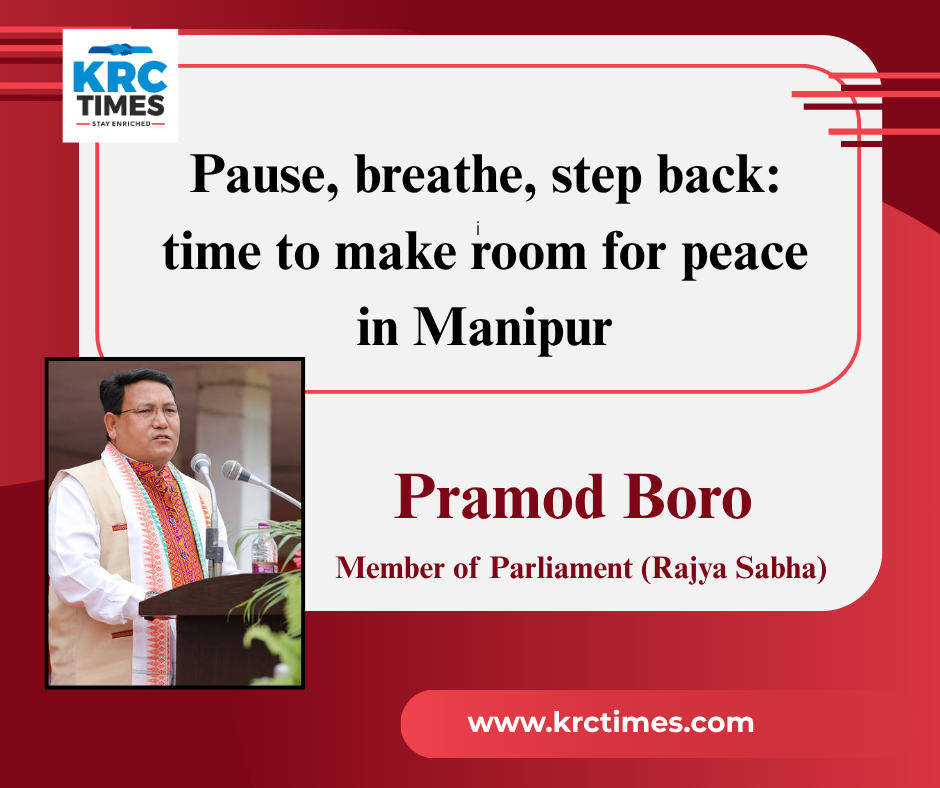
Pramod Boro
Manipur is living a tragedy that has become unacceptably familiar. A conflict that began in May 2023 between Meitei and Kuki-Zo communities has now stretched into a third year, leaving behind a landscape of deaths, grief, segregation and fatigue, with no signs of abatement. Official figures cited in multiple reports have placed deaths above 250 and displacement around 60,000 people.
But numbers do not fully capture what has happened to the moral geography of a state: neighbours have become enemies, roads have turned into frontlines, and ordinary life has been reorganised around fear. The most chilling feature of Manipur’s crisis today is the violence that has now become widespread, and the normalisation of hate.
A de facto partition has hardened across community and ethnicity, with security forces maintaining buffer zones to prevent clashes, while daily mobility and social interaction remain severely constrained. When a society start living in compartments, peace stops being a shared public good and becomes a private wish making it fragile and easily extinguished.
That is why this is way beyond a state’s “law and order” problem. It is a crisis of trust and legitimacy as well as the failure of social cohesion and the humane principle of coexistence. The April 7 blast in Bishnupur, reportedly by a projectile attack that killed two children and injured their mother was a brutal reminder of how civilians remain exposed in a conflict that claims to be “contained.”

The protests and clashes that followed pointed to the fact that the state’s inability to protect life led to anger on the streets and weaponization of rumours. In the last week of April 2026, reports also pointed to fresh clashes involving Naga and Kuki groups in Ukhrul, signalling a drift from a bipolar confrontation into a potentially multi-front crisis.
This expansion should alarm every concerned citizen of Manipur and beyond. Conflicts rarely stay neatly bounded as they metastasise socially, territorially, psychologically. And then there is the vacuum of governance. Manipur’s political stability has been repeatedly questioned leading to resignation of the Chief Minister in February 2025, followed by President’s Rule shortly thereafter.
In such an environment, administrative continuity weakens, civil services operate under pressure, and political leadership becomes episodic rather than deliberative. But conflict does not pause for bureaucratic transitions. Children still need schools, mothers still need health services, families still need livelihoods, and communities still need credible forums to resolve disputes.
When governance becomes performative reacting to each flare-up rather than building a sustained peace architecture the conflict learns that it can outlast the state. This is where our country must look into the mirror. We have, as a nation, demonstrated that political courage and policy imagination can shift longstanding conflicts if the government chooses to invest its authority in solutions rather than optics.
Yet Manipur has been allowed to fester, turning a vulnerable frontier into a theatre of recurring injury. The memory of draconian histories, especially the long shadow of AFSPA and the deep alienation it produced, still shapes how people interpret the presence of force in everyday life. Militarisation may prevent immediate escalation, but it cannot restore trust.
Trust returns only when people believe that rules are fair and institutions operate impartially to accommodate all groups and communities. A greater discomfort lies in the sense that Manipur’s political architecture was never designed to hold its layered aspirations with care. The State Reorganisation Act of 1956 folded the state into an administrative imagination that often treated ethnicity as an afterthought, leaving older questions of belonging, land, and representation to accumulate beneath the surface.

Over time, this has produced a weary pattern where there exist multiple faultlines. The bureaucracy rotates so frequently that institutional memory rarely matures into sustained peace craft, and politics, trapped in short cycles of survival and spectacle, struggles to invest in the patient labour that reconciliation requires.
In such a setting, peace becomes everyone’s stated desire but no one’s durable programme. That is why the contrast many citizens draw with the Government of India’s determined, high-attention handling of Kashmir feels so stark. Whatever one’s view of that approach, it signalled political will and relentless follow-through qualities that Manipur, tragically, has not yet experienced with the same urgency, allowing the crisis to harden into a chronic national wound.
Manipur’s conflict has roots in disputed claims over Scheduled Tribe status, land, political representation and the fear of demographic and cultural displacement. But a society does not bleed for three years only because of a policy dispute. It bleeds because there is no credible bridge between grievances and resolution and that there is no shared platform which is sturdy enough to hold the weight of competing anxieties.
The most painful truth is this: in trying to manage violence alone, we have forgotten to build peace. So, what must change? First, the Government of India must stop treating Manipur as an episodic emergency and start treating it as a national peace priority. This requires a standing, empowered peace mechanism and not a one-time delegation.
A credible peace architecture needs continuity that promotes sustained dialogue, verifiable commitments, and a clear timeline for trust-building steps that all stakeholders can see and measure. Second, dialogue must be redesigned to embed the principles of peace building. “Calling everyone to the table” is necessary, but insufficient. The table must be structured so that no group feels ambushed or symbolically defeated before conversations even begin.
That means political negotiations, community reconciliation, women’s and youth peace forums, and faith-based and civil society platforms must find traction in parallel tracks. A single track would fall far too short for carrying a conflict that has entered the bloodstream of everyday life. Third, the state must invest in what might be called peace services.

Relief and rehabilitation are generally political signals. If camps are neglected, if compensation is uneven, if mobility remains restricted, if hate speech circulates unchecked, then every day becomes a quiet vote against the possibility of coexistence. Humanitarian governance must be impartial, transparent and rapid not because it looks good, but because it prevents new grievances from being manufactured inside the crisis. Fourth, we must build “everyday peace” from below.
This is the soul-searching part, and it is also the hardest. Peace does not arrive like a government notification. It grows when people take small risks: pausing before forwarding an incendiary message; refusing to turn one incident into collective blame; protecting a neighbour’s dignity even when fear whispers otherwise; teaching children that identities are not enemies.
From our Bodoland experience, I have seen that violence and gun-culture has no winners but only different forms of loss. For Manipur’s civil society organisations, who have already been carrying extraordinary burdens, the moment underscores how difficult their task has become: to keep channels of communication open when politics hardens into identities, to insist on accountability without being misread as partisan, and to make space for a simple but often unspeakable truth that the other side’s pain is also real.
Member of Parliament (Rajya Sabha)
For citizens elsewhere in India, Manipur should not be reduced to a distant “northeast problem” or a passing headline. It is, instead, a living measure of our constitutional ethic where a diverse society can protect dignity and coexistence without letting difference collapse into permanent hostility.
If the present trajectory hardens further, Manipur could slide into a long-term reality of separation where barricades, buffer zones, and suspicion become the default backdrop of childhood and public life. Yet the story is not finished. A different future remains possible if sustained political stewardship creates a credible peace architecture.
For this everyone should make room for dialogue again, and slowly rebuild the everyday social fabric comprising relationships, shared spaces, and shared identities. Pause a moment. Breathe. Step back. Not in surrender—never that—but in wisdom. Because peace is not a dispensable option. It is the only path that does not betray the dead and does not sacrifice the living.