


Nehru represented the Indian National Congress and independent India
Mountbatten supervised the British transfer of power
Radcliffe drew the Radcliffe Line dividing India and Pakistan
Jinnah led the demand for Pakistan through the Muslim League
 KRC TIMES Desk
Col (Dr.) Ashwani Kumar, MiD, VSM,(Retd)
The Wound That Never Fully Healed
The Partition of India in 1947 remains one of the most defining and painful events in modern history. It was not merely the division of territory between India and Pakistan; it was the division of memories, civilizations, families, and centuries of shared existence.
Even after nearly eight decades, one question continues to haunt historians, political thinkers, and ordinary families alike:
Was Partition unavoidable, or was it a failure of leadership, trust, and vision?
The Historical Background: Seeds of Division.
India had for centuries been a civilizational space where multiple faiths, cultures, languages, and traditions coexisted. Conflicts existed, but so did coexistence.
However, after the Revolt of 1857, where Hindus and Muslims jointly challenged British authority, the colonial administration became increasingly suspicious of united Indian nationalism.
Over time, British policies gradually deepened communal distinctions:
Partition of Bengal in 1905.
Separate electorates under the Morley-Minto Reforms,
Political representation based on religion.
These measures slowly transformed religious identity into political identity.
The rise of the Indian National Congress and the All-India Muslim League created two increasingly divergent political visions for India.
The British Strategy: Divide, Control and Exit.
By the end of the Second World War, Britain had become economically exhausted and politically weakened. Governing India was no longer sustainable.
Many historians believe the British policy of “Divide and Rule” played a major role in widening communal fault lines. By encouraging separate political identities, the colonial administration ensured that Indians increasingly thought in communal terms rather than national unity.
The British priority by 1946–47 was not reconciliation, but a rapid and safe withdrawal.
Lord Louis Mountbatten arrived with the responsibility of overseeing the transfer of power. However, the process was hurried. Borders were drawn in haste, administrative systems collapsed, and humanitarian safeguards remained grossly inadequate.
Critics argue that Britain left India divided and burning, without ensuring stability or protection for millions caught in the chaos.
Political Leadership and Conflicting Visions.
The demand for Pakistan gradually gained momentum under Muhammad Ali Jinnah, who argued that Muslims were not merely a minority, but a separate nation entitled to political sovereignty.
The Lahore Resolution of 1940 became the foundation for the demand for a separate Muslim homeland.
On the other hand, leaders like Mahatma Gandhi, Jawaharlal Nehru, and Sardar Vallabhbhai Patel initially opposed Partition.
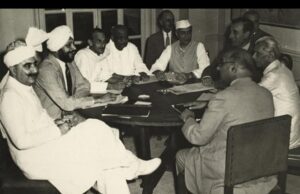
Gandhi believed India’s soul rested in Hindu-Muslim unity. Yet by 1947, the atmosphere had deteriorated beyond repair. Communal tensions, political deadlock, and rising violence made compromise increasingly difficult. Many leaders eventually came to believe that Partition, however tragic, was perhaps the only way to avoid a larger civil war.
Direct Action Day and the Collapse of Trust.
The turning point came on 16 August 1946 during Direct Action Day, called by the Muslim League.
Massive communal riots erupted in Calcutta, followed by retaliatory violence in Noakhali, Bihar, Punjab, and several other regions.
Fear spread rapidly:
Neighbours turned suspicious of each other,
Militias emerged,
Rumours multiplied,
and local administrations failed to maintain order.
By 1947, Partition was no longer just a political negotiation. It had become a desperate attempt to contain widespread communal collapse.
The Human Tragedy: Migration, Killings and Survival.
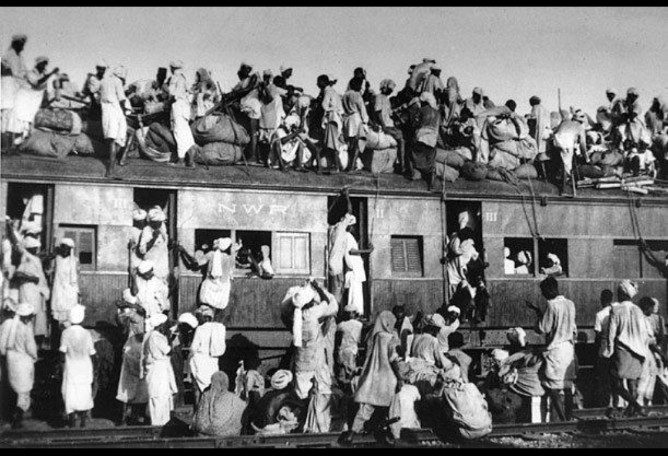
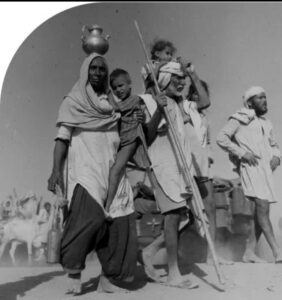
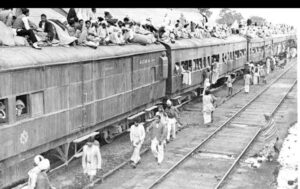
Partition triggered one of the largest forced migrations in recorded history. Nearly 10 to 15 million people crossed borders amidst unimaginable chaos. Historians estimate that between one and two million people may have lost their lives through massacres, starvation, disease, and displacement. Trains arrived filled with corpses. Villages disappeared in flames. Women suffered abductions, assaults, forced conversions, and unbearable humiliation.
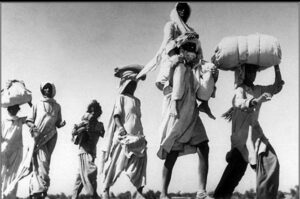
Families who had lived together for generations suddenly became refugees overnight. Yet beyond statistics and politics, Partition was ultimately a deeply personal human tragedy.
A Survivor’s Memory of Partition
During my visits to villages in Punjab over the years, I once met an elderly man whose trembling voice carried the weight of 1947 even after decades had passed. His fading eyes still reflected the horror of Partition as though the flames had never truly died.
Sitting quietly beneath an old tree, he began narrating how his family was forced to abandon their ancestral home in undivided India, now in Pakistan. Overnight, they lost everything, land, cattle, belongings, and the comfort of identity. What remained was only fear and the desperate instinct to survive.
He recalled endless columns of refugees moving silently across dusty roads, carrying children, bundles of clothes, and broken hopes. The skies were darkened by smoke rising from burning villages. Every passing rumour brought panic. Every unfamiliar face carried suspicion.
The old man narrated how his family walked from Narowal (now in Pakistan) continuously for nearly two days without food. Somewhere near Dera Baba Nanak, communal killings were taking place on a horrifying scale. Corpses lay abandoned near roadsides, and silence itself had become frightening.
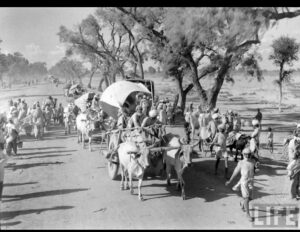
Among the refugees was his younger brother, still a small child then, crying uncontrollably from hunger. There was no food, no shelter, and no certainty that any of them would survive till the next morning.
In desperation, the old man’s father went out searching for something edible.
What he witnessed that day remained buried in his soul forever.
By the roadside lay the body of a woman killed during the violence with his tiny child clinging to her breast and having feed. Beside her was a torn cloth bag carrying atta. Half the flour had been soaked in blood, while the remaining portion was still dry.
The old man paused while narrating this part. His eyes lowered, and for a moment silence overtook his words.
Then softly, almost painfully, he said:
“Survival was greater than emotion that day.”
His father quietly gathered the dry atta leaving the blooded portion cut into two parts, collected the Atta and returned to the family. That flour became food for the starving children.
Years later, when he narrated this story to his family, everyone sat stunned in silence. The room had filled with goosebumps, grief, and an unbearable realization of what Partition had truly meant.
That was Partition.
Not speeches.
Not political slogans.
No lines drawn on maps.
Partition was hunger walking beside death.
It was humanity collapsing under fear.
It was memories that refused to die even after generation.
Children crying on unknown roads. Young womens were raped, young generation was brutally killed. A train full of killed wounded and fees survivers was landed in Amritsar, And humanity struggling to survive amidst madness.
Was Partition Unavoidable?
The debate continues even today.
Arguments Supporting Its Inevitability
Complete breakdown of communal trust.
Political deadlock between Congress and Muslim League.
Escalating violence across regions.
British urgency to leave India quickly.
Fear of nationwide civil war.
Arguments Against Partition
Failure of political leadership.
British haste in transferring power.
Lack of stronger constitutional safeguards.
Communal mobilisation for political gain.
Missed opportunities for compromise.
Perhaps history may never provide a final answer.
Lessons Beyond Borders.
Partition was not merely the division of territory, it was the tearing apart of human lives, emotions, and generations.

The greatest lesson of 1947 is not hatred, but caution. When politics exploits identity, when fear replaces dialogue, and when communities stop seeing each other as fellow human beings, even ancient civilizations can fracture.
India and Pakistan emerged as separate nations, but the pain of Partition still survives in memories, abandoned homes, refugee stories, and silent tears carried across generations.
History must therefore not become a weapon for revenge. It must become a mirror reminding future generations of the terrible cost of division and the priceless value of humanity.
Author’s Note.
This article is not written to reopen old wounds or to assign collective blame to any community. It is an attempt to understand one of the most tragic turning points in the history of the Indian subcontinent through the lens of humanity, memory, and historical reflection.
Partition was not merely a political event; it was a civilizational rupture that affected millions of ordinary people whose voices often remain absent from official narratives. The personal account included in this article is based on memories passed down through my own family, representing the silent suffering endured by countless refugees during those turbulent days of 1947.
As a student of history and military affairs, I believe that history must serve as a guide for future generations not as fuel for hatred, but as a reminder of the devastating consequences of division, fear, and communal violence.
About the Author.
Col (Dr.) Ashwani Kumar is a retired Indian Army officer, military historian, defence analyst, and writer known for his deep interest in strategic affairs, civilizational studies, and historical narratives. A postgraduate in History, he has extensively studied military history, border conflicts, Partition narratives, and India’s civilizational heritage.
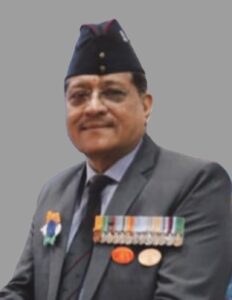
During his distinguished military career, he served in various operational and sensitive assignments across the country. He is a recipient of the:
Vishisht Seva Medal (VSM) for distinguished service,
Mention-in-Despatches (MiD) for operational contributions, along with several service and operational honours earned during his years in uniform.
Apart from defence and geopolitical analysis, he writes reflective essays and human-centred historical narratives blending military experience, spirituality, culture, and social memory. His writings often explore the emotional dimensions of history and the enduring strength of human resilience.
He writes under the pen name Ashk Machhanvi.
Disclaimer:
This article is intended purely for historical reflection, academic discussion, and humanitarian understanding. Any images, maps, or references used are sourced from open-source or publicly available archival material. The author has no right on these inages nor any financial benefits. The article does not intend to promote hatred, communal bias, or political hostility toward any community or nation.