


Newspapers play a positive and indispensable role in maintaining the health of a democratic society
 KRC TIMES Desk
Pradip Dutta Roy
In recent times, readers have been showing increasing disinterest in newspapers. This is a matter of serious concern and an unhealthy sign for democracy. The media is regarded as the fourth pillar of democracy. It plays a vital role in monitoring the functioning of the other three pillars—the executive, the judiciary, and the government.
Whenever there are lapses, shortcomings, or irregularities within these institutions, newspapers bring them before the public. Therefore, if the role of the press weakens, it can never be considered beneficial for democracy. In short, newspapers play a positive and indispensable role in maintaining the health of a democratic society.
However, for various reasons, readers today are gradually losing interest in newspapers. Some households subscribe to newspapers merely as a symbol of social status, while others read only the headlines and move on. Fortunately, there is still a section of readers who carefully read newspapers from beginning to end and point out errors and inaccuracies to the publishers.
Elderly readers, in particular, still cherish the tradition of beginning their mornings with a newspaper and a cup of tea. Their day feels incomplete without it. The younger generation, however, has a very different mindset. They believe they have little time to read newspapers and instead begin their day by browsing social media.

Send your resume:
biswa@jigyasu.co.in
krcfoundation@gmail.com
Although newspaper circulation has been steadily declining, newspapers remain indispensable for democracy. Even today, newspaper clippings are presented as documentary evidence while raising issues in Parliament or State Legislative Assemblies.
Social media posts cannot be used in the same manner. Thus, despite declining reader interest, newspapers have not lost their credibility. Through newspapers, people learn about public grievances, social injustice, crime, and other important developments. For ordinary citizens, newspapers continue to be a trusted source of information.
In recent years, one newspaper after another has shut down in the Barak Valley. Not only weekly and bi-weekly publications, but even daily newspapers have struggled to survive. After the closure of Dainik Sonar Cachar, the Northeast’s first Bengali daily newspaper, Dainik Prantajyoti, also ceased publication. Subsequently, Gati Dainik stopped publishing from July 1, 2026. It is deeply saddening to witness the gradual disappearance of print media in the region.
The greatest sufferers are journalists whose livelihood depends on the profession, as well as the many individuals associated with newspaper publishing. Writers, poets, and literary figures will have fewer opportunities to publish their work, while readers will also be deprived. Many remaining newspapers are facing financial hardship, and some have reportedly reduced their workforce simply to stay afloat.
The Barak Valley once had a vibrant newspaper culture that played a significant role in society. Although many of those newspapers were modest in size, their contribution was immense. During those days, journalists were driven more by a spirit of public service than by professional ambition.
Many had to pursue other occupations to support their families while continuing to publish newspapers for the benefit of society. Despite the considerable gap between publication costs and income, they persevered and built a loyal readership. Today, however, professional journalism has become far more expensive, making it increasingly difficult for many newspaper organizations to survive.

One of the principal reasons behind the present crisis is the government’s decision, beginning during the COVID-19 pandemic, to significantly reduce advertisements in daily newspapers. This has created a substantial gap between publication expenses and revenue from newspaper sales. Government advertisements in literary magazines published monthly, biannually, or annually have also been almost completely withdrawn.
As a result, many literary journals have become financially unsustainable, making it especially difficult for emerging poets and writers to publish their work. Numerous literary magazines have been forced to close, limiting opportunities for literature, culture, and socially conscious writing. No individual or institution can continue publishing indefinitely while bearing continuous financial losses.
Private-sector advertising has also changed dramatically. Commercial organizations now prefer electronic media over print, leaving newspapers at a disadvantage. Yet, for the overall development of society, preserving print media and literary publications remains essential. If the platforms where thoughtful individuals express their ideas disappear, society will inevitably suffer.
The writings of intellectuals and scholars have always guided society toward progress. During India’s freedom movement, national leaders inspired the masses through their writings, awakening the spirit of independence among ordinary people. Although the role of newspapers has evolved since Independence, they remain one of the most influential platforms for shaping public opinion. If the space for diverse viewpoints continues to shrink, democracy itself will be weakened.
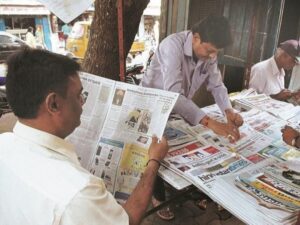
There are several reasons behind the declining circulation of newspapers. One of them is the tendency of some newspapers to publish only favorable reports about government activities. Readers also want to know about unfinished development projects, large-scale corruption, and the misuse of public funds. They expect investigative reports that expose those responsible.
Unfortunately, newspapers that publish such investigations often face the threat of losing government advertisements. Many readers are unaware of this reality. Consequently, despite their willingness, media organizations are frequently unable to meet readers’ expectations.
Another major concern is the growing lack of tolerance in public life. Governments increasingly appear unwilling to accept criticism and often expect newspapers to remain supportive of those in power. Such attitudes place immense pressure on media organizations. Earlier governments generally allowed greater freedom to the press, enabling newspapers to highlight administrative failures and contribute positively to society. Governments could learn from criticism and correct their mistakes.
A notable example is the renowned cartoonist Kutty, who frequently caricatured the then Prime Minister Indira Gandhi. Despite being the subject of his cartoons, Indira Gandhi herself inaugurated one of his cartoon collections, illustrating the level of tolerance that existed. Although she has been criticized for imposing the Emergency, this incident reflects a degree of democratic tolerance that appears to be increasingly absent today.
Readers spend their own money to purchase newspapers, and therefore it is natural for them to have expectations. Newspapers must find ways to satisfy these expectations. Readers are interested in the opinions and activities of various political parties, crime, political conspiracies, social decline, and many other issues.
Newspapers continuously strive to address these interests. However, many readers feel dissatisfied with the cautious approach newspapers often adopt while covering political affairs due to pressure from the ruling establishment. As a result, they gradually lose interest in newspapers.
Many people now rely solely on social media headlines to stay informed. However, information circulated on social media is often difficult to verify. Exaggerated stories, manipulated videos, and fake news frequently mislead the public. For ordinary citizens, distinguishing truth from falsehood is extremely difficult.
The most reliable way to verify such information is by comparing it with professionally reported newspaper coverage. This is precisely why newspapers should never be dismissed. Thoughtful readers continue to trust newspapers, even though younger generations increasingly prefer digital platforms and remain satisfied with brief news updates delivered through their smartphones.
As India is a welfare state, the government has a responsibility to protect and support the news media. Every government exists to serve the people, and strengthening democracy requires safeguarding independent journalism. Therefore, government advertising policies should be made more supportive and transparent.

Newspapers may legitimately express opinions that differ from those of the government, but they should not be punished or marginalized for doing so. Ensuring the freedom of the press is one of the government’s fundamental responsibilities. Constructive criticism of governmental actions should be viewed as an opportunity for improvement rather than as hostility. Newspapers also help governments understand the perspectives and concerns of opposition parties.
At the same time, newspapers themselves must adapt to changing circumstances. They should modernize their methods of circulation and outreach so that their publications reach readers even in remote areas. They must also make greater efforts to attract private advertisements. Manufacturers and businesses depend on advertising to promote their products, and newspapers should actively develop attractive advertising policies that encourage them to continue using print media alongside electronic platforms.
Newspapers should place greater emphasis on publishing stories that genuinely capture readers’ curiosity and interest. By presenting verified facts instead of the misleading or inaccurate reports often found on electronic and social media, newspapers can once again earn the confidence and loyalty of readers.
The opinions expressed above are those of the author. The author is a former student leader and an advocate of the Gauhati High Court.