


Is a hunger strike a noble instrument of conscience, or does it undermine democratic institutions by exerting pressure outside established constitutional processes?
 KRC TIMES Desk
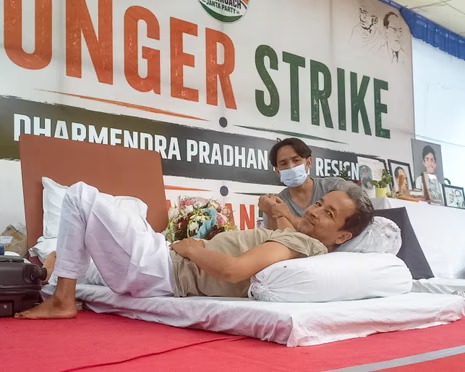
Few forms of political protest evoke as much moral force and public emotion as the hunger strike. It is a method that places the human body at the centre of political dissent, transforming personal suffering into a public appeal for justice. Yet it is also a method that has long divided political thinkers and constitutionalists. Is a hunger strike a noble instrument of conscience, or does it undermine democratic institutions by exerting pressure outside established constitutional processes?
The debate is not new. It was articulated with remarkable clarity by Dr. B.R. Ambedkar in his historic address to the Constituent Assembly on November 25, 1949. As India prepared to adopt its Constitution, Ambedkar warned against relying on methods such as civil disobedience, non-cooperation, satyagraha and hunger strikes in a democratic republic. He famously described these methods as the “grammar of anarchy” when constitutional avenues for redress remained available.
Ambedkar’s concern was rooted not in hostility to protest but in his faith in constitutional democracy. He feared that fasting unto death could create overwhelming moral and emotional pressure on governments and society, making rational democratic deliberation difficult. When a respected public figure risks death to secure political demands, governments often find themselves trapped between conceding to pressure and risking public unrest. Such situations can inflame passions, destabilize public order and weaken institutional decision-making.
His warning remains relevant even today. Democracies cannot function if every disagreement is settled through emotional coercion rather than debate, legislation and judicial review. Constitutional institutions exist precisely to mediate competing interests and resolve conflicts peacefully. When these institutions are bypassed, democratic governance can become vulnerable to pressure tactics rather than public reason.

Send your resume:
biswa@jigyasu.co.in
krcfoundation@gmail.com
Yet Ambedkar’s argument also raises an equally important question: what happens when citizens lose faith in the responsiveness of those very institutions?
Democracy is not merely about periodic elections. It is also about accountability, transparency and the willingness of governments to engage with public concerns. Constitutional mechanisms derive legitimacy from their ability to address grievances fairly and effectively. When citizens perceive that their voices are being ignored, that public debates are stifled, or that institutions are failing to respond, frustration inevitably seeks alternative channels of expression.
History offers numerous examples of non-violent resistance emerging precisely from such circumstances. Mahatma Gandhi transformed fasting into a moral instrument designed not to compel through force but to awaken the conscience of society. His fasts were intended to provoke reflection, encourage dialogue and draw attention to injustice. They succeeded because they appealed to shared moral values rather than physical coercion.
The effectiveness of such methods, however, depends largely on the character of both the protester and the state. As civil rights activists have often observed, non-violent resistance works best when those in power possess the willingness to listen and respond. A government confident in its democratic legitimacy should not fear peaceful dissent; it should engage with it. Conversely, indifference to public concerns can deepen alienation and intensify social tensions.
This broader context explains why contemporary hunger strikes continue to resonate with many citizens. Across the country, concerns ranging from education reforms and examination irregularities to unemployment, inflation, governance failures and environmental challenges have generated significant public debate. Whether one agrees with every criticism or not, the underlying demand is often the same: accountability from those entrusted with public power.
The recent hunger strike undertaken by education reform advocate Sonam Wangchuk has become a focal point of this discussion. Wangchuk, known for his work in education, sustainable development and environmental conservation, has chosen the path of non-violent protest to draw attention to issues he considers critical to the future of the nation. His approach reflects a tradition of peaceful civic engagement deeply embedded in India’s democratic history.

What makes such protests significant is not merely the duration of a fast or the individual leading it. Their importance lies in the questions they raise. Are citizens being heard? Are institutions functioning effectively? Is there sufficient space for dialogue between the government and society? These are questions that every democracy must confront honestly.
At the same time, hunger strikes should not become a substitute for democratic processes. A mature democracy requires strong institutions, vibrant parliamentary debate, an independent judiciary, a free press and active civil society participation. Public protest can draw attention to issues, but durable solutions ultimately emerge through institutional action and democratic consensus.
The challenge, therefore, is not to choose between constitutionalism and protest. It is to ensure that both reinforce rather than undermine each other. Governments must remain open to criticism and responsive to legitimate public concerns. Citizens, in turn, must continue to exercise their democratic rights responsibly and peacefully.
Ambedkar’s warning against the “grammar of anarchy” was a defence of constitutional democracy, not a rejection of public conscience. Equally, Gandhi’s embrace of non-violent resistance was not an attack on democracy but an appeal to its highest moral ideals. The tension between these two perspectives continues to shape India’s democratic journey.
Ultimately, a hunger strike becomes neither an act of anarchy nor an unquestionable moral virtue by its very nature. Its legitimacy depends on the cause it advances, the means it employs and the democratic context in which it occurs. When undertaken peacefully, transparently and as a last resort to seek accountability, it can serve as a powerful reminder that democracy is not sustained by institutions alone but also by the conscience of its citizens.
A healthy democracy does not fear such reminders. It listens, engages and responds. That, perhaps, is the true test of constitutional governance in any age.