

The question we rarely ask is this: Are we encouraging our children to compete with others, or are we teaching them to become a better version of themselves?
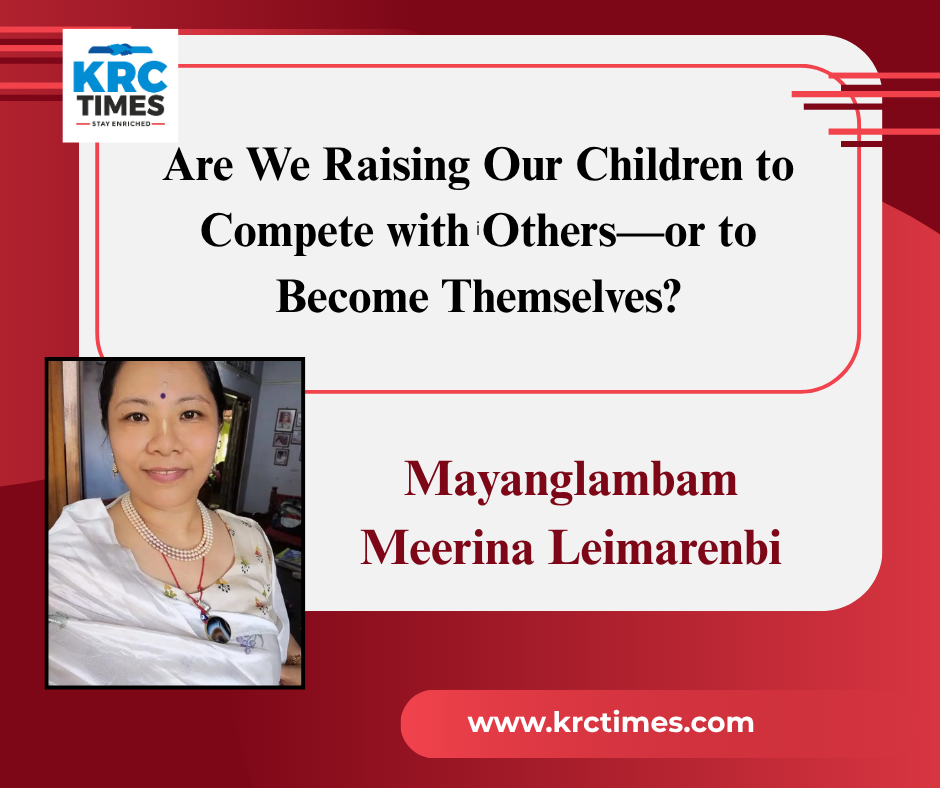
 Mayanglambam Merina
There was a time when childhood was measured by scraped knees, dusty playgrounds, paper boats in the rain, and evenings that seemed endless. A child’s greatest worry was whether the game would end before sunset. Today, childhood often begins with a timetable and ends with another.
School, tuition, music lessons, sports coaching, coding classes, language courses, competitive examinations—the calendar of a ten-year-old sometimes resembles that of a working professional. Somewhere between ambition and expectation, we seem to have forgotten that children are not projects to be completed; they are lives unfolding at their own pace.
The question we rarely ask is this: Are we encouraging our children to compete with others, or are we teaching them to become a better version of themselves?
Competition, in itself, is not the enemy. It can inspire discipline, perseverance and excellence. But when a child begins to measure self-worth only through ranks, marks and medals, learning slowly loses its joy. Curiosity gives way to comparison. Confidence becomes dependent on applause. Success is celebrated, while effort often goes unnoticed.
Every child is born with a different rhythm. One may find comfort in books, another in music, another in the quiet language of nature, and yet another in asking questions that have no easy answers. When we compare one child with another, we unintentionally tell them that being themselves is not enough.

The cost of this comparison is often invisible.
Children smile less freely. They fear making mistakes. They hesitate to try something new because failure has become something to avoid rather than something to learn from. Many carry anxieties that they cannot yet express. Their days are full, but their hearts are tired.
Childhood is not a race to adulthood. It is a season that should never be hurried.
A tree does not grow stronger because another tree grows faster. A flower does not bloom earlier because the one beside it has already blossomed. Nature allows every living thing to grow according to its own season. Yet we often expect every child to reach the same destination at the same time.
Perhaps what children need most today is not another class or another certificate, but unstructured time—to laugh without purpose, to daydream without guilt, to climb a tree, to read for pleasure, to create without fear of being judged, and to simply be children.

The greatest lessons in life are not always found in textbooks. They are found in conversations around the dinner table, in family walks, in kindness shown to strangers, in learning to lose gracefully, and in discovering that happiness cannot be measured by a report card.
As parents, teachers and society, our responsibility is not merely to prepare children for examinations. It is to prepare them for life—to help them become resilient, compassionate, curious and confident human beings.
The finest competition a child can ever have is with the person they were yesterday.
If they become a little kinder, a little wiser, a little more patient, a little more courageous with each passing day, they have already succeeded in ways no examination can measure.
Perhaps it is time we asked ourselves a different question. Instead of asking, “Is my child ahead of others?” we should ask, “Is my child happy? Is my child growing into someone who loves learning, values people, and still knows how to smile without a reason?”
Because one day, marks will fade, trophies will gather dust, and rankings will be forgotten. But a joyful childhood, if protected, becomes the quiet strength on which an entire life is built.