

The problems of humanity do not come in disciplinary compartments; therefore, their solutions cannot come from disciplinary silos,” believes Prof Goel
 Dr. M. M. Goel
Parbhani : Needonomics (Economics of Needs) can emerge as a practical and ethical roadmap for sustainable, inclusive and human-centered development in an age dominated by artificial intelligence, technological innovation and multidisciplinary research, said Prof. M. M. Goel, Former Vice Chancellor and Propounder Needonomics School of Thought superannuated from Kurukshetra University.
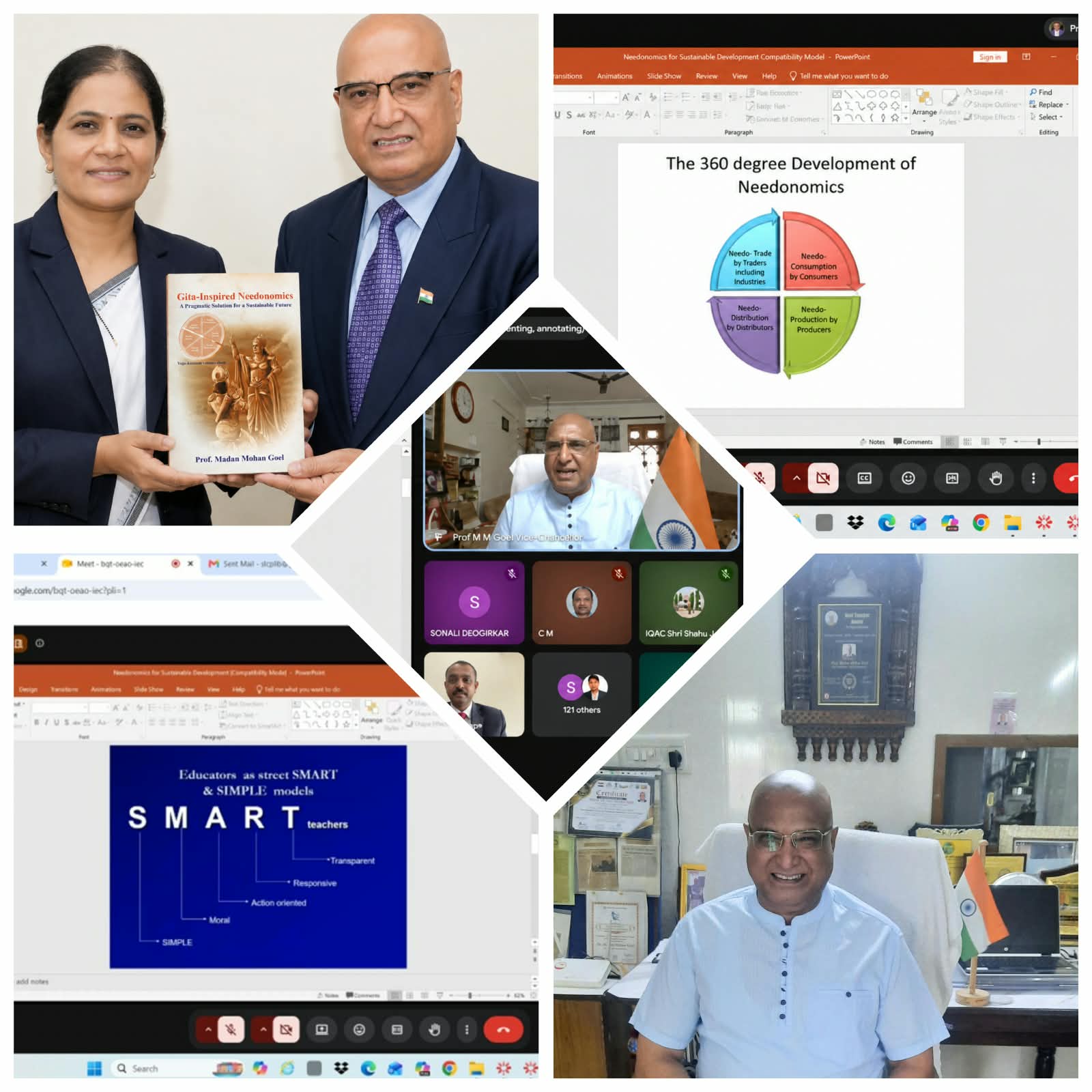
Prof. M. M. Goel addressed on “Needonomics Framework for Sustainable and Inclusive Socio-Economic Development in the Era of Multidisciplinary Research and Innovation” at the Multidisciplinary National E-Conference organized by Shivaji Law College, Parbhani (Maharashtra), affiliated with SRTMU, Nanded, in collaboration with Global Foundation. Dr. Harsha Suryawanshi, Associate. Prof. and Convener delivered the welcome speech and introduced Prof Goel to the participants. Dr. Sonali Devgirikar, Prof., Department of Commerce K.J. Somaiya

College of Arts & Commerce, Mumbai presided over the event. Santosh P Mane, President Global Foundation India, Pune proposed vote of thanks. His address highlighted the relevance of Needonomics in advancing sustainable, inclusive and ethical socio-economic development through multidisciplinary research and innovation.
“The problems of humanity do not come in disciplinary compartments; therefore, their solutions cannot come from disciplinary silos,” believes Prof Goel.
He said that despite remarkable advances in science, technology, biotechnology, digitalization and green innovation, the world continues to face inequality, unemployment, climate change, environmental degradation, stress and social exclusion. Economic growth, therefore, must be judged not merely by GDP but by its contribution to health, education, dignity, happiness, social inclusion and environmental sustainability.
Prof. Goel called for a shift from unlimited wants to legitimate needs and from excessive consumption to conscious consumption. He advocated Artificial Intelligence (AI) with Spiritual Intelligence (SI) to ensure that technological progress remains guided by ethics and human welfare.
Highlighting responsible innovation, he presented the NAW principle—Need, Affordability and Worth—as a basis for needo-entrepreneurship and socially meaningful innovation. He also emphasized Street SMART governance—Simple, Moral, Action-oriented, Responsive and Transparent.
Concluding, Prof. Goel said, “The purpose of economics is not to maximize wants, but to optimize human welfare through the satisfaction of legitimate needs.” He stressed that multidisciplinary research guided by Needonomics can help build a more sustainable, inclusive and humane civilization.