


Now the Shoe Is on the Other Foot
 KRC TIMES Desk
Insaf
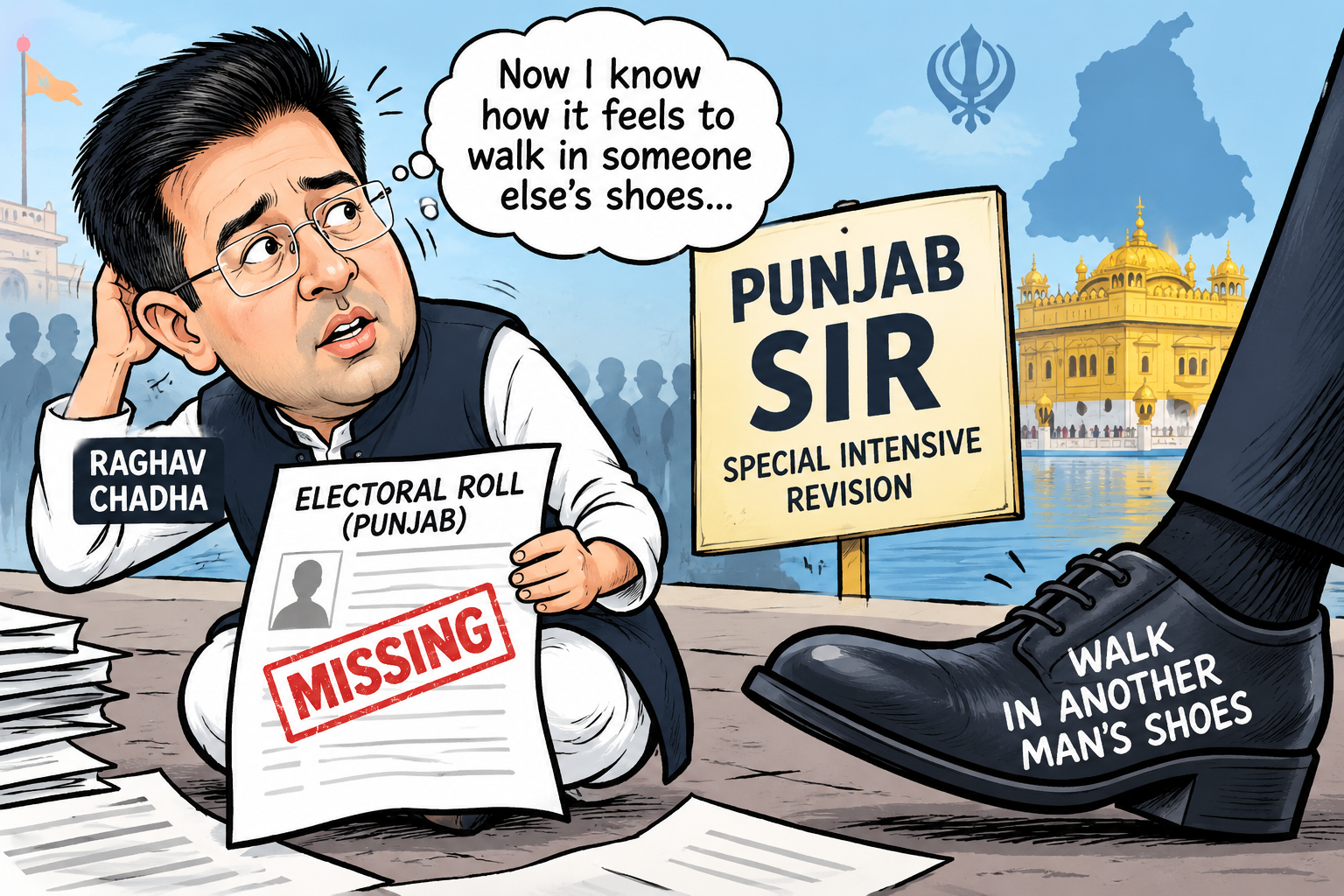
Amid the ongoing Special Intensive Revision (SIR) of electoral rolls in Punjab, BJP Rajya Sabha MP Raghav Chadha may now be getting a taste of what it feels like to be on the other side of the issue. His name is missing from the state’s draft electoral roll. Chadha has accused the Aam Aadmi Party government of “political vendetta”.
However, Chadha was elected to the Rajya Sabha from Punjab as an AAP candidate in 2022 and joined the BJP earlier this year. He says he is registered as a voter in Mohali and has questioned why he has been placed in the “transferred” category.
The AAP has rejected the allegation, saying the SIR is being conducted by the Election Commission and that the Punjab government has no role in it.
Chadha is among the 20.66 lakh voters-equivalent to 9.7 per cent of the electorate before the SIR-whose names have been excluded from the draft roll. Voters affected by the deletions can file claims and objections until September 12, while the final electoral roll will be published on October 12.
Chadha says he is filing his claim under the prescribed procedure and will have the “wrong classification” corrected. But the matter may not be quite so simple.
The AAP says it is a matter of public record that Chadha lives in Delhi, not Punjab. The irony is hard to miss. Just before the 2025 Delhi Assembly elections, Chadha, then an AAP MP, had accused the electoral authorities of a “planned and large-scale conspiracy of voter fraud” in Arvind Kejriwal’s New Delhi Assembly constituency and described it as a deliberate attempt to influence the election results.
Now, thanks to the SIR, Chadha himself is in the headlines!
Progressive Kerala
Three cheers to Kerala Chief Minister Satheesan for taking a clear stand in support of Muslim women’s freedom and rejecting the regressive views of influential cleric Kanthapuram Aboobacker Musliyar. In doing so, he has also risked a possible confrontation with his coalition partner, the Indian Union Muslim League.

Following Eid Milad-un-Nabi programmes last week, Kanthapuram issued written instructions stating that women being present in public places and among unrelated men was not in accordance with Islam. He claimed that the Quran teaches women to remain within the confines of their homes and that their entry into public life could lead to “great disaster”.
Community leaders and scholars-including some who disagreed with his views-criticised the position. Several Muslim women also voiced their opposition on social media. The Congress too disagreed with the statement, while the Indian Union Muslim League backed Kanthapuram.
Satheesan, however, was unequivocal. He said such views belonged in the 19th century, not the 21st. “Our approach is progressive,” he said.
He asserted that women must participate fully in mainstream social life and that the Quran was being misinterpreted. Indeed, Kerala, popularly known as “God’s Own Country”, has its own distinctive way of championing women’s rights!
Tug-of-War Over PM Candidate in Tamil Nadu
An interesting political tug-of-war has already begun in Tamil Nadu over a possible prime ministerial candidate for the 2029 Lok Sabha elections. Newly elected legislators of the ruling TVK are lobbying to project Chief Minister Vijay as the prime ministerial candidate, while alliance partner Congress remains firm that Rahul Gandhi is its undisputed choice.
The statements coming from the two camps have generated considerable curiosity.
TVK legislator Kanimozhi Santhosh says, “Delhi will not decide who becomes the Prime Minister; Tamil Nadu will decide.” She claims Vijay will bring about a major change in national politics and that Rahul Gandhi himself will support him for the prime minister’s post.
Congress leaders dismissed the claim on Wednesday as a manifestation of a “fan mentality”. They said there was “no confusion” about the official position of the party or the broader alliance. The Congress also reminded everyone that Vijay himself had earlier described Rahul Gandhi as the alliance’s declared candidate.
So far, there has been no response from the TVK headquarters or from Vijay. Perhaps remaining silent is the better strategy in this case. After all, it was the support of the Congress and other alliance partners that helped Vijay reach the Chief Minister’s chair.
Three years is a long time in politics and, as the saying goes: “There are no permanent friends or permanent enemies in politics; only permanent interests.” This is certainly a development worth watching closely.

Defection Season Begins in Uttar Pradesh
Political preparations for the Uttar Pradesh Assembly elections, scheduled for early next year, have gathered pace-and the season of defections has begun as well. Asaduddin Owaisi’s AIMIM has suffered its first setback. The party’s national spokesperson, Syed Asim Waqar, and his close associates joined the Congress on Wednesday.
The development has raised hopes in the opposition camp, which is seeking to unseat the BJP-Yogi government.
This is not merely a defection; it also carries a political message.
Waqar has alleged that AIMIM talks about defeating the BJP but ultimately contests elections against the Congress and the Samajwadi Party. This has revived the opposition’s long-standing allegation that AIMIM’s presence divides anti-BJP Muslim votes.
The timing is also uncomfortable for Owaisi, who is intensifying AIMIM’s campaign in Muslim-dominated areas of western Uttar Pradesh. The crowds at his rallies and his aggressive speeches have heightened concerns in the Samajwadi Party camp.
In the 2022 elections, AIMIM secured only 0.49 per cent of the vote across the state. However, in several targeted constituencies, its vote share ranged between 5,000 and 25,000 votes, and in seven or eight seats, its vote count was greater than the margin by which the Samajwadi Party lost.
In other words, had AIMIM not contested those seats-or had some of its votes gone to the Samajwadi Party-the results could have been different in several close contests. Thus, even without winning seats, AIMIM has the ability to influence electoral outcomes. Waqar has taken the first step. The question now is: will others follow him?
Political Face-Off Between TMC and BJP Continues
The political confrontation between the Trinamool Congress (TMC) and the BJP in West Bengal shows no sign of abating.
In the latest development, TMC national general secretary and Rajya Sabha MP Abhishek Banerjee alleged that BJP workers vandalised the party office on Camac Street in Kolkata on Thursday, damaged property and stole the mobile phones of party workers.
The BJP denied the allegations, saying that “no party worker was involved”, and claimed that the TMC had staged the incident itself to remain in the political headlines.
Banerjee, however, posted CCTV footage on X and questioned whether there was any rule of law in the state. He asked the Governor, the Union Home Minister and the Prime Minister’s Office whether they would “take action or simply watch”.
He also targeted Chief Minister Suvendu Adhikari, asking why he was “so afraid” of the TMC and of him.
Banerjee warned that incidents of violence, vandalism and intimidation could undermine the government’s “moral authority” and demanded Adhikari’s resignation.
In an indirect warning, he said every attack would be remembered and “nothing would be forgotten”.
The dispute is believed to have its roots in an incident last week involving a controversy between the Kolkata Municipal Corporation and the TMC over an “illegal” hoarding installed at the party office. TMC workers had prevented the civic body from removing it.
But has Banerjee forgotten the history of allegations of violence by TMC workers against BJP workers?
This is truly a case of the pot calling the kettle black!
Warning Bells for Sikkim
Sikkim and New Delhi need to sit up and take notice. Of the 40 high-risk glacial lakes in the eastern Himalayan state, 16 have been classified as being at “very high risk”. If any of these lakes suddenly bursts, it could trigger devastating floods in downstream areas.
The warning becomes even more serious in the backdrop of the recent flash floods in Nepal. More than a thousand people were killed and thousands remain missing in the devastation caused by the collapse of a glacier there. Although the tragedy was not attributed to a Glacial Lake Outburst Flood (GLOF), it nevertheless highlighted the sweeping environmental changes taking place across the Himalayas.
Glaciers are retreating rapidly, new lakes are forming in their place and existing lakes are expanding.
On Thursday, Chief Minister Prem Singh Tamang’s government said remote sensing and satellite imagery were being used to monitor changes in glacial lakes.
The state government is also working towards preparing the country’s first dedicated GLOF mitigation protocol. The objective is to establish a standardised scientific framework for assessing glacial flood risks, preparing for them and mitigating their impact.
The priority now must be to ensure that early warnings translate into timely evacuation of people, stronger infrastructure and coordinated disaster preparedness.
For Sikkim, this climate threat is not distant. It is real, immediate and staring the state in the face.