


This leaves Washington confronting a basic problem: how to finance increasingly large deficits without allowing borrowing costs to spiral
 KRC TIMES Desk
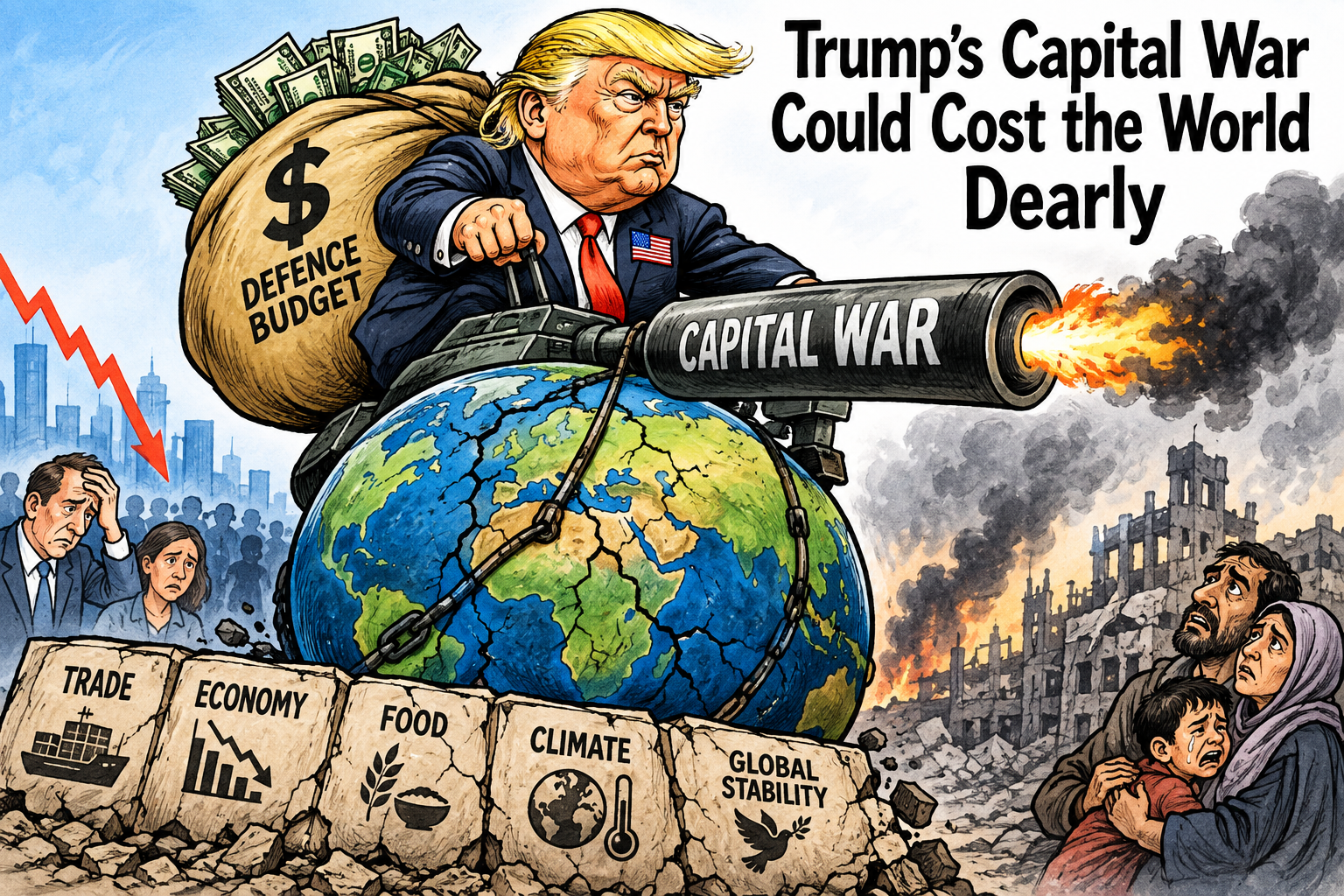
Donald Trump’s trade war may be giving way to something potentially far more disruptive: a battle over capital. Tariffs were supposed to narrow America’s trade deficit, revive domestic industry and generate enough revenue to support tax cuts and government spending. Instead, the US trade deficit remains stubbornly high, while the cost of tariffs has fallen overwhelmingly on American importers and consumers. The next target, therefore, appears to be foreign capital.
The numbers explain the urgency. The US government is carrying debt of nearly $40 trillion, equivalent to about 130 per cent of GDP, while the federal budget deficit is estimated at around $1.9 trillion in 2026. Tariff revenues, even if they exceed $180 billion, would cover only a fraction of that gap. Over the coming decade, further borrowing is likely to add several trillion dollars to the debt burden, even as debt-servicing costs rise sharply.
This leaves Washington confronting a basic problem: how to finance increasingly large deficits without allowing borrowing costs to spiral. Foreign investors remain central to that equation. Overseas investors hold trillions of dollars in US equities and Treasury securities. Their continued willingness to hold American assets has helped sustain the dollar’s international role and enabled Washington to borrow on a scale few other countries could contemplate.
That dependence could encourage the Trump administration to turn its attention from trade restrictions to financial restrictions. Foreign companies and investors could face higher taxes, additional fees, changes in the treatment of sovereign wealth funds and restrictions on the movement of capital. More radical proposals have included restructuring the terms of Treasury securities, effectively extending maturities or imposing costs on foreign holders.

Such measures would amount to financial repression. Instead of confronting the underlying causes of America’s fiscal imbalance-tax cuts, rising defence spending, demographic pressures and structurally high expenditure-Washington would seek to make creditors bear a larger share of the adjustment.
The danger is that financial markets are far less forgiving than trade flows. Tariffs can disrupt supply chains and raise prices; a capital war could destabilise the very financial architecture on which the US economy and the global economy depend. The dollar remains the dominant reserve currency, while US Treasury securities are treated as the world’s benchmark safe asset. Any attempt to undermine foreign investors’ confidence in either could trigger violent movements in currencies, bond yields and equity markets.
Foreign investors are also caught in a difficult position. Countries such as Japan, China and several European economies hold vast quantities of US assets. A sudden large-scale sell-off could depress the value of the dollar and American securities, inflicting heavy losses on the very investors seeking to reduce their exposure. Continuing to hold those assets, meanwhile, could leave them vulnerable to inflation, currency depreciation or policy changes imposed by Washington.
This is the paradox of America’s financial dominance. The United States possesses enormous leverage because the dollar and Treasury market remain indispensable. But using that leverage recklessly could eventually weaken the foundations of that dominance.
Other countries have begun exploring alternatives to excessive dependence on the dollar, including new payment mechanisms, greater use of local currencies and diversification of foreign-exchange reserves. Yet building a credible alternative to the US financial system will take years. In the meantime, the world remains deeply exposed to decisions made in Washington.
The lesson is not that America has no right to protect its economic interests. It is that fiscal problems cannot be permanently solved by shifting their cost onto trading partners and foreign creditors. Tariffs cannot substitute for fiscal discipline, and financial repression cannot substitute for structural reform.
A capital war may initially give Washington more bargaining power. But if pursued with the same unpredictability that has characterised Trump’s tariff policies, it could turn America’s greatest economic advantage-the global primacy of the dollar-into a source of systemic vulnerability.
The United States may hold many of the cards. It should be careful not to play them all at once.