

The audience takes control
 KRC TIMES Desk
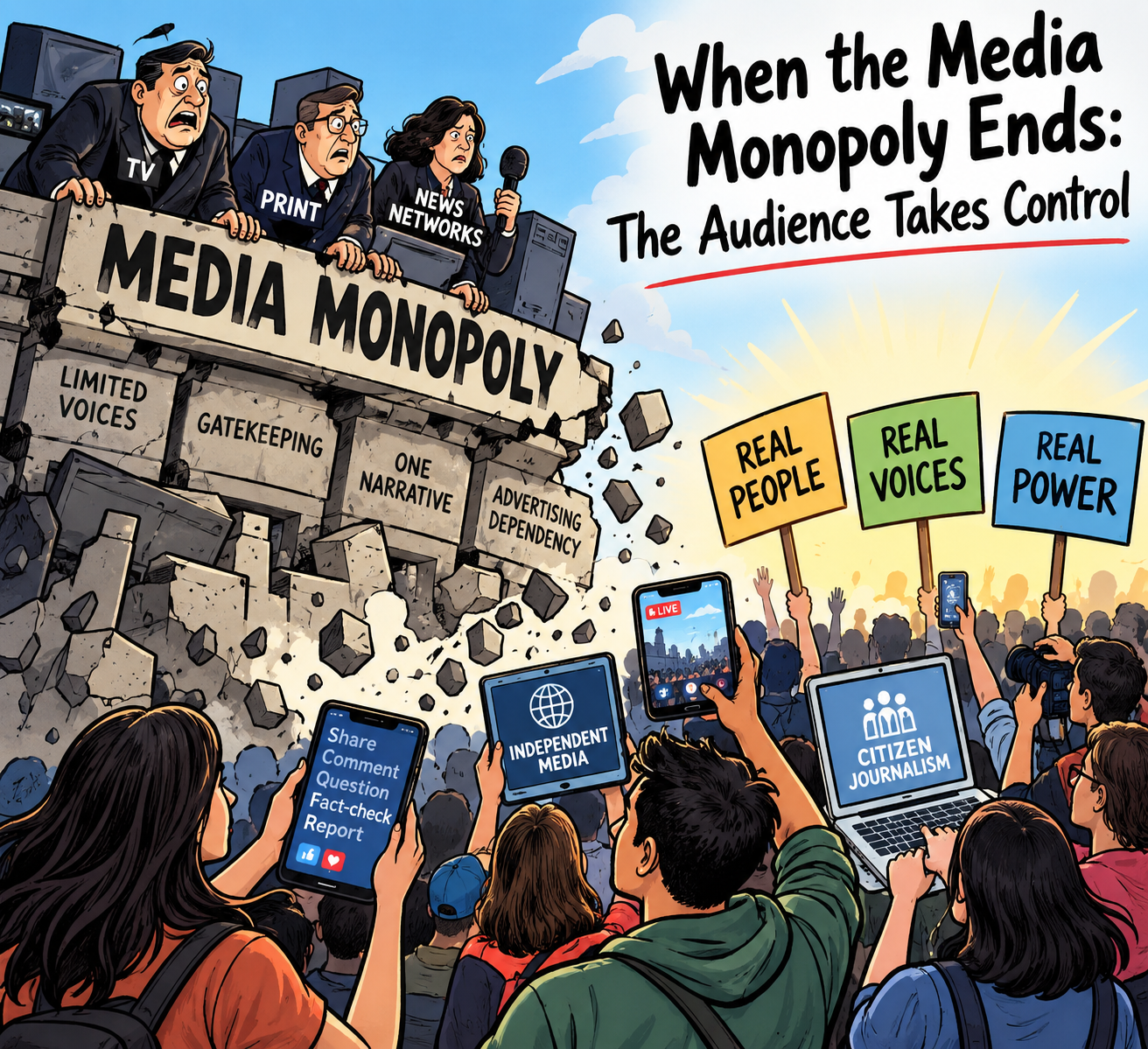
Digital platforms have not simply created new competitors for main- stream media. They have fundamentally changed who controls attention, challenges narratives and shapes public opinion. For decades, the power of main- stream media rested on a simple advan- tage: scarcity.
There were only so many newspapers people could buy, only a limited number of television channels they could watch and only a handful of broadcasters ca- pable of reaching millions. The organi- sations that controlled these platforms enjoyed enormous influence over what people knew, discussed and, often, con- sidered important.
That era is over. The most significant transforma- tion in the media industry today is not merely the decline of newspapers or the rise of social media. It is the collapse of the old monopoly over public attention. News organisations are no longer the unquestioned gatekeepers of information.
They are now participants in a vast and fiercely competitive ecosystem in which a newspaper report, a television debate, a YouTube video, an Instagram post, a podcast and a citizen’s mobile-phone recording can all compete for attention. The audience, armed with unprecedented choice, has become more powerful than ever before. This change raises a fundamental question: what exactly constitutes mainstream media today?
Traditionally, the term referred to established, professionally run media organisations with large public reach — national and regional newspapers, magazines, radio networks and television channels. Their influence flowed from their ability to gather information, decide what deserved publication and distribute it to a mass audience.
But the digital revolution has dramatically expanded that definition. Today, major digital news platforms, YouTube channels, podcasters, independent journalists and even individual creators can command audiences comparable to, and sometimes larger than, those of established media houses.

Facebook, X, Instagram, TikTok and YouTube have changed not only how people receive information but also who gets to distribute it. Legacy media organisations have recognised the shift. Newspapers have built digital editions, television channels have expanded into round-theclock online operations, and virtually every major media organisation now competes across multiple platforms. Yet entering the digital arena has not solved their biggest problem: attention itself has become fragmented.
Former Time editor-in-chief Nancy Gibbs warned earlier this year that the world could be moving towards an “information wasteland”, where the fragmentation of attention makes meaningful communication increasingly difficult. In an environment where almost everything is presented as “breaking news”, the race is no longer simply to report first. It is to prevent the audience from scrolling away.
That has altered journalism at a fundamental level. Pew Research Center data have shown a decline since 2019 in news consumption across age groups, with social media becoming an increasingly important source of information. Independent creators, influencers, podcasters, YouTubers and subject specialists have filled part of the space once dominated almost exclusively by established news organisations. The consequences go beyond busi- ness and technology.
In the past, a government announce- ment, a political speech or a major na- tional event would usually pass through relatively few media filters before reaching the public. Today, the same event is interpreted simultaneously by television channels, newspapers, digital platforms, political commentators, independent journalists and ordinary citizens Every narrative can now face an i m m e d i a t e counter-narrative. Every mistake can be challenged within minutes.
E v e r y omission can become a story in itself. This has weakened the ability of any single organisation, or even a group of dominant organisations, to monopolise public opinion. But it has also created a serious crisis of credibility. The competition for ratings and attention has encouraged sensationalism, dramatic presentation and an endless breaking-news culture. In India, a section of major television networks has faced persistent criticism over perceived political bias, confrontational prime-time debates and the blurring of the distinction between reporting and opinion.
Audiences may differ sharply in their assessment of individual channels, but the broader trend is difficult to ignore: trust has become increasingly conditional. Viewers no longer necessarily accept a report because it appears on a major network. They compare it with other sources, search for alternative ac- counts and, increasingly, turn to digital platforms The problem is not confined to tradi- tional media.
The digital ecosystem has its own dangers — misinformation, ma- nipulated content, anonymous propa- ganda and viral falsehoods. The decline of the old gatekeepers has democratised information, but it has also removed some of the barriers that once slowed the spread of unverified claims. The challenge, therefore, is not a simple battle between old media and new media. It is a battle over credibility.
Several episodes have contributed to this changing relationship between the media and its audience. The criticism of television coverage during the 2008 Mumbai terror attacks triggered a major debate about responsibility and the risks of broadcasting sensitive operational information.
More recently, the 2024 parliamentary elections demonstrated the growing influence of digital media, with online platforms providing space for perspectives that were often absent or less visible on some major television networks. The conflict between India and Pakistan following the Pahalgam terror attack in May 2025 further exposed the dangers of the competition for attention.
A section of television coverage was criticised for sensational and unverified claims, reinforcing concerns about the pressure to produce dramatic content during fast-moving events. Such episodes carry a heavy cost. When one platform loses credibility, the audience does not necessarily stop consuming news. It simply moves elsewhere. This is perhaps the most important change confronting mainstream media.
The public has not lost its appetite for information. It has gained more places from which to obtain it. The shift was visible globally as ear- ly as the Arab Spring of 2011, when social media emerged as a powerful in- strument for organising protests and bypassing traditional channels. Since then, digital platforms have steadily transformed themselves from supplementary communication tools into central arenas of political and social discourse. India is now witnessing the same transformation at an accelerated pace.
The recent Cockroach Janata Party protest at Jantar Mantar offered another illustration of the changing media environment. While questions were raised over the extent and nature of broadcast coverage, the event received significant attention across digital platforms. Commentator Arghya Sengupta, writing in The Times of India, argued that television was increasingly becoming merely another form of content competing within the same digital feed.

That observation captures the scale of the disruption. A television channel is no longer competing only with another televi- sion channel. It is competing with a 30-second vid eo. A live stream. A podcast. An independent reporter. A local citizen with a mobile phone. And, ultimately, the next swipe of a finger. At the same time, established news- papers have retained an important advantage: depth, verification and in- stitutional accountability.
In recent controversies and major public events, leading newspapers have continued to report, investigate and publish ed- itorial opinion while attempting to preserve the distinction between news and commentary. That distinction may become one of journalism’s most valuable assets in the years ahead.
The changing media landscape is also evident closer home. During As- sam’s recurring flood crises, tradition- al newspapers and television channels now operate alongside social media users, local digital platforms and independent reporters. Videos from affected villages can reach the public before a television crew arrives. Citizens can document gaps in relief distribution, highlight administrative failures and challenge official claims in real time. Young people, too, have increasingly used digital platforms to expose hate speech and counter communal propaganda.
None of this means that traditional media has become irrelevant. Far from it The role of professional journalism may actually become more important in an information environment flooded with competing claims. But relevance can no longer be assumed because of a famous brand name, a large newsroom or a prime-time slot. It has to be earned repeatedly. The media’s old power came from controlling access to information.
Its future power will depend on something far more difficult to retain: public trust. The audience now has alternatives, and it knows it. That is the real revolution in the media landscape. The gates have opened, the monopoly has disappeared and the consumer of news has become an active participant in deciding whose version of reality deserves attention. For mainstream media, the message is unmistakable.The battle is no longer about who has the loudest voice. It is about who remains credible when everyone can speak.