


Pakistani personnel have served in Saudi Arabia for decades, while Saudi officers have repeatedly come to Pakistan for professional military education
 KRC TIMES Desk
Lt. Gen Bhopinder Singh (Retd)
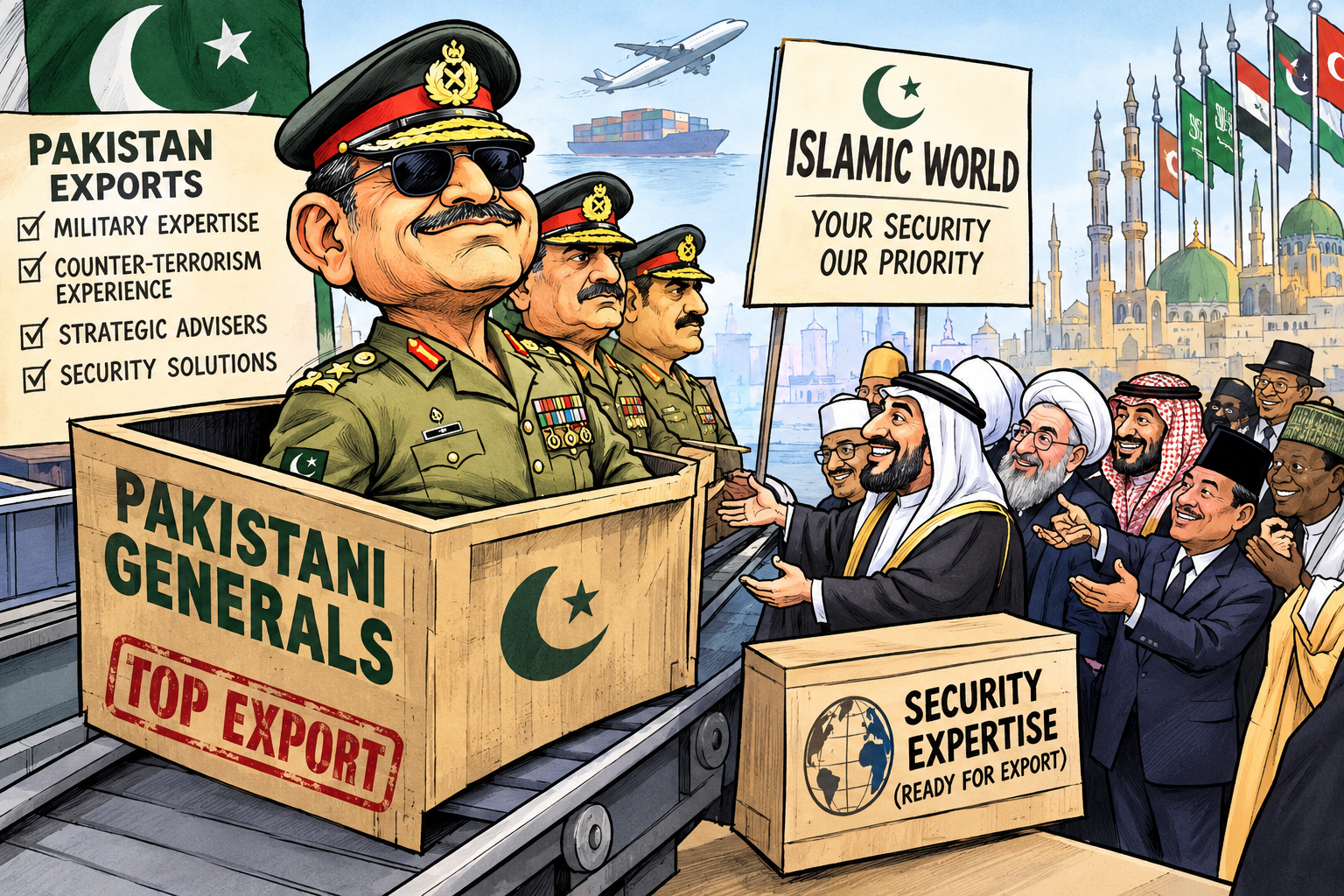
There is a revealing pattern in Pakistan’s ‘military diplomacy’ when Islamic countries need experienced security leadership, they repeatedly look toward Rawalpindi General Headquarters. The latest example is Lt Gen (Retd) Nauman Mahmood, appointed this week as the first Secretary General of the Makkah Joint Defence Agreement between Pakistan, Saudi Arabia and Türkiye. His job is not expected to be ceremonial. He will establish and lead the alliance’s secretariat in Riyadh as the three countries translate a political agreement into institutions, procedures and practical defence cooperation.
Lt Gen Mahmood brings an ostensibly rich résumé for the assignment. He commanded an infantry division in North Waziristan during Pakistan’s counterterrorism campaign, served in senior intelligence and analytical roles, and spent years in professional military education, including as chief instructor at the Command and Staff College. He subsequently headed the Pakistan Military’s National Defence University. That combination explains something important about Pakistan’s appeal – their Veterans are bloodied in combat experience. Pakistani Generals are not merely military men; many have spent decades operating at the intersection of combat, intelligence, strategy, diplomacy and institution-building. And Pakistan has, over generations, effectively exported that experience to the wider Muslim world.
The first and most obvious precedent is former Pakistani Army Chief, General Raheel Sharif. After retiring, Gen Sharif was appointed commander of the Saudi-led Islamic Military Counter Terrorism Coalition in 2017. The coalition brought together 41 Muslim countries and was designed to coordinate counterterrorism efforts across military, ideological, communications and counter-terrorist-financing domains.
This was an extraordinary post-retirement appointment – Saudis chose a Pakistani General as opposed to one from Egypt, Jordan, Malaysia, Indonesia or even one of its own. Sharif had commanded one of the world’s largest armies after a career shaped by Pakistan’s own battles against Al Qaeda, the Taliban and other militant organisations. His experience was therefore directly relevant to an organisation whose stated purpose was counterterrorism. The choice was consequently more practical than ornamental – Riyadh was buying access to a senior commander who had already spent years dealing with the kind of security problems the coalition was supposed to address.
Fact is, Pakistani stock in the other Islamic countries is an old story and Raheel Sharif and Nauman Mahmood are just the more recent examples, but the relationship is much older. Pakistan’s military relationship with Saudi Arabia dates to the 1960s. Pakistani officers served as trainers, advisers and engineers, while Saudi personnel were trained in Pakistan. By 2023, Arab News reported that 1,522 foreign cadets from 31 countries had trained at the Pakistan Military Academy, including personnel from Saudi Arabia, Jordan, Iraq, Qatar, Bahrain and Palestine. The relationship subsequently expanded into deployments, advisory missions, joint exercises and institutional cooperation. Pakistani personnel have served in Saudi Arabia for decades, while Saudi officers have repeatedly come to Pakistan for professional military education.
Pakistani history extends beyond Saudi Arabia. During the 1970s, Pakistan concluded military cooperation arrangements with Saudi Arabia, Libya, Jordan, Iraq, Oman, the UAE and Kuwait; by the end of that decade, Pakistani military advisers and trainers were serving across the Middle East. This is why the Nauman Mahmood appointment should not be viewed as an isolated personnel decision. It is the latest expression of a decades-old model. Pakistan has developed a niche in the Muslim world as a “value for money” provider of military human capital. The reason is straightforward – Pakistan’s senior officers tend to arrive at retirement having accumulated three kinds of experience that are particularly useful to states building or coordinating security institutions.
Firstly, combat experience. Pakistan’s army has spent decades conducting conventional operations, counterinsurgency and counterterrorism campaigns. Officers who have commanded formations in places such as the tribal areas have dealt with insurgency, intelligence networks, border security and irregular warfare as operational realities rather than classroom concepts. Secondly, longevity within a professional military system. A senior Pakistani general has normally passed through a long sequence of command, staff, instructional and strategic appointments.
Mahmood’s career, for example, combined field command with intelligence and military education. Thirdly, familiarity with the institutional machinery of multinational security cooperation. Pakistani officers have spent decades training foreign militaries, serving abroad, conducting joint exercises and interacting with Arab defence establishments. That makes the proposition relatively economical as instead of building the experience from scratch, a Gulf or Muslim-majority state can recruit someone who has already spent thirty-plus years acquiring it.
There is also a cultural advantage, but it needs to be understood carefully. It is tempting to describe Pakistani officers as having a “natural fit” in the Islamic world because Pakistan is a Muslim-majority country. That explanation is too simplistic. The more interesting advantage is institutional and cultural familiarity. Pakistani officers have spent decades working with Arab militaries, training Arab cadets and operating in environments where religion, national identity, territorial sovereignty and security are often closely intertwined.
That familiarity matters when the assignment involves not simply defeating an adversary, but operating within a political environment in which the defence of territory, protection of holy sites, counterterrorism and the wider security of Muslim societies can carry religious as well as strategic significance.
The 1979 seizure of the Grand Mosque in Makkah is the most dramatic historical illustration of that intersection. Pakistani special forces participated in the operation alongside Saudi and French elements, although accounts differ over the precise nature and extent of Pakistan’s operational role. The lesson from the broader relationship is less about religion than about accumulated familiarity. Pakistan’s military establishment understands the operating environment.
Raheel Sharif demonstrated that a Pakistani former army chief could become the military face of a multinational Islamic security organisation. Nauman Mahmood now demonstrates that the model extends beyond operational command – a Pakistani General can also be entrusted with building the institutional architecture of a new regional defence arrangement. That is a significant form of strategic capital.
The irony is that Pakistan’s domestic political economy often struggles to monetize the expertise accumulated by its military establishment. Abroad, however, that expertise can be highly sought after. For Pakistan, the benefit is equally tangible. Every such appointment extends Islamabad’s diplomatic reach without requiring another embassy, another treaty or another billion-dollar weapons system. It is ‘military diplomacy’ by personnel. And Lt Gen Nauman Mahmood’s appointment suggests that, nearly six decades after Pakistani officers first began helping build Gulf military institutions, this particular Pakistani export remains very much in demand.
(The author is former Lt Governor of Andaman & Nicobar islands & Puducherry)

