


There are encouraging signs that the India-Switzerland relationship is moving beyond conventional commerce
 KRC TIMES Desk
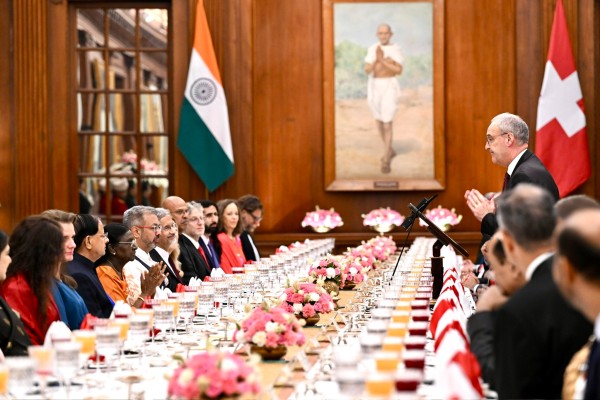
Switzerland’s President Guy Parmelin’s second visit to India this year is more than a diplomatic repeat. It signals that a relationship long associated with trade, investment and finance is acquiring a broader strategic dimension. But as New Delhi and Bern celebrate a year of the India-EFTA trade agreement, the more important question is not how many agreements have been signed, but how much they are delivering.
The visit, which began on Monday, coincides with the first anniversary of the Trade and Economic Partnership Agreement (TEPA) between India and the European Free Trade Association (EFTA), comprising Switzerland, Norway, Iceland and Liechtenstein. The immediate agenda is built around what India’s Ministry of External Affairs calls the “3Ts” – trade, technology and talent.
The framework is sensible. But it needs a fourth T: tracking.
TEPA carries an ambitious investment commitment: $100 billion from the four EFTA countries over 15 years, including $50 billion during the first decade, with the potential to generate one million direct jobs. Parmelin’s participation in the second India-EFTA Prosperity Summit therefore provides an opportunity not merely to celebrate the agreement, but to examine its first-year performance.
That distinction matters. Large investment numbers announced at the governmental level ultimately have to translate into decisions by companies, factories, laboratories, infrastructure projects and employment. Governments can negotiate the framework; businesses determine whether the framework works.
There are encouraging signs that the India-Switzerland relationship is moving beyond conventional commerce. The two countries have expanded cooperation in migration and mobility, including longer-duration multiple-entry visas and renewable student permits. A young professionals’ exchange programme is intended to deepen people-to-people links. Cooperation is also expanding into electric mobility, ropeways, tunnelling and the circular economy.
Defence exchanges, defence manufacturing and nuclear energy have also emerged as areas of potential cooperation. Artificial intelligence provides another important avenue. India and Switzerland have maintained high-level engagement on AI, while Switzerland is scheduled to host the global AI summit in 2027.
The relationship has the advantage of history. India and Switzerland have maintained cordial ties since Independence, with India’s non-alignment and Switzerland’s neutrality providing a relatively uncomplicated diplomatic foundation. Prime Minister Narendra Modi and Parmelin have met twice this year – in New Delhi in February and in Geneva in June.

Yet economic realities demand a more searching assessment.
India’s trade with Switzerland remains heavily tilted in one direction. In 2024-25, India imported goods worth about $21.8 billion from Switzerland while exports stood at roughly $1.47 billion. Swiss direct investment in India reached $10.87 billion between April 2000 and June 2025, while more than 330 Swiss companies operate in the country.
Swiss investment is already visible in Indian infrastructure and technology. A subsidiary of Zurich Airport operates Noida International Airport, while Swiss technology has contributed to the Varanasi ropeway project. Such examples demonstrate the possibilities of combining Swiss technological expertise with India’s infrastructure and consumer-market scale.
But there are also reminders that economic diplomacy cannot run entirely on goodwill.
Switzerland’s suspension of the most-favoured-nation clause in its tax treaty with India from January 2025, following the Indian Supreme Court’s Nestlé ruling, exposed the importance of tax certainty for cross-border investment. Investors require not only access to markets but also predictable rules under which capital can operate.
This is where the fourth T becomes important.
India and EFTA should establish a transparent annual mechanism to track the implementation of TEPA. Investment commitments should be measured against actual investment flows. Announced projects should be followed through to implementation. Employment promises should be quantified. Visa and mobility arrangements should be assessed by actual usage. Sectoral cooperation should be evaluated not merely by the number of memoranda signed but by projects completed.
Such tracking would also help address a fundamental problem with headline investment targets: governments can announce ambitions, but companies ultimately decide where to put their money.
For India, the message is equally clear. If it wants Swiss and wider European capital to scale up, it must continue to improve the conditions under which investment takes place – predictable taxation, regulatory clarity, faster approvals, efficient infrastructure and greater policy consistency.
Parmelin has described his visit as a “stepping stone”. That is an apt description. The India-Switzerland relationship has already accumulated diplomatic goodwill, commercial links and a growing list of new areas of cooperation.
The next stage should be about delivery.
The success of the partnership should therefore not be measured by the number of summits, declarations or memoranda exchanged. It should be visible in investment actually arriving, factories being established, technologies being transferred, students and professionals moving more easily, and jobs being created.
The first three Ts provide the ambition. The fourth – tracking – can provide accountability.
And that may ultimately determine whether the India-Swiss partnership is remembered for the promises made in conference rooms or for the economic opportunities that emerged beyond them.