


Broken Promises, Rising Anger and the Crisis of Governance
 KRC TIMES Desk
Pallab Bhattacharyya
The autumn of 2026 has brought a familiar but increasingly urgent question to the forefront of global politics: what happens when a generation loses faith in the promise of a better future?
In France, student protests that reportedly began on September 17 over deteriorating facilities at a secondary school in Créteil grew into a wider movement demanding better public services, fair wages and greater institutional accountability. Images of broken toilets, mould-covered ceilings and missing classroom furniture circulated on social media, turning a local grievance into a symbol of a larger public-sector crisis.
University students, trainee teachers, trade unions and the Yellow Vests subsequently joined the demonstrations. The movement’s demands extended well beyond classrooms, reflecting growing frustration over the cost of living, public expenditure and the perceived indifference of political institutions.
The reported scale of the protests and the forceful response by the authorities underscored the depth of the confrontation. Attempts by Prime Minister Sébastien Lecornu to offer concessions did little to satisfy demonstrators who believed that limited administrative adjustments could not address years of accumulated grievances.
The significance of the unrest lies not merely in the number of people taking to the streets. It lies in the growing perception among young citizens that the institutions meant to secure their future are failing to deliver.
Europe’s generational divide
France is part of a broader European debate over economic opportunity and generational fairness. For more than two decades, governments across the continent have grappled with austerity, financial crises, rising public debt and the pressures of ageing populations. The consequences have not been distributed equally across generations.
Young people face uncertain employment prospects, increasingly expensive housing and the growing difficulty of achieving financial independence. In several European countries, the transition from education to stable employment has become prolonged, while the cost of renting or buying a home has moved beyond the reach of many first-time earners.
The result is a generation that may be better educated than its predecessors but finds it harder to secure the economic security traditionally associated with adulthood.
Public spending priorities have become part of this debate. Pension commitments and healthcare costs are legitimate obligations of the state, particularly in ageing societies. Yet governments must also ensure that schools, universities, vocational institutions, public transport and affordable housing receive adequate investment. The challenge is not to pit the young against the elderly, but to prevent one generation’s security from being financed through another’s prolonged insecurity.

When young citizens perceive that the political system protects established interests while asking them to accept precarious employment and rising living costs, resentment can quickly spill into the political arena. Populist movements on both the left and the right have frequently drawn support from such disillusionment.
The danger is that economic frustration, if left unaddressed, can weaken confidence in democratic institutions themselves.
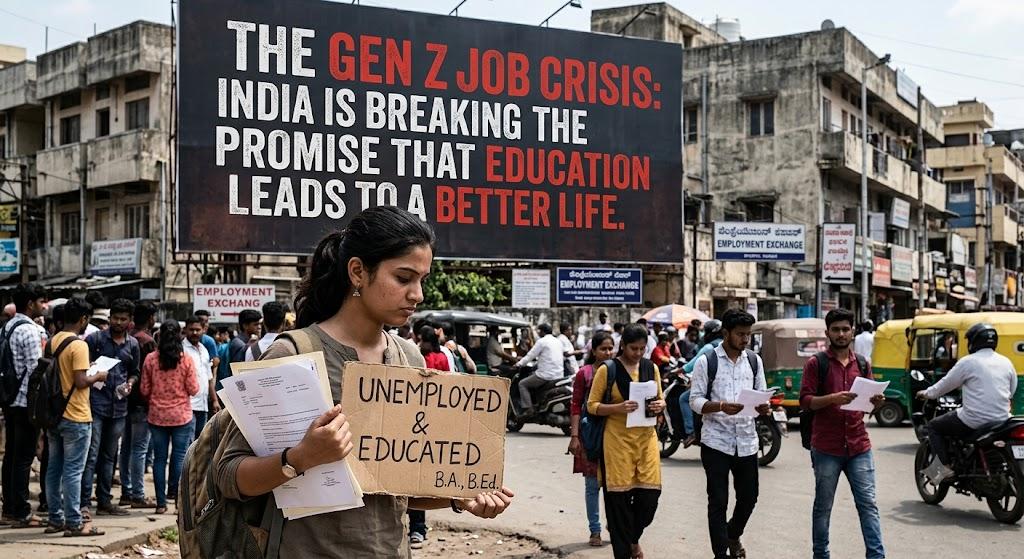
India’s employment and examination crisis
India faces a different economic and demographic reality, but several of the underlying anxieties are strikingly similar.
The country’s large youth population is often described as its greatest demographic advantage. A young workforce can drive productivity, innovation, consumption and economic growth. But this dividend is not automatic. It depends on the availability of productive employment, the quality of education and the ability of young people to translate qualifications into meaningful careers.
For millions of Indian students, competitive examinations have become the principal gateway to professional advancement and social mobility. Government recruitment examinations, medical and engineering entrance tests, and other selection processes carry enormous stakes because access to quality education and secure employment remains highly competitive.
Paper leaks, examination cancellations, allegations of irregularities and recruitment delays can therefore have consequences far beyond administrative inconvenience. Candidates frequently spend years preparing for a single opportunity, often with considerable financial and emotional support from their families. When an examination is compromised, the damage extends to lost time, depleted household savings and the erosion of trust in public institutions.
The controversy surrounding the National Eligibility-cum-Entrance Test (NEET) and wider concerns over examination integrity have demonstrated how vulnerable the system becomes when fairness is questioned. Any specific allegation, cancellation or administrative decision must be assessed on verified evidence, but the underlying policy concern is undeniable: high-stakes examinations must be transparent, secure and accountable.
India’s employment challenge also requires a more nuanced understanding than headline unemployment figures alone can provide. The difficulties facing young graduates include a mismatch between qualifications and available jobs, uneven educational quality, limited access to practical training and the concentration of high-quality employment in particular cities and industries.
A degree does not automatically guarantee employability, but neither should young people be blamed for a system that fails to connect education with economic opportunity.
The consequences are visible in the prolonged preparation cycles that many aspirants endure while waiting for recruitment examinations, vacancies and appointment letters. For some, the twenties become years of uncertainty, with professional independence repeatedly postponed.
This is not merely an individual hardship. It represents a loss of productive potential for the economy and a growing test of public confidence.
When institutions lose credibility
The relationship between citizens and the state rests on a basic expectation of fairness. People may accept disappointing outcomes when the rules are transparent and the process is credible. They are far less likely to accept those outcomes when they believe the system is manipulated, arbitrary or indifferent to their circumstances.
This principle applies equally to examinations, recruitment and elections.
If students begin to doubt the integrity of entrance tests, jobseekers question recruitment procedures and voters lose confidence in the accuracy or fairness of electoral processes, the damage can accumulate across institutions. Each controversy reinforces the suspicion that established channels of advancement are no longer dependable.

Digital platforms can accelerate this process. A grievance that might once have remained confined to a classroom, university campus or district can now reach millions within hours. Videos, personal accounts and online campaigns can bring neglected issues into public view, enabling citizens to organise across geographical boundaries.
Such mobilisation can be a powerful instrument of accountability. It can also spread misinformation, amplify unverified allegations and intensify public anger. Governments therefore need to distinguish between legitimate protest, unlawful conduct and demonstrably false claims rather than treating all dissent as a threat to public order.
The instinct to respond to unrest primarily through arrests, force or internet restrictions may offer temporary administrative control. It rarely resolves the grievances that brought people onto the streets. Excessive coercion can instead convince young citizens that peaceful participation has little value.
The more durable response is to restore the credibility of institutions before frustration turns into sustained confrontation.
The lessons of 1789
The current wave of youth discontent inevitably invites comparison with the French Revolution of 1789. The historical circumstances are very different, but the comparison offers useful lessons about the consequences of economic hardship, perceived privilege and political inflexibility.
On the eve of the Revolution, the French monarchy faced severe fiscal pressures, while the unequal distribution of taxation and privilege intensified public resentment. Food shortages and the rising cost of bread added immediate hardship to a deeper crisis of legitimacy. Educated and politically conscious sections of society increasingly challenged the authority of institutions they considered unjust.
Today’s democracies operate under fundamentally different conditions. Citizens generally have access to elections, constitutional protections, courts, political parties and established channels of public participation. Contemporary protesters often seek reforms within the constitutional framework rather than the overthrow of the state.
Yet the historical warning remains relevant. Institutions can become vulnerable when they lose the ability to respond credibly to changing social expectations. Limited concessions may fail when citizens believe that the problem is structural rather than temporary.
The lesson is not that present-day protests will necessarily lead to revolution. It is that governments should not mistake the absence of revolutionary demands for an absence of serious political risk.
A society can remain formally stable while confidence in its institutions steadily erodes.
Turning demographic potential into opportunity
India’s circumstances make the stakes particularly high. Unlike much of Europe, which faces ageing populations and pressures on its workforce, India has a substantial reservoir of young people entering the labour market. This can be a major advantage, but only if economic growth generates sufficient productive employment.
The number of young people alone does not create a demographic dividend. Skills, health, education, labour-force participation and the quality of available jobs determine whether a young population becomes an engine of prosperity or a source of frustration.
Governments must therefore look beyond headline growth rates and examine the quality of employment being created. Secure jobs, fair wages, opportunities for advancement and access to social protection matter as much as the overall expansion of economic output.
Equally important is the transition from education to work. Universities and colleges cannot be expected to solve the employment crisis independently, particularly when curricula and labour-market requirements remain poorly aligned. Industry, educational institutions and public authorities must work together to ensure that qualifications lead to relevant skills and realistic career opportunities.

Vocational education and apprenticeships deserve greater emphasis. Models in Germany and Switzerland demonstrate how closer cooperation between employers and training institutions can provide young people with practical experience while helping industries develop the skills they need. Such approaches cannot simply be transplanted into India, but their underlying principle is relevant: education and employment must be connected by design, not left to chance.
India must also recognise the importance of jobs outside a narrow group of prestigious professions. Modern manufacturing, healthcare, tourism, renewable energy, logistics, construction, agricultural processing and the digital economy can all generate opportunities if supported by appropriate investment, training and infrastructure.
For states in the Northeast, the agenda should include stronger local enterprises, food processing, tourism, logistics, renewable energy and cross-border trade where commercially and legally viable. Young people should not have to leave their home regions simply because meaningful employment is concentrated elsewhere.
Four priorities for governments
Preventing recurring waves of youth anger requires more than appeals for patience. It demands credible policy commitments and measurable results.
First, protect the integrity of examinations and recruitment. High-stakes tests require secure question-paper handling, transparent procedures, independent oversight and prompt investigation of suspected irregularities. Candidates affected by cancellations or proven malpractice must receive clear information about remedies and revised schedules. Recruitment agencies should publish vacancy calendars, examination timelines and selection results wherever practicable.
Technology can improve security, but it cannot substitute for accountability. Independent audits, effective grievance mechanisms and meaningful penalties for proven wrongdoing are essential to restoring confidence.
Second, build a reliable bridge between education and employment. Governments should expand apprenticeships, industry-linked training and career guidance while improving the quality of vocational institutions. The European Union’s Youth Guarantee, which seeks to connect young people with employment, further education, apprenticeships or training, offers a useful policy reference.
India could adapt this principle through time-bound support for young jobseekers, stronger placement services and publicly accessible information about training and employment opportunities. The objective should be to ensure that leaving school or college does not mean entering an indefinite period of uncertainty.
Third, make housing and essential services more affordable. Economic opportunity loses much of its value when rent, transport and basic living costs consume an excessive share of earnings. Cities need more affordable rental housing, reliable public transport and better access to healthcare and education. Vienna’s long-standing social-housing system offers one example of how sustained public investment can moderate housing pressures, although local solutions must reflect India’s land markets, finances and urban conditions.
Public budgets should also be assessed through the lens of generational fairness. Pension commitments and support for older citizens must be protected, but not at the expense of essential investment in schools, public health, infrastructure and skills. Transparent spending reviews can help governments identify imbalances without turning intergenerational fairness into a contest between age groups.
Fourth, give young citizens a meaningful voice in decision-making. Youth participation should not begin and end with election campaigns. Statutory youth councils, consultations with student organisations, accessible grievance systems and regular engagement with young workers can help governments identify problems before they escalate.
Digital consultation platforms, including Taiwan’s vTaiwan initiative, offer examples of how technology can facilitate public discussion and policy engagement. Such mechanisms must be designed to include those who lack reliable internet access or the resources to participate in formal consultations.

The right to peaceful protest must also be respected. Authorities should maintain public order proportionately while ensuring that students and other citizens can express grievances without intimidation. Timely dialogue is not a concession to disorder; it is a practical means of preventing disputes from becoming crises.
A generation demanding answers
The central issue connecting youth discontent across countries is not that young people have suddenly become impatient. It is that the promises made to them increasingly appear disconnected from their lived experience.
They are told that education will create opportunity, yet encounter examinations whose integrity they question. They are encouraged to work hard, yet struggle to secure stable employment. They are urged to become independent, yet face housing costs that make independence difficult. They are asked to trust democratic institutions, yet expect those institutions to demonstrate fairness and accountability.
These contradictions cannot be resolved through slogans about national progress or by dismissing every protest as politically motivated. Nor can governments assume that economic growth will automatically eliminate dissatisfaction. Growth that fails to produce accessible opportunities may leave substantial sections of the population feeling excluded from its benefits.
The autumn of 2026 should serve as a warning to political leaders. Whether the immediate grievance concerns deteriorating schools in France, examination controversies in India or the rising cost of living elsewhere, the underlying demand is for institutions that work fairly and effectively.
Young citizens do not necessarily expect governments to eliminate every hardship. They do expect a credible path forward, transparent rules and a reasonable chance to build a secure life through effort.
When those expectations are repeatedly disappointed, anger becomes more than a passing political mood. It becomes a challenge to the legitimacy of governance.
The choice facing governments is therefore clear: invest in education, employment, affordable living and institutional accountability, or risk allowing manageable grievances to develop into prolonged social unrest.
A country’s future cannot be secured by asking its young people to wait indefinitely for their turn. It must be built by giving them a fair opportunity to participate in the present.

