These rules apply to the 2026–27 Class 9 batch appearing for Class 10 Boards in 2027–28. Students in Class 10 during the 2026–27 session continue under the existing scheme
 5E for Success
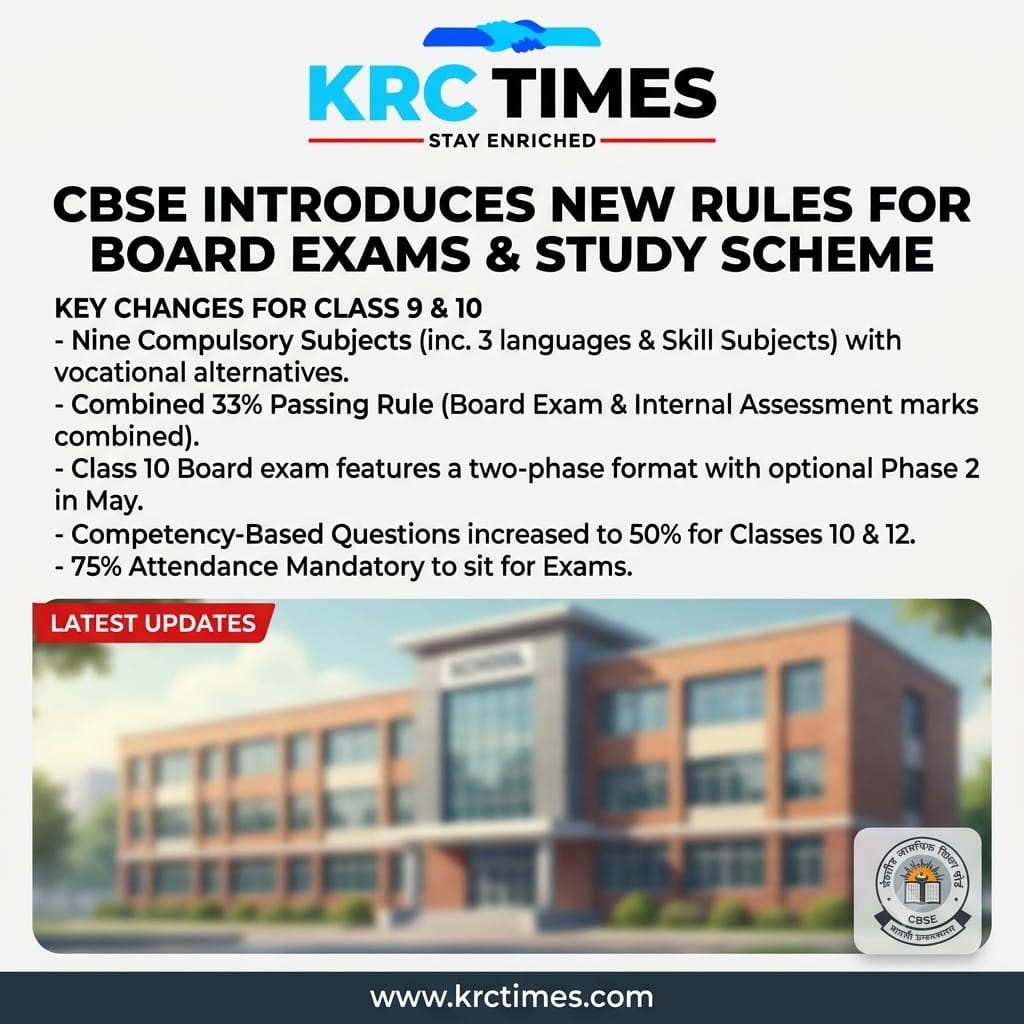
The Central Board of Secondary Education (CBSE) has rolled out major curriculum, examination, and evaluation reforms—most notably the revised Scheme of Studies for Class 9 (2026–27) and Class 10 (2027–28) issued on October 29, 2026, alongside ongoing board examination structural updates.
1. Revised Class 9 & 10 Scheme of Studies (October 2026 Circular)
(Note: These rules apply to the 2026–27 Class 9 batch appearing for Class 10 Boards in 2027–28. Students in Class 10 during the 2026–27 session continue under the existing scheme.)
- Nine Compulsory Subjects: Students in Class 9 must study nine compulsory subjects: three languages (R1, R2, R3), Mathematics, Science, Social Science, Art Education, Physical Education & Well-being, and Vocational Education. At least two of the three languages must be native Indian languages (Bharatiya Bhashas).
- Compulsory Vocational Education (2 Choices): Students must select either Kaushal Vikas or one of 22 prescribed Skill Subjects (such as AI, Data Science, Information Technology, Financial Markets, Retail, Healthcare, Tourism, or Design Thinking).
- Optional & Advanced Subjects: Students can opt for one additional subject from a list of 57 options (e.g., Computer Applications, Home Science, Painting, NCC, or a fourth distinct language), as well as Mathematics Advanced or Science Advanced.
- Dropped Components: CBSE has dropped three previously planned curricular components for this batch: Environmental Education, Individuals in Society, and the standalone Computational Thinking & AI interdisciplinary module.
2. Passing Criteria & Subject Replacement Rules (Class 10)
- Combined 33% Passing Rule: To pass, students must secure at least 33% marks in each of the five compulsory Board exam subjects (R1, R2, Maths, Science, Social Science). The 33% is calculated by combining Board Exam and Internal Assessment marks (e.g., scoring 24/80 in theory and 9/20 in internal assessment equals 33/100, which counts as a pass).
- Skill Subject Replacement: If a student fails in Mathematics, Science, or Social Science (scoring below 33%) but passes their chosen Board-examined Skill Subject (from the 22 notified subjects), the skill subject will replace the failed subject in the final result computation. (Note: This replacement benefit does not apply if the student chose Kaushal Vikas.)
- Language Replacement: If a student fails in either Language R1 or R2, a passed optional language (which must be distinct from R1, R2, and R3) can replace the failed language.
3. General Board Exam & Evaluation Rules (Classes 10 & 12)
- Two Board Exams a Year for Class 10: Class 10 Board exams follow a two-phase format. Phase 1 (February–March) is mandatory for all students. Phase 2 (May) is an optional improvement exam where students who passed Phase 1 can re-attempt up to three subjects (from Science, Maths, Social Science, and Languages). The best score of the two attempts is retained. Class 12 remains a single annual exam.
- 50% Competency-Based Paper Pattern: For both Classes 10 and 12, question papers are structured to test conceptual application rather than rote memorization:
- 50% Competency-Based Questions: Case studies, source-based integrated questions, data interpretation, and real-life situational problems.
- 20% Objective Questions: Multiple Choice Questions (MCQs).
- 30% Constructed Response: Short and long descriptive answer questions.
- Strict Section-Wise Answering (Class 10 Science & Social Science): Answer sheets for Science and Social Science are divided into compulsory subject-specific sections. Answers written in the wrong section will not be evaluated and will be marked as “Attempt Not Done.”
- Mandatory 75% Attendance: Students must maintain at least 75% attendance to be eligible to sit for the Board examinations.
- Digital Evaluation & Registration: CBSE utilises On-Screen Marking (OSM) where physical answer scripts are scanned and evaluated digitally to prevent totaling errors and speed up results. Additionally, registration via the Pariksha Sangam portal alongside student APAAR IDs is mandatory for Classes 9 through 12.