“Today if we had sea access we would no longer be worried about the Chicken’s Neck [Siliguri Corridor],” Manikya noted, emphasizing how the loss of Chittagong strategically isolated India’s northeastern states.
 KRC TIMES National Bureau
NEW DELHI:
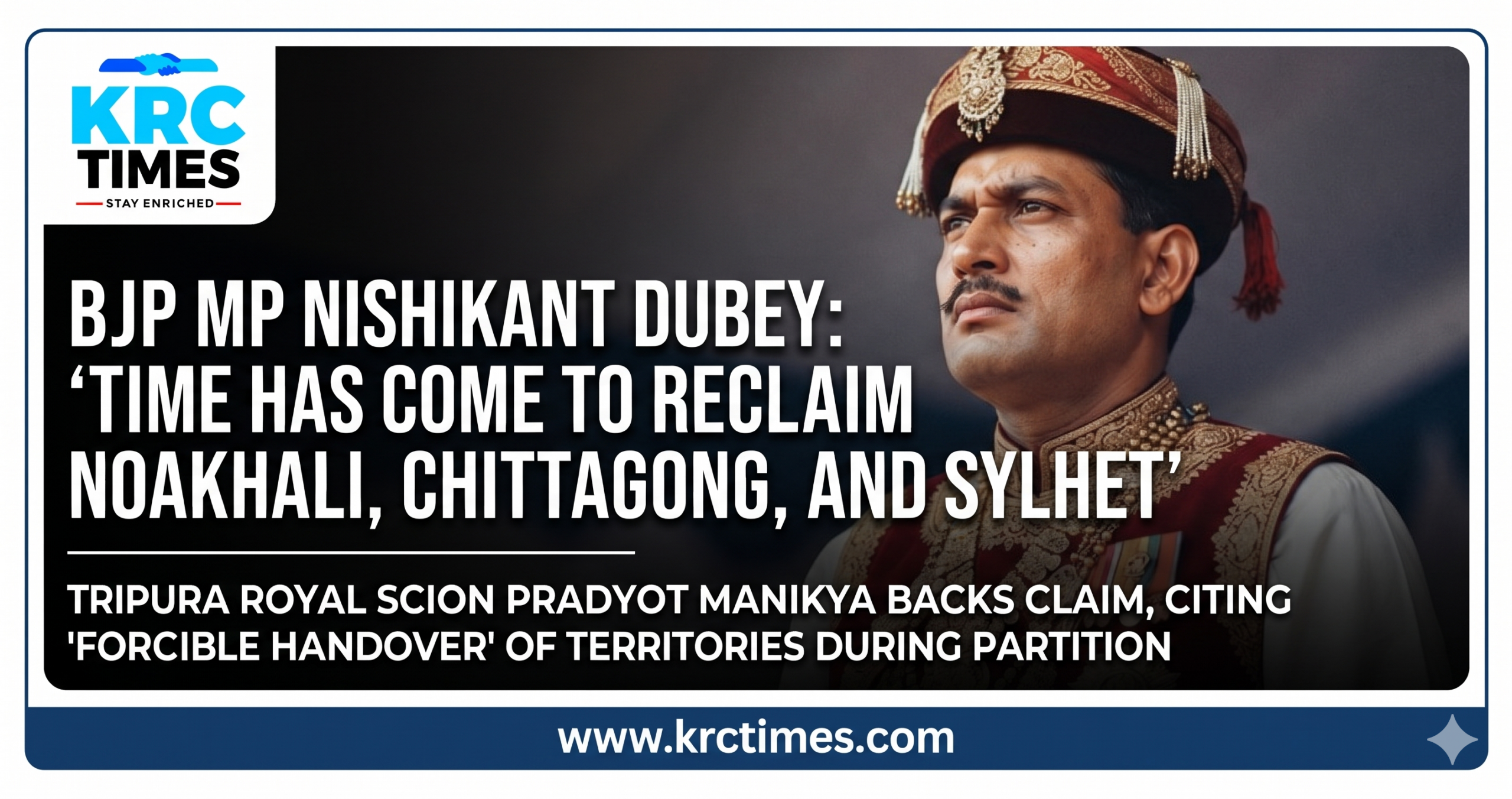
In statements that have ignited a fresh political controversy, Bharatiya Janata Party (BJP) Lok Sabha MP Nishikant Dubey asserted that the time has come for India to “reclaim” the regions of Noakhali, Chittagong Port, and Sylhet—territories that are currently part of Bangladesh (formerly East Pakistan).
Speaking to news agencies, Dubey blamed India’s first Prime Minister, Jawaharlal Nehru, alleging that the decision to cede these regions during the 1946–47 period was driven by political expediency to secure the Muslim League’s backing in the interim government.
Key Highlights of the Controversy
- The Core Claims: Dubey stated that alongside calls to reclaim Pakistan-occupied Kashmir (PoK), India should look back at territories “forcibly handed over” or ceded during the Partition, specifically targeting Noakhali, Chittagong Port, and Sylhet.
- Criticism of Jawaharlal Nehru: The BJP MP accused Nehru of prioritising his political positioning in the 1946 interim government over territorial integrity, claiming that the erstwhile ruler of the Tripura Kingdom, Bir Bikram Kishore Manikya, fiercely opposed decisions concerning Noakhali, Sylhet, and Chittagong.
- Impact on Northeast India: Dubey argued that losing direct access to the Chittagong Port crippled the economic development and connectivity of Northeast India, keeping the region landlocked.
Support from Tripura Royal Scion Pradyot Manikya
Dubey’s remarks drew immediate backing from Pradyot Manikya Debbarma (Pradyot Manikya), the founder of the Tipra Motha Party and descendant of the Tripura royal family.
Weighing in on the historical debate, Pradyot stated that extensive parts of the erstwhile Tripura Kingdom were seceded to East Pakistan “keeping [his] grandmother in the dark during Partition,” calling it one of the darkest chapters in the nation’s history.
“Today if we had sea access we would no longer be worried about the Chicken’s Neck [Siliguri Corridor],” Manikya noted, emphasizing how the loss of Chittagong strategically isolated India’s northeastern states.
Historical Context Raised by the Leaders
- The 1946 Interim Government and Partition Pressures: Dubey pointed to the volatile political climate of 1946—noting events like the Noakhali riots—and argued that political concessions made at the time bypassed local sovereignty and the opposition mounted by King Bir Bikram Kishore Manikya of Tripura.
- The Access to the Sea Debate: Regional leaders have frequently argued that the separation of Chittagong during Partition deprived the Northeast of a natural maritime outlet, rendering the region heavily dependent on the narrow Siliguri Corridor (“Chicken’s Neck”) for transit to the rest of India.
The statements are expected to draw sharp reactions and fuel intense debates across political circles regarding historical partition decisions, bilateral relations, and regional connectivity in South Asia.
Promotional | Subscribe Bangla e-copy @KRC TIMES