


The larger issue is that air quality monitoring must serve public health, not merely statistical uniformity
 KRC TIMES Desk
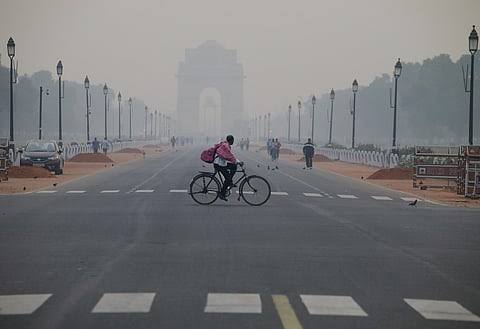
When pollution crosses the limits of the monitoring system, the problem is not merely a technical gap. It raises a larger question about whether the country’s air quality data can adequately reflect the risks people are breathing.
Delhi’s post-Diwali pollution crisis has exposed an uncomfortable contradiction in India’s air quality monitoring system. At a time when residents are struggling to breathe under a blanket of toxic smog, some of the monitoring stations have failed to reflect the full extent of the pollution in their official readings. The reason is not necessarily a failure of the instruments to detect pollutants, but a decade-old data validation framework that cannot adequately process extreme readings.
The Central Pollution Control Board (CPCB) introduced the National Air Quality Index (NAQI) in 2015, when particulate matter analysers were calibrated to measure concentrations between zero and 1,000 micrograms per cubic metre. Under the existing automated validation system, hourly readings exceeding this range are classified as out-of-range and excluded from AQI calculations. Consequently, when pollution levels rise beyond the prescribed threshold, the official data may show gaps precisely when accurate information becomes most critical.
This is more than an administrative or technical inconvenience. Air quality data is the foundation on which public warnings, emergency restrictions and health advisories are issued. If the monitoring framework cannot properly accommodate extreme pollution episodes, the reliability of the information available to policymakers and citizens comes into question.

The scale of the problem became evident after Diwali, when reports indicated that 45 of Delhi’s 59 monitoring stations had recorded missing hourly readings for at least one pollutant. Environment Ministry sources have clarified that the readings were available but were not being included in the AQI calculations because they exceeded the system’s calibrated range. In other words, the pollution was being detected, but the existing methodology was unable to incorporate it into the official index.
The distinction matters. A missing reading can easily be mistaken for missing data, while the actual problem lies in the rules governing its use. Yet, from the perspective of an ordinary citizen checking the AQI to assess the danger outdoors, the distinction offers little reassurance. What matters is whether the published figures accurately communicate the severity of the situation.
The CPCB has defended its methodology, pointing out that the AQI is designed to assess exposure over time rather than react to momentary fluctuations. Its 24-hour running average requires at least 16 hours of available readings for most pollutants to generate a sub-index. The board has also maintained that an AQI of 500 already represents the highest health concern category, and that extending the numerical scale would not change the assigned ‘Severe’ classification.
There is a scientific rationale behind standardised measurement and averaging. Instantaneous readings can fluctuate, and comparisons between monitoring systems require consistent methods. However, scientific consistency should not become an excuse for allowing an outdated framework to remain unchanged when pollution patterns and monitoring technologies have evolved.
The contrast between infrastructure expansion and methodological stagnation is particularly striking. India’s network of continuous ambient air quality monitoring stations has increased from 30 in 2014-15 to 634. Delhi’s network has expanded from 10 to 59 stations. Monitoring instruments have also undergone upgrades. Yet, according to Environment Ministry sources, the underlying data validation methodology has remained largely unchanged.
This raises an obvious question: what is the purpose of expanding the monitoring network and investing in sophisticated equipment if the system cannot adequately process the data generated during the most extreme pollution episodes?
The CPCB has acknowledged that its methodology is under review and that internal discussions are underway on how readings beyond the existing measurement range should be handled. However, the absence of a formally constituted external expert group suggests that the review process has yet to acquire the institutional depth it requires.
India needs an independent scientific assessment involving atmospheric scientists, public health experts, monitoring specialists and environmental researchers. Such a review should examine not only the upper measurement limits but also the treatment of extreme readings, averaging periods, data gaps and the communication of health risks. International practices should be considered, but the revised framework must also reflect India’s distinctive pollution patterns and urban conditions.

Another concern is the growing difference between readings published by government monitoring stations and those displayed on private air quality platforms. The CPCB attributes these variations to differences in measurement techniques, averaging periods and sensor quality. While these explanations deserve consideration, the public should not be left navigating conflicting figures without a clear understanding of what each measurement represents.
Transparency must therefore be central to any reform. Individual pollutant concentrations, out-of-range readings and the reasons for their exclusion should be clearly disclosed. An extreme reading should not simply disappear from public interpretation because it falls outside an existing calculation framework. Even if it cannot be incorporated directly into the standard AQI, it should trigger an appropriate warning indicating that pollution has exceeded the system’s measurement threshold.
The larger issue is that air quality monitoring must serve public health, not merely statistical uniformity. An index is useful only when it communicates the danger accurately. A system that continues to report the highest pollution category without adequately explaining how far concentrations have exceeded the prescribed limits risks reducing a serious public health emergency to a numerical classification.
Delhi’s pollution crisis is not going to be resolved by changing an algorithm or extending the measurement range alone. Vehicular emissions, industrial pollution, construction dust, waste burning, crop residue burning and other sources require sustained policy intervention. But effective action begins with reliable information.
The CPCB’s acknowledgement of the limitations of its existing framework should be treated as an opportunity for urgent reform, not another round of official deliberations. The 2015 methodology was designed for the circumstances and technology of its time. A decade later, it must be reassessed against present realities.
When the air becomes too polluted for the monitoring system to measure properly, the failure is not merely technological. It is a warning that public policy has fallen behind the scale of the crisis.

