


Memories of an Anglo-Indian childhood in Assam’s tea gardens
 KRC TIMES Desk
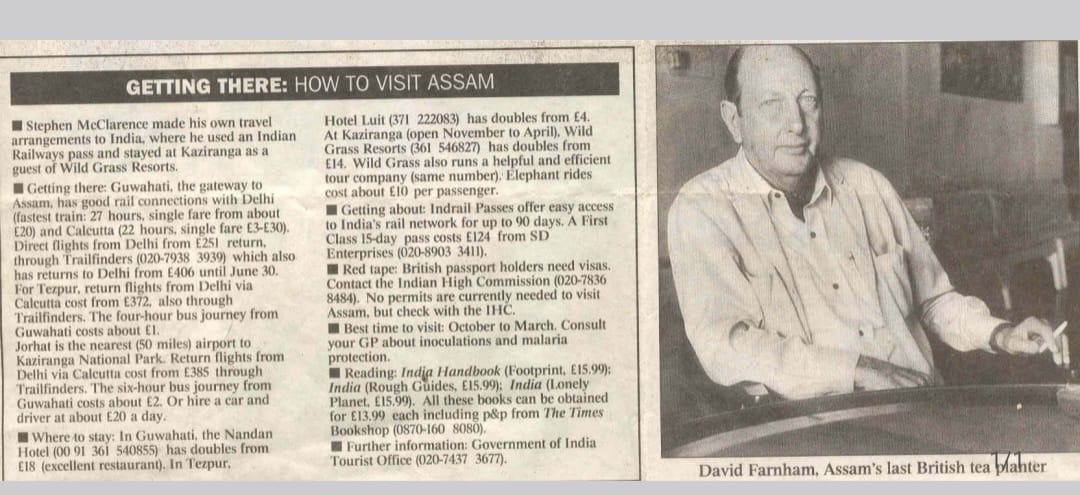
Geoffrey Farnham
A World Between Tea and Forest
Assam’s tea gardens have long been associated with plantations, managers’ bungalows, labour lines, clubs and the rhythms of estate life. Yet, for those who grew up among the tea bushes, they were also places of extraordinary natural beauty: dense forests, winding roads, elephants, birds, rivers and wildlife. For one Anglo-Indian family, the tea gardens of Assam were not merely a workplace. They were home.
This is a personal recollection of that world, seen through the childhood memories of Geoffrey Farnham, whose father, David William Farnham, was among the last British tea planters in Assam. It is also a tribute to E.P. Gee, a British-born naturalist whose work helped change the way India understood and protected its wildlife.
E.P. Gee: From Tea Planter to Conservationist
Edward Pritchard Gee, better known as E.P. Gee, arrived in Assam’s Golaghat district as an assistant manager at Doyang Tea Estate. Like many planters of his generation, he began his career within the colonial tea industry. Unlike many, however, he became one of India’s most important early wildlife conservationists.
Gee eventually became manager of the estate and lived in its bungalow until his retirement. But his lasting contribution lay beyond tea. At a time when hunting was often regarded as a normal part of planter life, Gee helped represent a major shift: from the hunter-shooter to the careful observer and protector of wildlife.
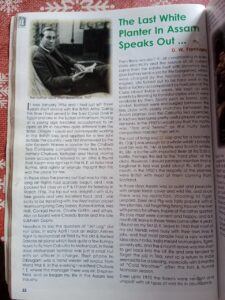
He is credited with the discovery of the golden langur, a striking primate found along the Assam-Bhutan border. He also played an important role in the campaign to upgrade Kaziranga from a game sanctuary into a wildlife sanctuary. Gee even guided Prime Minister Jawaharlal Nehru through Kaziranga on elephant back, helping bring national attention to the park and its remarkable wildlife.
Gee wrote the classic book *Wildlife of India*, for which Nehru wrote the foreword. Beyond conservation, he was deeply connected to local society. He served as an honorary lecturer in English at Debraj Roy College in Golaghat and contributed to local schools and religious institutions, including the Namghar at Kunwari Village.
After retiring from the tea gardens, Gee chose to remain in the North East and settled in Shillong, then the capital of undivided Assam, at a residence known as Green Cottage. Although he died in London, his heart remained in the riverine forests of the Brahmaputra.
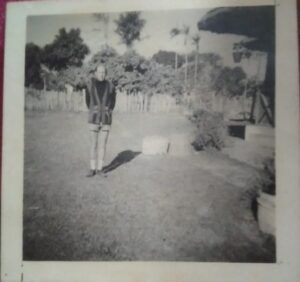
Gee’s life reminds us that the tea planters of the North East were not only industry pioneers. Some became early scientific observers of the region’s extraordinary biodiversity, helping lay the foundations for the conservation movement that followed.
A Childhood Among Tea Bushes
My father, David William Farnham, was a well-known name in tea circles and one of the last British tea planters in Assam. After completing his short-service commission in the British Army, he joined the tea industry in the 1950s.
At that time, many British and Scottish managing agency houses operated primarily from Calcutta and London, managing tea gardens across Assam. Names such as James Finlay, James Warren, Gillanders, Walter Goodricke and Duncans, Balmer Lawrie and Octavius Steel were familiar throughout the industry. Many continued to play an important role until the 1960s.

My father was also a keen sportsman, excelling at rugby and football. Many people connected with the tea industry in the Dooars and Assam during the 1950s to 1970s would remember his sporting ability.
My mother was an Indian woman from Assam, and I was born in 1972 in a tea garden near Tezpur in Sonitpur district. That makes me a first-generation Anglo-Indian. I was later sent to boarding school in Shillong, but my childhood remained deeply rooted in the tea gardens.
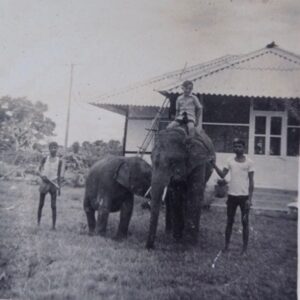
I grew up surrounded by tea bushes, colonial bungalows, estate staff, traditional khana-pinas prepared by trained cooks, clubs and even elephant rides. Some gardens kept elephants for estate work. I fondly remember riding an elephant to the Borsola Club near our garden during the Christmas and New Year season.
Wildlife at the Doorstep
Wildlife was abundant in those days. Chinese ferret badgers, pygmy hogs and a wide variety of birds were frequently seen. Around our bungalow stood a few betel nut trees, or areca palms, where weaver birds built their nests from dawn to dusk, chirping continuously.
Tea garden workers sometimes brought us unexpected surprises: a large python, or an almost-white owl that may have been an Eastern Grass Owl. Jackals, foxes, tigers and leopards were not unusual sights. Flora and fauna thrived, and life often seemed like a scene from Rudyard Kipling’s *The Jungle Book*.
Returning to the garden bungalow from boarding school for the holidays was always eagerly awaited. My parents kept two chowkidars to guard the ripening lychees from birds so that we children could enjoy the fruit ourselves.
My brothers and I would feast on lychees with such enthusiasm that we often ended up suffering from hot boils after overeating. It was a small price to pay for one of the great pleasures of a tea-garden childhood.
The Elephant in Musth
One memory remains particularly vivid. I once saw an aggressive and restless wild makhna—a tuskless adult male elephant—in musth. With testosterone levels at their peak, the elephant approached our bungalow, breaking branches and attempting to topple a tea-shade tree.
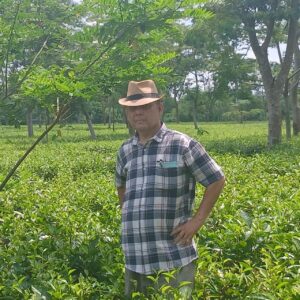
It was a frightening and unforgettable sight. I was fortunate to witness such a powerful moment of wild nature so close to home. Only now, with the passage of time, do I fully understand how rare and extraordinary such experiences were.
A Hundred Elephants at Dusk
In the early 1980s, my family—my father, mother, two brothers and I—was returning home to our garden from Tezpur town. At that time, Tezpur was the district headquarters of Darrang district. In 1983, when Darrang was bifurcated, Tezpur became the headquarters of Sonitpur district.
We were running late, and dusk was settling in. My father decided to take a shortcut near the outer division of our main garden. We had to cross a kachcha road; most garden roads were unpaved in those days, although many have since been paved.

The road was flanked by dense Assam jungle on both sides. Our Mahindra jeep’s headlights cut through the darkness of the narrow road. Suddenly, my father had to stop. A herd of elephants—no fewer than a hundred, of different sizes and ages—was crossing the road.
It felt as though time had stood still. We watched, captivated, as the herd moved unhurriedly across the road: majestic, graceful and entirely indifferent to our presence. Elephants are often more active after dark, when the air is cooler and human activity is reduced.
The sight was exhilarating, but also a little frightening. We waited patiently until the last elephant, a large adult male, had crossed. Only then did we continue our journey. Although we were late, the memory of that magnificent spectacle remains priceless—one that money simply cannot buy.
Golden Frogs and Sunday Rides
On another occasion, I was fortunate enough to see hundreds of male Indian bullfrogs resting beside a pond within the tea estate. During the breeding season, these frogs turn a brilliant yellow. I watched them basking in the afternoon sun, their skins shimmering with a golden sheen. It was a truly magical sight.
I am grateful to my father, who often took me along on his Rajdoot motorcycle during his Sunday afternoon outings. He loved motorcycles because they could take him into the remote corners of the tea garden, places that four-wheel-drive vehicles could not reach. In fact, he rode a motorcycle until the age of 74.
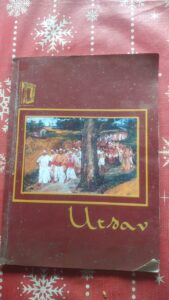
There were no mobile phones then, and cameras were brought out only on special occasions. What a pity that a photograph could not have captured that moment forever.
A Life Worth Remembering
In short, this was the typical Anglo-Indian life in an Assam tea garden—quite different from the Anglo-Indian experience elsewhere. It was a life of tea, bungalows, clubs, servants, trained cooks, boarding schools, sports, wildlife, elephants, Christmas celebrations, family and the timeless rhythm of the Assam tea country.
It was also a life closely connected to the land. The forests, rivers, birds and animals were not distant attractions. They were part of everyday life, sometimes beautiful, sometimes dangerous, and always unforgettable.
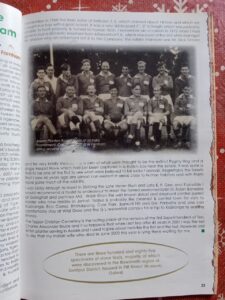
Men such as E.P. Gee helped ensure that this extraordinary world would be seen not merely as a backdrop to plantation life, but as a natural inheritance worth understanding and protecting. Today, as Assam continues to balance development, agriculture and conservation, those early connections between people, tea and wildlife remain an important part of its story.
I loved those good old days of tea life—and I am grateful that their memory remains so vivid.
— Geoffrey Farnham, Assam, India
About the Author
Geoffrey Farnham is a first-generation Anglo-Indian who was born in an Assam tea garden near Tezpur in 1972. His father, David William Farnham, was a British tea planter in Assam and the Dooars. Geoffrey’s writing draws on his childhood memories of tea-garden life, wildlife and the Anglo-Indian community of North East India.