


Political Promises, Mounting Debt and the Cost to India’s Future
 KRC TIMES Desk
S.DUTTA
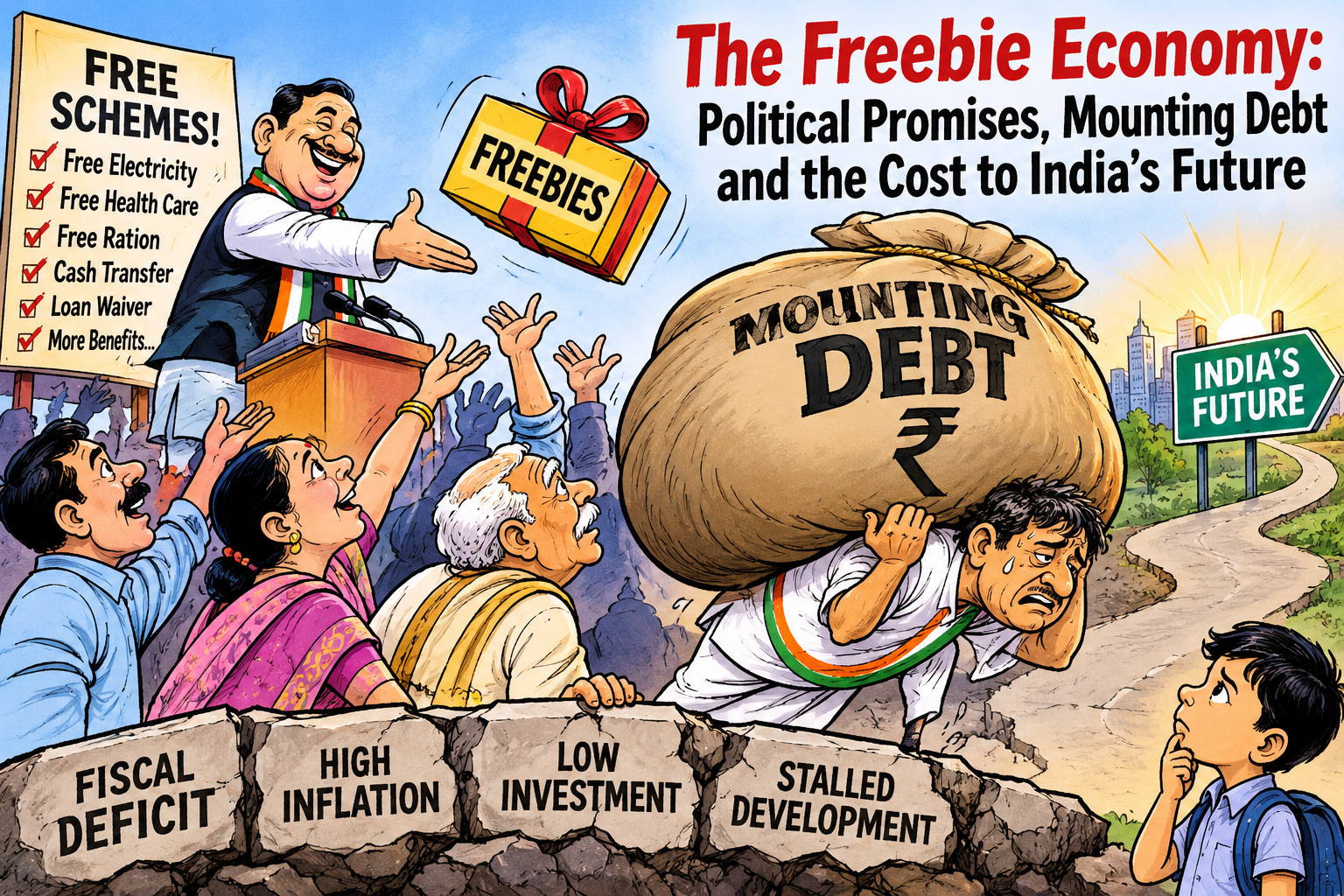
The growing competition among political parties to offer free electricity, consumer goods and loan waivers is raising concerns over fiscal discipline, employment generation and the long-term sustainability of India’s economic growth.
The politics of free benefits has become an increasingly prominent feature of India’s electoral landscape. From free electricity and farm loan waivers to household appliances, laptops and subsidised pilgrimages, political parties are competing to offer increasingly attractive benefits to voters. What is presented as social welfare, however, raises a larger question: how much can governments distribute without undermining their financial stability and development priorities?
Welfare spending is an essential responsibility of a democratic government. Free or affordable education, accessible healthcare, food security and social protection for vulnerable communities are important instruments for reducing inequality. Such expenditure can strengthen human capital and create opportunities for people who otherwise remain excluded from economic progress.
The problem arises when welfare policies become electoral instruments rather than components of a clearly defined development strategy. Distributing consumer goods and providing unlimited subsidies without assessing their long-term financial implications can place considerable pressure on public finances. The distinction between genuine social protection and politically motivated giveaways therefore deserves greater attention.
The growing culture of competitive populism is not restricted to regional political parties. National parties, including the BJP and Congress, have also relied on welfare promises and direct benefits to strengthen their electoral appeal. As a result, the debate is no longer about which political party offers more benefits, but whether governments are adequately accounting for the costs of their commitments.
The growing pressure on state finances
The financial consequences of populist spending are particularly visible in several Indian states. A Reserve Bank of India assessment has identified Bihar, Kerala, Punjab, Rajasthan and West Bengal among states facing significant fiscal stress, taking into account their debt-to-GSDP positions and other financial vulnerabilities.
The debt figures cited for 2021-22 were particularly concerning. Punjab’s debt-to-GSDP ratio stood at 53.3 per cent, followed by Rajasthan at 39.8 per cent, West Bengal at 38.8 per cent, Kerala at 38.3 per cent and Andhra Pradesh at 32.4 per cent. These figures highlighted the growing gap between state borrowing and economic output.

High public debt cannot be attributed exclusively to freebies. Interest payments, salaries, pensions, infrastructure expenditure, revenue constraints and other structural factors also contribute to fiscal pressure. Nevertheless, expanding subsidies and recurring electoral commitments can make the situation more difficult, particularly when state revenues fail to grow at the same pace.
Another concern is the growing reliance on off-budget borrowing. Some state governments use public-sector enterprises and other government-linked entities to raise funds, with future government revenues or guarantees supporting these liabilities. Such arrangements can make the immediate budgetary position appear healthier than the underlying financial reality.
Ultimately, these obligations do not disappear. They return to the public exchequer in the form of repayment commitments, interest payments or additional financial support. Greater transparency in accounting for such liabilities is therefore essential.
Punjab offers an important example of the challenges involved. Despite its substantial debt burden, the state continues to maintain significant electricity subsidies. The Aam Aadmi Party government introduced its promise of 600 units of free electricity per billing cycle from July 2022, with a large number of households subsequently benefiting from the scheme. While the measure provides immediate relief to consumers, its long-term financial implications need to be assessed alongside the state’s revenue position and other development priorities.
The central issue is not whether poor households should receive assistance, but whether such assistance can be sustained without compromising investment in infrastructure, education, healthcare and employment generation.
Lessons from Latin America’s economic experience
India’s growing dependence on electoral welfare promises also brings to mind the economic experience of several Latin American countries.
During much of the twentieth century, populist governments in the region expanded public spending to address inequality and build political support among working-class populations. Leaders such as Brazil’s Getúlio Vargas and Argentina’s Juan Perón became prominent figures in this political and economic landscape.
However, in several countries, prolonged fiscal expansion, weak revenue mobilisation and excessive dependence on public borrowing contributed to serious economic instability. By the 1980s, parts of Latin America were struggling with mounting fiscal deficits, unsustainable debt and high inflation.
The period became widely known as the region’s ‘Lost Decade’. Economic growth slowed sharply, inflation eroded household savings and poverty increased. Brazil, Argentina and Mexico experienced different combinations of these difficulties, demonstrating how prolonged macroeconomic imbalances can undermine the very welfare objectives governments seek to achieve.
India’s economic circumstances are different, and the Latin American experience should not be treated as a direct prediction of India’s future. Nevertheless, it offers an important lesson: welfare commitments that are not supported by sustainable revenues and productive economic activity can eventually become a burden on the people they are intended to help.
Fiscal discipline and social protection are not necessarily competing objectives. The challenge is to ensure that welfare expenditure contributes to long-term economic resilience rather than creating permanent financial liabilities.
Employment generation must remain the priority
One of the most important concerns surrounding the freebie debate is the question of employment. Direct financial assistance and subsidies can provide immediate relief to economically vulnerable households, but they cannot substitute for stable employment and opportunities for income generation.
A government that focuses excessively on distributing benefits without creating adequate employment opportunities risks perpetuating economic dependence. Young people need quality education, vocational training, industrial opportunities and access to markets. Farmers require better infrastructure, technology, irrigation and reliable market linkages. Small businesses need affordable credit and a predictable policy environment.

Public expenditure should therefore prioritise investments that expand the productive capacity of the economy. Infrastructure development, healthcare, education, agricultural modernisation and industrial growth generate benefits that extend beyond individual households.
This does not mean that every subsidy is economically wasteful. Targeted assistance can improve productivity and consumption, particularly among poorer sections of society. The distinction lies in whether a scheme addresses a clearly identified social or economic need and whether its benefits justify its cost.
The need for accountability and fiscal transparency
The growing competition over welfare promises also raises questions about political accountability. Electoral victories give governments the authority to implement policies, but they do not remove their responsibility to manage public money prudently.
Before announcing expensive schemes, governments should disclose their estimated costs, funding arrangements and long-term implications. Independent fiscal assessments, transparent budgetary reporting and regular performance audits can help voters understand the actual price of political promises.
The judiciary, constitutional institutions, auditors, economists and the media also have important roles in strengthening public scrutiny. The objective should not be to discourage legitimate welfare spending but to ensure that public resources are used efficiently and that governments remain accountable for their financial decisions.
A stronger framework for monitoring state guarantees, public-sector borrowing and contingent liabilities would also help prevent governments from concealing the real cost of their commitments.
India’s development ambitions require sustained investment, sound public finances and a capable workforce. Governments cannot build a competitive economy merely by expanding consumption subsidies. Nor can fiscal prudence become an excuse for withdrawing essential support from vulnerable citizens.
The real challenge is to strike a balance between immediate social protection and long-term economic development. Welfare policies must empower people to become economically secure, rather than leave governments trapped in an endless cycle of electoral promises and borrowing.
Ultimately, the success of a government should not be measured by the number of free benefits it announces before an election. It should be judged by the quality of public services it delivers, the employment opportunities it creates, the strength of its economy and the financial stability it leaves for the next generation.