

Modi’s Leadership Faces a New Test
 Sangram Datta
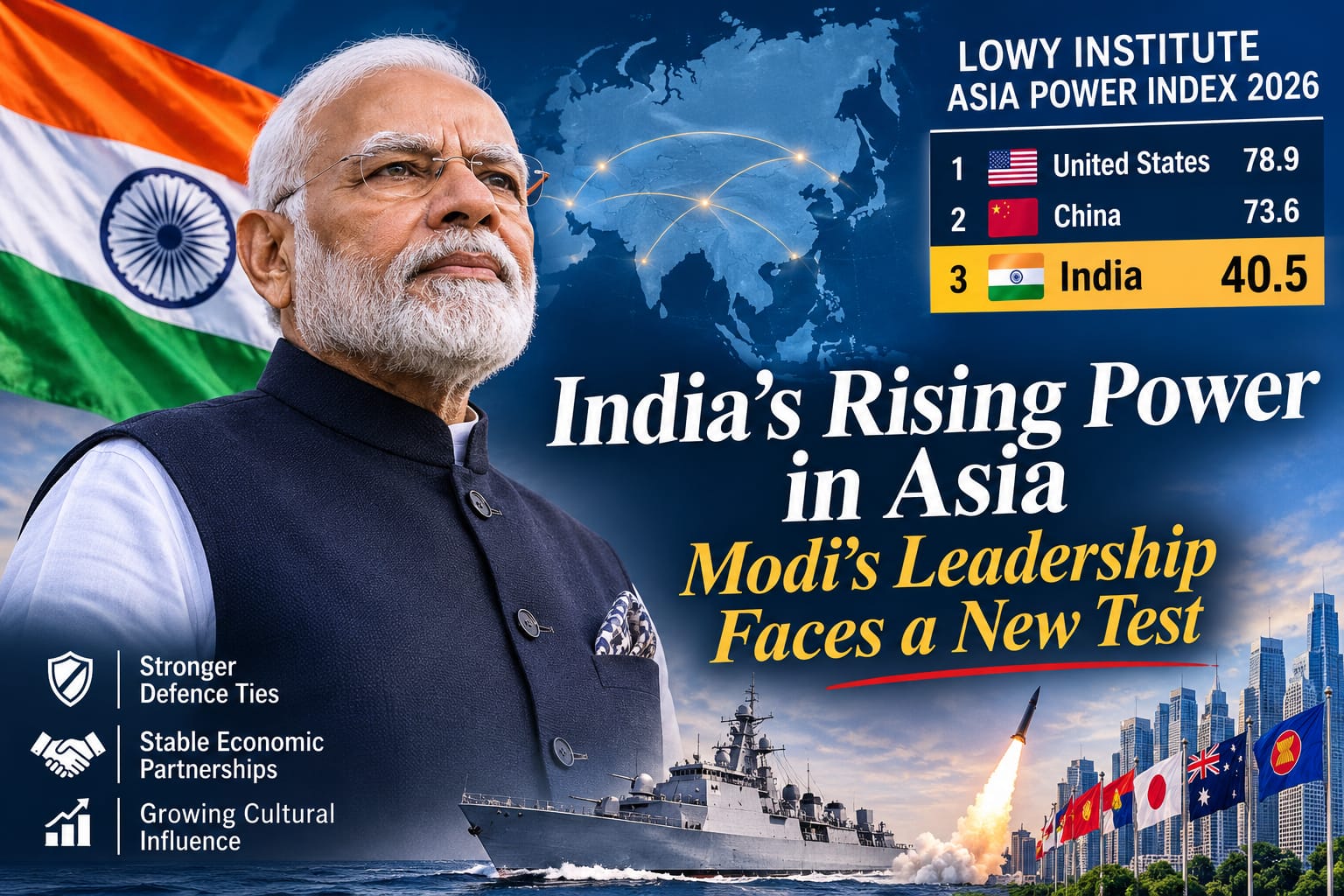
India’s growing influence across Asia is becoming increasingly difficult to ignore. The latest Lowy Institute Asia Power Index 2026 confirms that the country has retained its position as Asia’s third most powerful nation, reinforcing its emergence as a major regional powerhouse. More significantly, Prime Minister Narendra Modi has been ranked the second-most effective regional leader, behind China’s Xi Jinping.
The findings reflect a country steadily expanding its strategic influence at a time when Asia’s geopolitical landscape is undergoing profound change. With a power score of 40.5 out of 100, up 0.5 points from the previous year, India is consolidating its position among the region’s most influential players. Its narrowing power gap with China, the smallest since 2018, is another indication of its growing regional weight.
The United States and China continue to dominate the Asian power landscape, scoring 78.9 and 73.6 respectively. Yet India’s position is particularly significant because it has strengthened its influence despite facing considerable domestic economic and political challenges.
One of the most encouraging developments is India’s expanding defence engagement with Southeast Asia. Its BrahMos missile exports and growing military cooperation with regional partners have strengthened its defence networks, demonstrating that New Delhi is increasingly prepared to translate its strategic ambitions into tangible partnerships.
Equally important is India’s economic diplomacy. At a time when several countries have experienced weakening trade and investment relationships, India has managed to maintain relatively stable economic partnerships. This resilience has helped preserve its standing as a dependable regional partner.
The index also highlights a notable improvement in India’s cultural influence, which recorded the country’s biggest gain, rising by 2.3 points. Its defence networks improved by 2.1 points, while future resources and military capability registered gains of 1.2 and 0.5 points respectively.

However, India’s performance is not without weaknesses. Its economic capability score declined by 0.7 points to 26.4, highlighting the continuing challenge of converting its enormous economic potential into greater regional power. Although its cultural influence reached 43.8 and diplomatic influence stood at 70.3, economic competitiveness remains an area requiring sustained attention.
Modi’s ranking as the region’s second-most effective leader is another important feature of the report. It reflects India’s diplomatic visibility and the prime minister’s influence in regional affairs. However, the assessment also points to the limitations of India’s international leadership, particularly its relatively low profile during the Gulf conflict, which affected perceptions of his global leadership.
This presents an important challenge for New Delhi. Economic growth, military modernisation and diplomatic engagement must go hand in hand if India hopes to become more than simply Asia’s third most powerful country. Its leadership ambitions will increasingly depend on how effectively it responds to international crises, builds trust with neighbouring countries and contributes to regional stability.
India’s rise also carries wider implications for the balance of power in Asia. As competition between Washington and Beijing intensifies, New Delhi has an opportunity to strengthen its position as an independent strategic actor. Its relationships with Southeast Asia, its expanding defence industry and its diplomatic engagement across the region could make it an increasingly important force in shaping Asia’s future.
Ultimately, the Lowy Institute’s 2026 findings offer India both recognition and a reminder. The country has made meaningful progress in strengthening its regional influence, but significant challenges remain. Retaining third place is an achievement; narrowing the gap with the two Asian superpowers will require a far more ambitious economic and diplomatic strategy.
India’s emergence as a major powerhouse is no longer just an aspiration. It is becoming a measurable reality. The real question now is whether New Delhi can turn that growing influence into lasting leadership across Asia.