


The Remarkable Journey of Dr. Thangjam Dhabali Singh
 KRC TIMES Desk
Sanjoo Thangjam
There are individuals whose lives are measured by the positions they occupy, the wealth they accumulate or the awards they receive. And then there are those whose contributions are better measured by the institutions they build, the opportunities they create and the difference they make in the lives of others. Dr. Thangjam Dhabali Singh belongs to the latter category.
His journey from Manipur to becoming a distinguished medical professional, entrepreneur, philanthropist and institution-builder is a story of perseverance, vision and an enduring commitment to his homeland. His achievements extend well beyond medicine, encompassing healthcare, hospitality, tourism, historical preservation and social responsibility. It is a journey that offers valuable lessons, particularly to the younger generation aspiring to make a meaningful contribution to society.
From medical science to a larger vision
Trained as a medical professional, Dr. Dhabali Singh specialised in Pathology, pursuing his medical education at the Regional Institute of Medical Sciences (RIMS), Imphal, and postgraduate studies at the Postgraduate Institute of Medical Education and Research (PGIMER), Chandigarh. His scientific training provided him with the foundation for a professional career, but his ambitions gradually extended beyond the conventional boundaries of medical practice.
He recognised a major challenge confronting Manipur: the limited availability of advanced diagnostic facilities. Patients often had to travel outside the State for specialised investigations, involving considerable financial expenditure, inconvenience and emotional stress for their families.
Rather than simply acknowledging this deficiency, he decided to address it through enterprise and initiative. This determination eventually became the foundation of what would grow into the BABINA Group.
BABINA: Building healthcare infrastructure in Manipur
The establishment of BABINA Diagnostics in 1983 was an important milestone in his professional journey. What began as a diagnostic initiative gradually developed into a recognised healthcare enterprise, contributing to the expansion of medical diagnostic services in Manipur.
The significance of this development goes beyond the growth of an institution. It demonstrated that quality medical facilities could be established and sustained within the State through professional competence, investment and a long-term vision.
Over the years, the group’s activities expanded into hospital services and specialised healthcare. Its association with AOI-BABINA Specialty Hospital has added an important dimension to the availability of specialised cancer care in the region.
In a State where patients and their families have frequently faced the hardship of travelling elsewhere for advanced treatment, such institutional initiatives have considerable social relevance. They also demonstrate the importance of private enterprise complementing public healthcare infrastructure.
Entrepreneurship beyond medicine
One of the remarkable features of Dr. Dhabali Singh’s career is his willingness to explore opportunities beyond his original profession.
Recognising the need for better hospitality infrastructure in Manipur, he ventured into the hotel industry. The development of The Classic Hotel and The Classic Grande contributed to the growth of organised hospitality in Imphal. His involvement in other hospitality and tourism initiatives, including Hotel Imphal and Sendra Resort, reflects his broader interest in promoting the State as a destination for visitors, investors and tourists.
These ventures have significance beyond commercial success. Hospitality infrastructure creates employment, supports allied businesses and provides facilities for visitors, professionals and delegates. For a State with considerable tourism potential, such investments can contribute to wider economic development.
His entrepreneurial journey demonstrates an understanding that the development of Manipur requires a diversified economic base, where healthcare, tourism, hospitality and other sectors can reinforce one another.
Preserving history and promoting international friendship
Another important dimension of Dr. Dhabali Singh’s contribution is his involvement in preserving the historical relationship between Manipur and Japan.
The Battle of Imphal during the Second World War remains a defining episode in the history of this region. The hills and valleys of Manipur witnessed immense suffering and sacrifice, but the conflict also created historical links between people of different countries.
Through initiatives associated with the Manipur Tourism Forum and collaborative efforts towards historical conservation, Dr. Dhabali Singh has contributed to bringing international attention to this shared history.
The Imphal Peace Museum at Maibam Lotpa Ching is an important example of how a place associated with wartime tragedy can be transformed into a centre for remembrance, education and peace.
The museum carries a message that transcends national boundaries: the lessons of war should encourage reconciliation and understanding rather than perpetuate hostility.
His contribution to India-Japan friendship received international recognition when the Government of Japan conferred upon him the Order of the Rising Sun, Gold and Silver Rays, in 2020. This honour acknowledged his contribution to strengthening relations between the two countries.
Success accompanied by social responsibility
The true worth of entrepreneurship is not determined solely by financial achievements. Its larger value lies in how it contributes to society.
Healthcare awareness and community-oriented initiatives associated with the BABINA Group, including screening and diagnostic programmes, have helped draw attention to the importance of early detection and preventive healthcare.
Such efforts are particularly relevant in Manipur, where awareness, affordability and accessibility remain important considerations in public health.

His involvement in social initiatives, support for vulnerable sections of society and employment generation also reflect a broader understanding of institutional responsibility.
In a State where unemployment and migration of educated youth remain serious concerns, institutions that create sustainable employment and professional opportunities are particularly valuable.
The next generation: Dr. Babina Thangjam
The story of Dr. Dhabali Singh also brings into focus his daughter, Dr. Babina Thangjam, who has pursued a professional career in medicine, specialising in Pathology, and is associated with BABINA Diagnostics.
Her professional involvement represents an important generational dimension of the family’s healthcare journey. The participation of women in medical leadership and institutional management is particularly significant in a society where their professional contributions deserve greater recognition and encouragement.
However, Dr. Babina’s identity should also be appreciated independently of her father’s achievements. Her medical qualifications, professional responsibilities and role in the healthcare sector constitute an important contribution in their own right.
The continuity of professional values across generations offers an encouraging example of how institutions can preserve their founding vision while adapting to changing healthcare needs.
An autobiography that records a journey
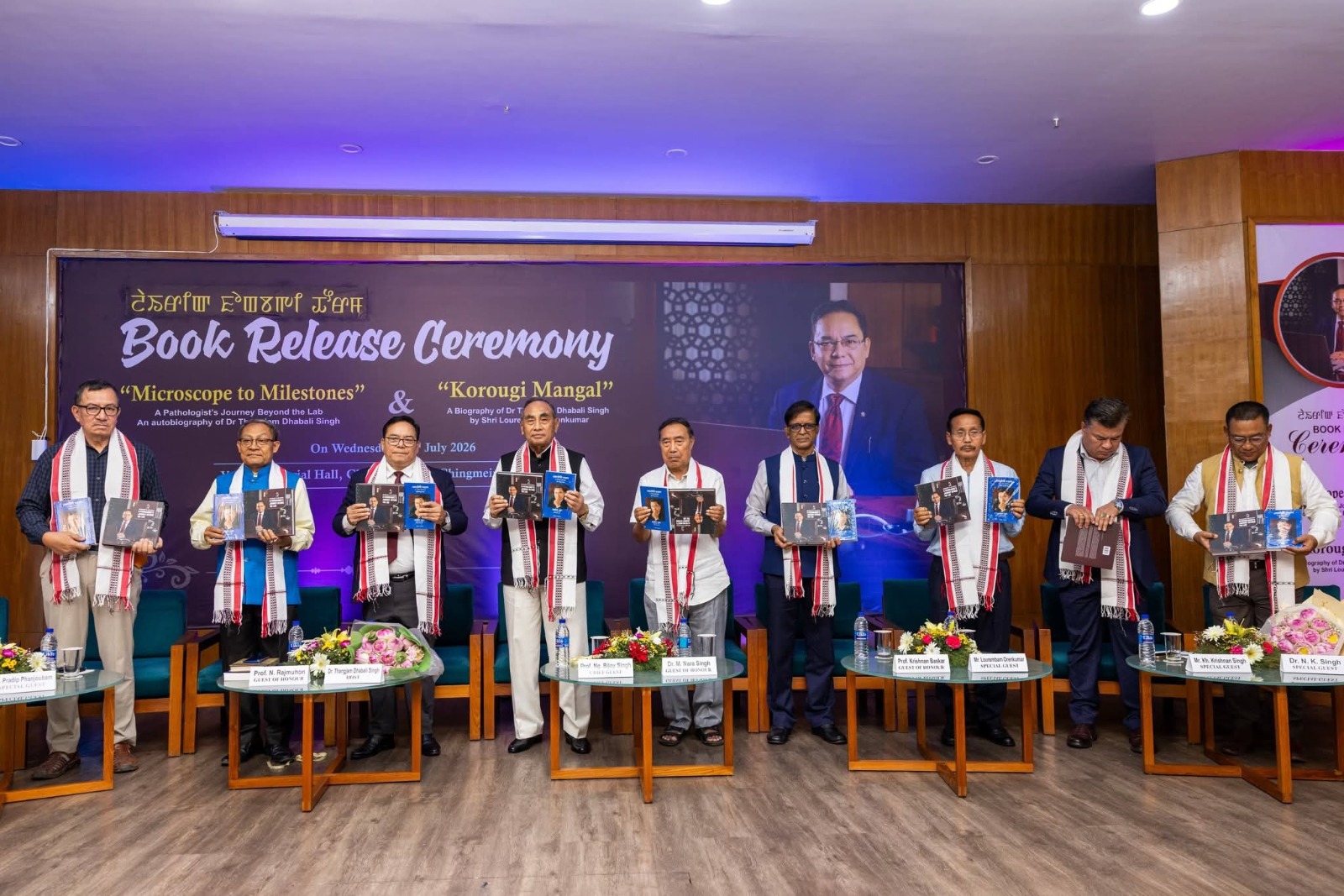
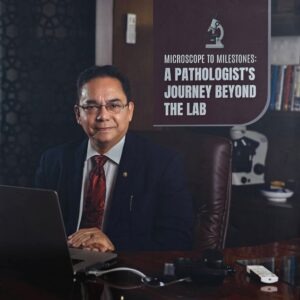
In 2026, Dr. Dhabali Singh’s autobiography, Microscope to Milestones: A Pathologist’s Journey Beyond the Lab, was released, offering readers an opportunity to understand the experiences and reflections behind his remarkable journey.
An autobiography is more than a documentation of achievements. It provides insights into the struggles, decisions, uncertainties and determination that shape an individual’s life.
For young people in Manipur, his story can offer lessons in perseverance, professional commitment, calculated risk-taking and the courage to pursue a vision even when circumstances are challenging.
His receipt of the 17th ONE India Award 2026 further recognises his contributions across different fields of endeavour.
A legacy beyond personal achievement
Manipur today needs visionary individuals who can build institutions, generate employment, strengthen healthcare and create opportunities for future generations. The journey of Dr. Thangjam Dhabali Singh offers an interesting example of how individual initiative can contribute to these larger objectives.
His life illustrates that professional knowledge need not remain confined to a particular discipline. When combined with entrepreneurial courage and social commitment, it can become a force for institutional and community development.
From a diagnostic laboratory to a diversified enterprise, from healthcare to hospitality, and from tourism promotion to the preservation of historical memory, his journey reflects an expansive understanding of development.
Ultimately, the legacy of Dr. Dhabali Singh should not be measured merely by the number of institutions he has established or the honours he has received. It should also be assessed by the opportunities created, the services made accessible and the inspiration his journey provides to those who wish to contribute to Manipur.
A microscope reveals the smallest details of life, but vision enables us to see possibilities beyond the immediate horizon. Dr. Thangjam Dhabali Singh’s journey from medical science to institution-building is a reminder that when knowledge is accompanied by determination and a sense of responsibility, one individual’s vision can leave a lasting imprint on society.
The writer is a Sub-Editor of The Morning Bell.