


“Are you listening?” she asked
“I am,” he replied, though his eyes remained fixed on his phone.
 KRC TIMES Desk
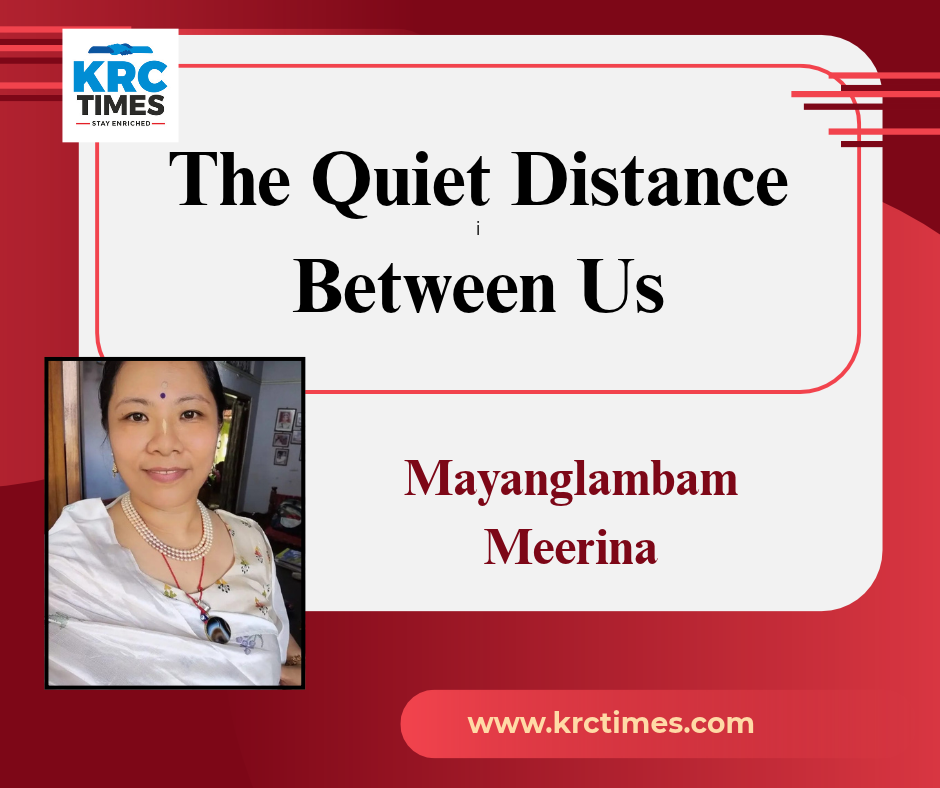
Mayanglambam Meerina Leimarenbi
There are moments when a family can sit in the same room and still feel miles apart.
Everyone may be physically present, yet each person is occupied with a separate world—one behind a phone screen, another inside a television programme, and someone else quietly waiting for a conversation that never begins.
This kind of distance does not always arrive through arguments. Sometimes, it grows through small habits: unanswered questions, distracted replies, postponed conversations and the repeated promise to talk later.
At first, nobody considers these moments serious.
A parent may think, “My child is busy.” A son or daughter may think, “I will make time tomorrow.” But tomorrow often becomes another day filled with responsibilities, notifications and distractions. Slowly, the conversations that once happened naturally begin to disappear.
Parents do not always ask for grand gestures. They may not expect expensive gifts, elaborate celebrations or constant attention. Often, they simply want to feel remembered.
They want to know that their presence still matters. A few minutes of genuine conversation can mean more to them than hours spent in the same room without attention. They may want to share a memory, describe something that happened during the day or ask a question whose answer they already partly know. The subject may seem ordinary, but the desire to connect is not.
As children grow older, they become busy building their own lives. They have careers, friendships, responsibilities and personal struggles. This is natural. Independence is part of growing up.
Yet, while children move forward, parents often remain emotionally connected to the years when family life was closer and more dependent. They remember the days when their children needed help with everything, called them frequently and shared even the smallest details.
When that closeness fades, parents may not always know how to express their loneliness. Some complain. Some become quiet.
Some stop asking.
“Why don’t you tell me when something is wrong?” a daughter asked one evening. Her mother smiled faintly. “I stopped asking for your time because I thought you had none to give.”
Her silence can be misunderstood as acceptance, when it may actually be disappointment. The painful truth is that people often recognise the value of someone’s presence only after that presence is no longer available. A conversation that once felt inconvenient may later become a cherished memory. A familiar voice may become something we would give anything to hear again.
This is why attention matters.
Listening is not merely hearing words. It is putting aside distractions long enough to make another person feel important. It is looking up, responding thoughtfully and allowing someone to finish speaking without making them feel like an interruption.
In a world that constantly demands our attention, giving someone our undivided presence has become a rare form of kindness. Technology is not the enemy. Phones, television and social media can provide entertainment, information and connection. The problem begins when they receive our best attention while the people beside us receive whatever remains.

A parent may not need us every hour. But when they reach out, we should remember that the opportunity may not remain forever.
There will always be another programme. Another message. Another update.Another task waiting to be completed.
But the person sitting beside us may not always be there to wait. Perhaps we should begin with small changes. Put the phone away during a conversation. Sit beside a parent without rushing. Ask about their day and listen to the answer. Call them before they have to call us. Visit them without needing a special occasion.
These actions may appear simple, but love is often preserved through simple actions repeated consistently.
Family relationships rarely disappear in one dramatic moment. More often, they weaken through years of neglect that seemed harmless at the time.
A missed conversation does not seem important. A delayed visit does not seem permanent. A distracted response does not seem cruel. But when these moments accumulate, they create an emotional distance that becomes difficult to cross.
We should not wait for a serious illness, a family crisis or a final goodbye to remind us of what truly matters. The people who love us should not have to compete endlessly with our screens, schedules and distractions.
Sometimes, the most meaningful thing we can offer is not advice, money or a solution.
It is our attention. It is the willingness to sit quietly, listen patiently and make someone feel that they are still an important part of our lives. One day, we may miss the very conversations we once tried to avoid. We may long for the questions that seemed repetitive, the stories we had already heard and the voice that interrupted our busy routine.
When that day comes, regret may remind us of every moment we could have chosen differently.
So, while the opportunity remains, let us make time for the people who have always made time for us.
Let us answer the call.
Let us stay a little longer.
Let us listen without looking at the clock.
Because love is not always expressed through dramatic words. Sometimes, it is found in a chair beside us, a familiar voice in the next room and a person quietly hoping that we will notice them.
And sometimes, all they are asking for is a few undistracted minutes of our life.