

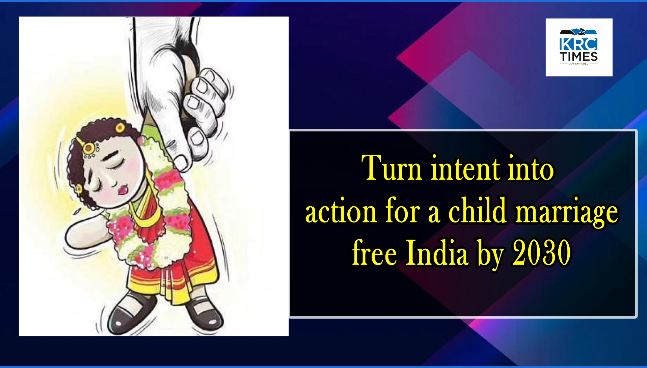
The Rajasthan High Court, in response to a petition by the Just Rights for Children (JRC) network, ruled that village heads would be held accountable for any child marriage in their jurisdiction
 KRC TIMES Desk
Ravi Kant
Last year on Akshaya Tritiya, something remarkable happened in Rajasthan. A day that had long been associated with a surge in child marriages passed without a single reported case in the state. That wasn’t a coincidence. It was the result of strong judicial intervention, clear Government directives, and the grit of a network of NGOs that responded with urgency.
The Rajasthan High Court, in response to a petition by the Just Rights for Children (JRC) network, ruled that village heads would be held accountable for any child marriage in their jurisdiction. The state administration acted swiftly, activating enforcement mechanisms at every level.
It was a moment that proved the power of coordinated action. That breakthrough was more than just a one-day victory it signalled what’s possible when law, governance, and community align. But the challenge goes beyond Akshaya Tritiya, and the question is no longer whether this change is possible, but whether this change can be seen across all religions, faiths, and all auspicious occasions when child marriage sees a surge.
The question is how to make it consistent, how to scale it nationally, and how to sustain the momentum so that India can truly become child marriage-free by 2030 — a goal the Government has already committed to achieving. India is not lacking in laws or intent.
The Prohibition of Child Marriage Act is clear. The Protection of Children from Sexual Offences Act is well drafted. The Government of India’s recent nationwide campaign for a ‘Bal Vivah Mukt Bharat’ shows a new level of resolve. Networks like Just Rights for Children, who have long been working to end child marriage, have actively been supporting the cause, and the judiciary is taking firm steps.
The over 250 NGOs of the network have been following a strategic roadmap outlined in Bhuwan Ribhu’s bestseller, ‘When Children Have Children: Tipping Point to End Child Marriage’. Notably, hearing the petition by Just Rights for Children’s partner, SEVA, the Supreme Court passed a judgement last year on Child Marriage, which is a roadmap for action to end Child Marriage.
The judgement emphasised a prevention-protection-prosecution strategy and community-driven approach; guidelines issued to various ministries for the complete elimination of child marriage; a multi-sectoral coordination, training and capacity building of the law enforcement officers needed to be there.
What we need now is to turn this intent into action at every level of society, especially at the last mile — in our panchayats, schools, and households. One of the most commendable recent steps has come once again from Rajasthan. In March 2025, the state Government issued an order that makes it mandatory to print the date of birth of both the bride and groom on every wedding invitation card.
It may appear like a small bureaucratic detail, but it’s a transformative move. With this step, age becomes public information — subject to scrutiny by relatives, neighbours, vendors, and authorities. It empowers communities to intervene early and gives law enforcement a tangible way to identify and prevent illegal child marriages.
This is a smart, low-cost, high-impact innovation that should be replicated across all states. There’s an irony we must acknowledge: poverty is often cited as the main reason families marry off their children early. But India also runs some of the largest social welfare programmes in the world — from free education for girls to scholarships, health insurance, and livelihood support schemes.
The disconnect isn’t in the intention or the policy. It’s in awareness and last-mile delivery. Far too often, families simply do not know about the schemes they are eligible for.
This is where panchayats and grassroots networks must play a stronger role. Panchayats are not just local governance bodies — they are the bridge between citizens and the state. When empowered and informed, they can help families access schemes, encourage education, and intervene when early marriages are being planned.
And as Rajasthan has shown, when panchayats are held accountable, they become effective watchdogs as well. Education is another key pillar. Without ensuring that every girl stays in school till the age of 18, we will not be able to end child marriage.
The dropout rates after Class 8 remain high in many parts of the country, and this is precisely the age when girls become vulnerable. Investing in education — not just by building schools but also by ensuring safe transport, toilets, books, and digital tools — is an investment in a child marriage-free future.
Several states, including Bihar, West Bengal, and Odisha, have introduced conditional cash transfers to encourage families to keep their daughters in school. These schemes have had measurable success. The central Government’s Beti Bachao Beti Padhao campaign has also done important work in shifting public perception around the value of girls. These are efforts that must be strengthened and expanded.
At the same time, enforcement must remain strong. Child marriage is not a tradition — it is a punishable crime. And everyone who facilitates it, knowingly or unknowingly, must be made aware of the consequences. This includes priests, band players, transporters, and tent owners. Several state Governments have rightly asked all such vendors to take pledges to refrain from supporting child marriages.
These are necessary steps — part of the broader cultural shift that’s already underway. The positive shift in Rajasthan has also been supported by civil society groups such as the Just Rights for Children (JRC), which works across 416 districts with over 250 NGO partners. Their model combines legal intervention, awareness building, school outreach, and community mobilisation.
Posters in temples and mosques, awareness drives in schools, and legal aid in high-risk districts — these are the kinds of actions that make a real difference. And the Government has welcomed this support, recognising that the fight against child marriage needs every hand on deck.
India has reached a turning point. The laws are in place. The Government’s commitment is visible and sincere. Civil society is energised. And there are already success stories to learn from. What we need now is scale.
Every village should have a working group on child marriage prevention. Every panchayat should have data on at-risk children. Every district should have a rapid response mechanism for suspected cases. This is not about doing more, it’s about doing smart and doing together.
Let’s stop thinking of child marriage as an issue we’ll tackle eventually. Let’s treat it as a national emergency — one that deserves the same focus we give to infrastructure, health, or digital access. Because at its core, child marriage is not just a violation of a child’s rights — it is a threat to India’s future.
We already have what we need: committed leadership, strong laws, innovative state initiatives, and an active civil society. If we now add stronger local governance, better delivery of welfare schemes, and consistent public awareness, we will reach the tipping point. India can become child marriage-free by 2030. That’s not a dream — that’s a deadline. And with the right push, we’re closer than ever.
Promotional | Subscribe KRC TIMES e-copy