


Dominance of Chaupals in Haryana – Roots of democracy or chains of tradition?
 Satywan Saurabh
In the rural culture of Haryana, ‘Chaupal’ is not just a place to sit but has been an informal platform for social, cultural and sometimes political decisions. This place where the elders sit with their deck of cards also sets the unspoken rules of social code of conduct. But with time the question has started to arise whether these Chaupals are becoming above the constitutionality of democracy?
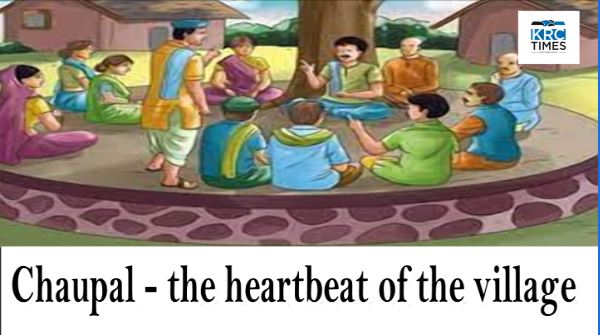
In the socio-cultural life of Haryana, Chaupal has not been just a place to sit but a tradition, a power structure and an informal justice system. When the village elders sit under a peepal tree or on a paved platform and discuss, it is called “Chaupal” in common language.
But this Chaupal is not limited to just conversations but has become an institution that decides the social direction. But today the question is whether this dominance is positive or is it becoming an obstacle in the way of a democratic and just society?
Historical background: The role of Chaupals
When the Panchayats were not fully developed in Haryana, the importance of Chaupals was even greater. Any village matter – be it a land dispute, fixing a marriage relation or deciding to boycott someone – everything was done in the Chaupal. It was a symbol of local self-governance, which was based on the principle of collective dialogue.
But as time changed, the institutions of democracy, Panchayat elections, police-administration and courts became stronger, the role of Chaupals should have also changed. But even today in Haryana, Chaupals remain the “informal court” of social decisions.
Chaupal vs Constitution: A clash
The Constitution of India gives equal rights to every citizen – discrimination on the basis of caste, sex, religion or class is prohibited. However, decisions in the Chaupals are often based on caste hierarchy. For example: “A boy from this caste should not marry a girl from that caste.”
“He has married without the panchayat, so he will be boycotted.” These decisions are against the basic spirit of the Constitution. Women and Dalits in particular rarely get a chance to speak in the Chaupal. In most cases, the Chaupals become a bastion of patriarchy and casteism.
Social control or social exploitation?
Chaupals sometimes play the role of social control that acts before the law. For example, when a girl uses a mobile phone, the Chaupal pronounces – “ban mobile phones.” Or “those who have married for love should be expelled from the village.” Such decisions fall under the category of social exploitation.
Even today, incidents of honour killings are reported in Haryana, which have their roots in the decisions of the Chaupal. The basic reason for this dominance is that Chaupals are often monopolized by elderly men, where youth, women or socially marginalised people cannot raise their voice.
Do Chaupals also have a positive role?
It would be wrong to say that Chaupals play only a negative role. In some areas, Chaupals are also a democratic form of resolving mutual disputes, maintaining social harmony, and taking collective decisions. Such as: water conservation, de-addiction campaign, or collective efforts to promote education. Making rules to prevent wasteful expenditure in marriages. But this role is constructive as long as it ensures everyone’s participation and is in accordance with the Constitution.
Political use and abuse
Chaupals have been used extensively in Haryana’s politics. Leaders go to Chaupals to do public relations, but at the same time they also use them as a means of caste mobilization and social polarization. Concepts like “Choudhary ji’s decision is more important than all” in Panchayat elections or Assembly elections harm the democratic process.
Women and Chaupal: Entry prohibited?
Participation of women in Haryana’s Chaupals is still very limited. Even though women have got reservation in Gram Panchayats, when the same woman Sarpanch goes to the Chaupal to present her views, she is silenced. This is a double standard – empowerment on paper and neglect on the ground
Many social activists fighting for women’s rights have faced direct opposition from the Chaupal culture. That is why the dominance of Chaupals is becoming an obstacle to women’s participation.
Thinking of the new generation and distance from the Chaupals
Today’s young generation, influenced by the internet, social media and urban life, is distancing itself from the Chaupal culture. They find this system outdated and biased. The youth ask questions: “Whom should I love, how will an elder decide this?” “I will decide my career path, not the Chaupal.” The democratic consciousness of this generation is challenging the dominance of the Chaupals. This is the direction of democracy, which needs to be strengthened in the villages.
Can there be a new form of Chaupals?
The solution is not to completely reject the Chaupals, but there is a need to redefine them. For example: Women, Dalits and youth should get equal rights to speak in the Chaupals. Decisions should be tested on the basis of rules and laws. Chaupals should be used in social campaigns, rural development and promotion of education. If Chaupals become an extension of democracy, then they can remain relevant even today.
Chaupal: Tradition or symbol of patriarchy?
The basic concept of Chaupals has been mutual dialogue, consultation and dispute resolution. But now this place often seems to be a hub of social oppression and caste dominance instead of justice. In the villages of Haryana, most of the Chaupals are dominated by men only. Women can neither speak nor sit there. This inequality is not just gender based, it is also caste and economic class based. Ignoring the words of backward classes, Dalits and minorities has become a part of the old traditions of these Chaupals.
The truth of the data:
Haryana tops the list of honour killing cases. Of the 25 cases registered in the country in 2021, 17 were from Haryana. Khap or Chaupal played a role in most of these cases. According to the report, 60% of rural disputes are first resolved in the Chaupal, 80% of the decisions of which do not involve women. A report by the Haryana State Women’s Commission (2020) shows that 72% of rural women are deprived of their rights due to the conservative system of Chaupal.
‘Balla village’ of Karnal district, Nalwa village of Hisar district
In 2016, the Chaupal of Balla village in Karnal decided to expel a loving couple from the village citing ‘same gotra’. The woman was estranged from her family and the boy was threatened with death. When the matter went to court, the court found it to be a violation of Article 21 (life and personal liberty) of the Constitution. But by then society had pronounced its ‘punishment’.
This case shows that even today Chaupals can ignore the law in the guise of their tradition. In 2019, a Dalit family faced social boycott in the Chaupal of Nalwa village in Hisar only because their daughter had married an upper caste youth. The Panchayat not only prevented the entire family from coming to the Chaupal, but also prohibited them from filling water from the village well and purchasing from ration shops.
Positive example: Bibipur village, ‘Dhosi village’ of Bhiwani, Rewari district
But not every Chaupal is a symbol of fanaticism. Bibipur village in Bhiwani changed the definition of Chaupal. The Sarpanch there, Sunil Jaglan, made the Chaupal a platform to raise the voice of women. The ‘Selfie with Daughter’ campaign started from here.
A women’s forum was set up in the Chaupal, where women also participate with equal rights. There was an open debate and decisions were taken on issues like de-addiction, child marriage, education and toilets.
This Chaupal of Bibipur shows that when the society wants, tradition can be combined with modern values. According to the Haryana Panchayat Development Report (2021), Chaupals in 78% of the villages of the state are not operated under any legal framework, due to which they often take decisions outside the scope of the Constitution.
Digital Chaupal was started for the first time in 2022 in the village Chaupal on the demand of the youth. In this, the problems of the village were linked to the block office through video conference and women also got equal participation. Its direct effect was that quick decisions and solutions were taken on issues like toilet construction, scholarship distribution and MNREGA wages in the village.
Criticism of Chaupals in the media
“Khap panchayats in Haryana still control social behaviour, bypassing constitutional rights.” “In a Rohtak village, a girl was punished for wearing jeans – the chaupal gave the verdict, women were expelled.” While Haryana’s chaupals are symbols of dialogue and community, they have also become an obstacle to democracy and equality.
These chaupals now need to introspect. They should adapt tradition, but with inclusiveness, gender equality and constitutional values. The chaupal of Bibipur is an ideal, while the chaupal of Balla is a warning. It is now up to the villages of Haryana to choose which path they take—the path of democracy or the shadow of tradition?

We need participation, not domination
The Chaupals of Haryana are the mirror of the society – but when the mirror itself becomes blurred, the image also gets spoiled. If the dominance of the Chaupals suppresses equality, justice and democratic values, then it is necessary to challenge it.
But if it is made inclusive, sensitive and democratic, then it can become the strongest institution of rural India. We have to decide whether the Chaupals will remain a platform for dialogue or the throne of power? Till the time the Chaupals do not become the voice of everyone, their dominance will remain a threat to democracy.
Promotional | Subscribe KRC TIMES e-copy