


Assam’s Demographic Crossroads and the Path to an Inclusive Future
 KRC TIMES Desk
For the past hundred years, Assam has been a land of crossroads-geographical, cultural, and now demographic. Situated at the heart of India’s Northeast, the state has been defined by its rivers and valleys, its tea gardens and forests, and above all by its people. In 1901, the census recorded Assam’s population at just 3.3 million. By 2024, that number has risen more than eleven-fold to an estimated 36.2 million.
Behind these numbers lies a complex story-one shaped by migration, fertility patterns, cultural shifts, and economic change. As Assam approaches its centenary demographic milestone between 1925 and 2025, it faces a critical question: how can it convert this extraordinary transformation into a foundation for inclusive prosperity?
This article examines Assam’s shifting demographic profile over the past century, the socio-political debates it has triggered, and the policy imperatives that must guide the state over the next two decades. A Century of Growth: Numbers That Tell a Story Assam’s demographic journey cannot be understood without looking at the sheer pace of its growth.
From colonial times to the present, the state’s population trajectory has consistently exceeded expectations. By 2011, Assam’s density stood at 398 persons per square kilometre. In 2024, that figure had climbed to 462-well above the national average.This demographic surge is not just the result of natural growth. Migration has played a defining role.
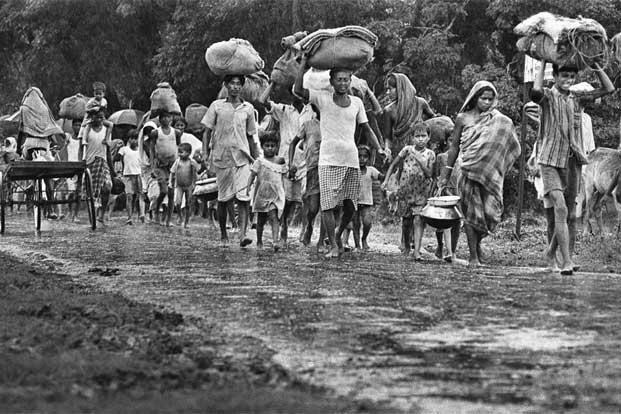
Waves of settlers came from East Bengal during colonial rule, encouraged by the British to cultivate Assam’s fertile plains. Partition in 1947 and the Bangladesh Liberation War of 1971 triggered further inflows, shaping districts along the Brahmaputra valley and Barak valley in profound ways.
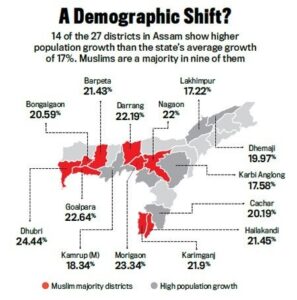
Religious demographics, too, reflect this historical evolution. Census data reveals that Muslims formed just 9.22% of Assam’s population in 1901. By 2011, that figure had risen to 34.2%. Hindus, who made up 61.5% in 2011, are projected to decline to 53.1% by 2050.
Demographers attribute these changes to higher fertility rates among Muslims, alongside historic patterns of migration. The implications of these shifts extend beyond numbers-they touch the heart of Assamese identity, raising questions about culture, language, land, and political repre sentation.
The Politics of Demography Few Indian states have seen their demographic profile so deeply entwined with politics as Assam. The rise of migration-related anxieties gave birth to one of the longest-running mass movements in post-independence India-the Assam Agitation (1979-1985).
Demands to detect and deport illegal migrants shaped the political discourse for decades, culminating in the Assam Accord of 1985. Yet, even after the Accord, concerns around identity and representation remain strong.
The growth of the Muslim population in districts such as Dhubri, Barpeta, and Goalpara is often cited as evidence of demographic imbalance. Indigenous Assamese communities voice fears of being outnumbered in their own homeland, sparking recurring debates on citizenship, land rights, and cultural preservation.
At the same time, religious polarization has overshadowed the reality that Assam’s diversity is not new but deeply historical. The state has always been home to a tapestry of communities-Ahoms, Bodos, tea tribes, Bengalis, Karbis, and many others.
The challenge today is to reconcile demographic change with the inclusive ethos that has long defined Assamese identity. Economic Transformation Amidst Demographic Change While demographic debates often dominate the headlines, Assam’s economic trajectory in recent years provides an equally important perspective.
The state’s per capita income, though still lower than India’s leading states, has grown at one of the fastest rates in the country. Between 2012 and 2022, Assam’s economy diversified beyond tea and oil, with emerging contributions from services, small industries, and transport infrastructure.
This growth coincides with the opening of what economists call a “demographic dividend” window. Between 2020 and 2040, Assam will have a rising proportion of its population in the working-age category. If harnessed effectively, this can provide the fuel for rapid economic expansion, higher productivity, and improved living standards. But the dividend is not automatic.
Without jobs, skills, and education, a young population can just as easily become a liability, leading to frustration and instability. The next decade is therefore decisive for Assam’s future. The Roadmap for Harnessing the Demographic Dividend Short-Term Priorities (2025-2027) In the immediate years ahead, Assam must first ensure its infrastructure keeps pace with population expansion.
By 2027, the state’s population will cross 40 million. Meeting their needs requires a three-prong push: “ Education: Building schools and colleges in underserved areas, particularly in rural and minority-dominated districts, is vital. Equal access will prevent demographic disparities from hardening into social divides.
“ Healthcare: With one of the lowest doctor-to-patient ratios in India, Assam urgently needs investment in public health infrastructure. Maternal and child health, in particular, must be prioritized to stabilize fertility rates and improve life expectancy. “ Employment: Creating job opportunities in manufacturing, agro-processing, and tourism is essential.
Unless millions of new jobs are created by 2030, the demographic dividend risks turning into demographic stress. Medium-Term Strategies (2027-2032) The next phase must focus on human capital. Skill development programs tailored to Assam’s economy-river transport, agrotech, renewable energy, and cross-border trade-can equip youth with employable skills.
Vocational training and entrepreneurship promotion will ensure that rural and urban youth alike can participate in growth. Long-Term Vision (2032-2040) Over the long horizon, Assam must embed sustainability into its development model. Rapid urbanization and agricultural expansion have already eroded forest cover.
Human-wildlife conflicts in Kaziranga and other areas highlight the need for integrated conservation policies. Climate change adds another layer of urgency, with rising floods threatening livelihoods along the Brahmaputra.
Only by balancing economic growth with ecological preservation can Assam ensure prosperity that lasts beyond the demographic dividend window. Migration and Its Continuing Complexities Migration remains a sensitive but unavoidable part of Assam’s demographic puzzle. While cross-border migration from Bangladesh has slowed in recent decades due to tighter controls, internal migration continues to reshape Assam’s labour market.
Workers from Bihar, Jharkhand, and West Bengal contribute heavily to construction, agriculture, and informal services. The challenge lies in balancing economic dependence on migrants with the anxieties of local populations. Transparent labour regulations, proper documentation, and fair wages can reduce tensions while ensuring migrant workers contribute productively without displacing local communities.
Environmental Stress in a Growing State No discussion of Assam’s future is complete without acknowledging its environmental fragility. The Brahmaputra and Barak rivers, lifelines of the state, are also sources of recurring devastation through floods.
With climate change intensifying rainfall variability, flood frequency and severity are projected to rise. At the same time, population pressure has led to encroachment in forest areas. Between 2001 and 2020, Assam lost thousands of hectares of tree cover, mostly to agriculture and settlements. The loss of wetlands has further reduced the state’s resilience to floods.
To safeguard its future, Assam must prioritize climate-resilient infrastructure-raised embankments, flood-resistant housing, and early warning systems. Urban planning must also shift to sustainable models, preventing unplanned sprawl in cities like Guwahati, Silchar, and Dibrugarh. Social Cohesion: The Fragile Fabric In a state as diverse as Assam, demographic shifts directly impact social cohesion.
Encouragingly, some indicators show progress-inter-community marriages are rising, and urban neighbourhoods are increasingly mixed. Yet, tensions remain visible in rural areas, where land disputes, competition for government jobs, and cultural anxieties often spark conflict.
One recurring concern is the fear among Assamese-speaking populations of linguistic marginalization. With Bengali, Hindi, and tribal languages also widely spoken, linguistic identity remains a cornerstone of political mobilization. Policies promoting multilingual education while protecting Assamese as the state language can help preserve balance.
The growth of the Muslim population, meanwhile, must be managed with sensitivity. Demonization risks deepening divides. Instead, policies should focus on ensuring equal access to education and employment, thereby integrating communities into a shared vision of progress. Policy Recommendations: Charting the Way Forward To navigate its demographic crossroads, Assam needs a comprehensive, inclusive roadmap.
Key measures include:
1. Creation of a Demographic Transformation Commission: A state-level body to oversee population trends, monitor fertility rates, and guide policies on education, employment, and healthcare.
2. District-Level Monitoring Committees: Localized approaches to track demographic indicators, migration patterns, and resource distribution in high-growth districts.
3. Human Capital Investment: Substantial allocations towards skill development, vocational training, and health services, especially for marginalized communities.
4. Environmental Safeguards: Integrated river basin management, forest conservation, and promotion of renewable energy.
5. Dialogue Platforms for Social Cohesion: Community-based forums to resolve disputes, promote cultural exchange, and prevent polarization.
6. Collaborative Funding Models: Mobilizing resources from state and central governments, international partners, and private investors to finance Assam’s transformation. A Defining Moment As Assam stands at the threshold of its demographic century, the choices made in the next two decades will determine whether it becomes a model of inclusive prosperity or a case study in missed opportunities.
The demographic dividend window is narrow but potent. Harnessed effectively, it can lift millions out of poverty, preserve cultural heritage, and position Assam as a leader in India’s Northeast.But success requires more than economics.
It requires trust between communities, sensitivity in governance, and a willingness to view diversity not as a threat but as a strength. If Assam can balance its competing narratives-demographic change and cultural preservation, economic growth and environmental sustainability, identity and inclusion-it will not just secure a prosperous future for its people but also offer lessons to the rest of India. The crossroads is here. The path forward must be chosen with wisdom, courage, and vision
Promotional | North East Integration Rally