


Why Building Infrastructure Won’t Fix Nagaland’s Real Development Deficit
 KRC TIMES Desk
The Northeast’s development debate remains stuck on highways, hotels and “potential”, while the deeper fault lines-inequality, policy incoherence and environmental fragility-continue to trap the region in a cycle of promise without progress. For over two decades, the Northeast has been marketed with unwavering zeal.
Successive governments, visiting dignitaries, and investment summits have all repeated a familiar refrain: the region is a “gateway”, a “hub”, a “future growth corridor” poised to transform India’s development trajectory.
Tourism potential, mineral wealth, agricultural diversity, waterways, youthful talent-almost every imaginable asset is held up as evidence that the Northeast is standing on the edge of an economic breakthrough.
And yet, here we are in 2025, still speaking the language of “potential”. Not achievement. Not outcome. Not transformation. The same talking points that dominated seminars in the early 2000s continue to animate government brochures and podium speeches today.
The uncomfortable truth is this: the Northeast’s developmental stagnation has never been about the absence of roads, ho- tels, airports, or power lines. It has always been about what comes after the infra- structure.
Because infrastructure, by itself, neither ensures equitable access nor guarantees economic dynamism. And nowhere is this more evident than in Nagaland. The Mirage of “Game-Changing” Infrastructure When India’s political leadership describes the region as a future “epicentre” of economic growth, the underlying assumption is that connectivity-physical, digital, or commercial-will automatically trigger development.
Huge investments in education, health, research, highways, and urban expansion are repeatedly held up as indicators that the Northeast is on the cusp of a structural shift. But the NITI Aayog’s periodic assess- ments, along with independent national and global studies, have said something stark: these investments overwhelmingly serve the already advantaged sections.

Growth is not distributed. Improvements in social indicators remain lopsided. Re- gional imbalances have deepened. In many cases, infrastructure amplifies inequality instead of reducing it. The rich get richer. Certain districts get all the attention.
The benefits of mobility or market access accrue to a narrow elite. And for all the talk of “double-engine” acceleration, the development engine sputters whenever it tries to carry the entire population along.
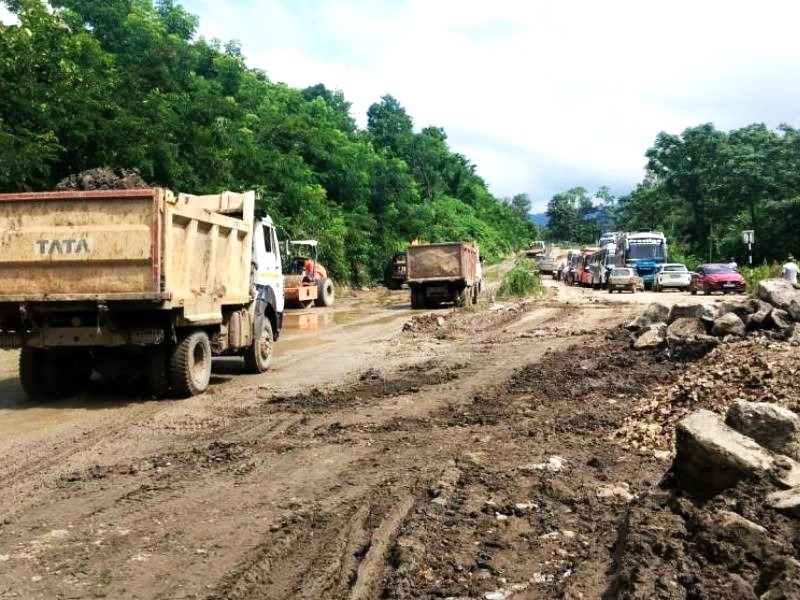
Nagaland illustrates this paradox: massive highways coexist with crumbling village roads. Private schools flourish while government schools struggle. Advanced hospitals in urban pockets contrast sharply with primary health centres that lack doctors. Infrastructure exists-but only for some.
This is why the “game” has not changed Because the game itself-who participates, who benefits, who gets left out-remains untouched. Tourism: A Case Study in Misplaced Expectations Nothing captures the Northeast’s development illusions better than tourism.
It is repeatedly presented as a magic bullet: eco-tourism will bring sustainable prosperity, cultural tourism will generate jobs, adventure tourism will draw global attention. But tourism is not a self-contained economic engine. It does not thrive on scenery alone.
Tourism needs an ecosystem. The Northeast has fragments. High-quality roads, reliable transport, accessible accommodation, safety assurances, trained manpower, robust communication networks, predictable weather systems, responsive governance-tourism depends on all of these. The Northeast possesses many attractions, but not the supporting ecosystem.

Even at its best, tourism is seasonal, volatile, and vulnerable. Climate change is redrawing weather patterns. Landslides, flash floods, and glacial events-as Sikkim recently witnessed-can erase entire seg- ments of the tourism calendar.
Political dis- ruptions, such as the conflict in Manipur, can destroy tourist confidence overnight. In this landscape, Nagaland tries to do what it knows best: lean heavily on one brand, one event, one spectacle-the Horn- bill Festival.
The Hornbill Trap The festival epitomises both the power and the limitations of tourism-driven development. For ten days, Kohima transforms. Thousands of domestic and international visitors arrive. Hotels overflow. Cultural troupes perform. Local entrepreneurs thrive.
But once the tents come down, Naga- land’s tourism calendar goes silent again. A recent study by the Urbaltour Proj- ect-a collaboration between The Highland Institute, Kohima, and the French Institute of Pondicherry-laid bare this dependence. Kohima’s tourism is overwhelmingly seasonal, heavily skewed, and structurally fragile.
The festival does not generate yearround income. It does not build permanent employment. It does not develop a tourism culture. It does not trigger a broader trans- formation of the service sector. Reliance on Hornbill has become a form of stagnation disguised as success. Kohima-Centric Tourism and the Neglect of the Rest Tourism in Nagaland is excessively concentrated in Kohima, leaving vast districts-Mokokchung, Phek, Longleng, Kiphire, Mon-with negligible investment or attention.
Where tourism does exist, it is largely because of private initiative: homestays built without government support, trekking routes maintained by local youth, village councils investing in smallscale ecotourism. Meanwhile, the state government prefers “grand projects” and “destination branding”, as seen in its recent proposal:
a ? 250-crore project to develop Dzukou Valley into a world-class eco-tourism spot complete with luxury hotels. This is not development-it is ecological vandalism. Dzukou Valley is among the most fragile ecological zones in the Northeast. Introducing large-scale construction is not just environmentally irresponsible; it betrays a deeper misunderstanding of what sustainable tourism actually means.

Imported ideas from global tourism markets-glamping resorts, luxury villas, concrete viewing decks-do not suit mountainous, biodiversity-rich, disaster-prone landscapes. Nagaland does not need “five-star nature”. It needs policies rooted in local knowledge, environmental ethics, and longterm community benefit.
Why “Potential” Has Become the Region’s Biggest Burden The Northeast is stuck not because it lacks talent or resources, but because development thinking is trapped in templates. Governments repeatedly attempt to rep licate ideas from across the world-Alpine tourism models, Southeast Asian adventure circuits, hill-town retail hubs-without recognising the region’s ecological and social specificities.
A one-size-fits-all developmental imagination cannot work in a region where: “ terrain varies sharply, “ ethnicities and governance structures are diverse, “ infrastructure gaps are extreme, “ political histories shape policy acceptance, “ land ownership is community-driven, “ and the environment is intensely vulnerable.

