

DEVELOPMENT ROUTE OR DRUG PIPELINE?
 KRC TIMES Manipur Bureau

In the hills of northeastern In- dia, where rugged terrain meets porous international borders, a silent battle is unfolding one that pits state sovereignty against transnational criminal networks, ethnic politics against nation- al security, and humanitarian needs against law enforcement priorities.
At the heart of this conflict is a controversial road network specifically the Churachandpur-Kangpokpi corridor whose very existence has sparked a fierce debate: Is it a lifeline for conflict-hit civilians or a highway for heroin and poppy smuggling?
What appears at first glance to be a logistical issue is in fact a layered crisis involving narco-terrorism, ethnic unrest, insurgency funding, and environmental degradation. As Manipur reels from the aftermath of the ethnic violence that erupted on May 3, 2023, this corridor has emerged as the epicenter of a revived drug economy one that is deeply interwoven with the region’s socio-political fractures.
Manipur: A Strategic Node in the Golden Triangle Manipur’s geopolitical significance cannot be overstated. Nestled against the Indo-Myanmar border, it lies adjacent to the infamous Golden Triangle Myanmar, Laos, and Thailand a region globally recog- nized for heroin production.
The porous border and weak surveillance infrastructure have long enabled cross-border trafficking. Former Chief Minister N. Biren Singh recog- nized the gravity of this threat when he launched the state’s flagship “War on Drugs” campaign in November 2018.
The campaign made significant strides: thousands of acres of illicit poppy were destroyed, and drug seizures valued at over ?70,000 crore were reported. For a time, it seemed the tide had turned. But the peace was fragile.
The recent violence that fractured Manipur’s ethnic balance has opened a dangerous new chapter in the state’s narcotics crisis, and the Churachandpur-Kangpokpi road has become its symbol. The Emergence of the German and Tiger Roads“In the wake of the 2023 violence, many arterial highways including the critical Moreh-Imphal route were blocked or rendered unsafe due to inter-community hos- tilities.
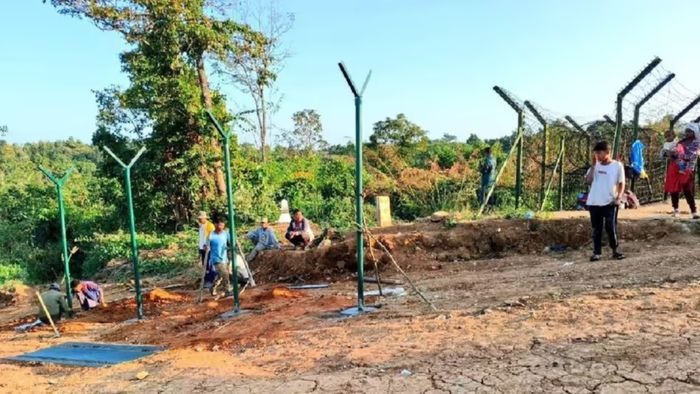
In their place, alternative routes, such as the illegally constructed German and Tiger roads, began to emerge. These roads, often cutting through reserve forest areas and disputed ethnic territories, were initially justified as humanitarian corridors.
Kuki and Zo groups argued they were necessary for transporting essential supplies and ensuring civilian mobil- ity between isolated settlements like Churachandpur, Kangpokpi, Chandel, and Tengnoupal. However, these just ring hollow as an increasing body of evidence suggests the roads are being exploited not for relief but for revenue generated from drug trafficking and poppy cultivation.
A Shift in Drug Routes: From Moreh to Kangpokpi“Before the violence, drugs entering Manipur from Myanmar typically followed two main routes. One originated in Mandalay, Myanmar, passing through Monywa and Kalewa before splitting into the Tamu-Moreh-Manipur route or the Rih-Champhai-Mizoram route.
The other stemmed from Bhamo in Kachin State, moving through Homa- lin in Sagaing Region to reach Na- galand and further into Assam and Bengal. These routes though always dangerous were relatively well-monitored. With the eruption of violence however, traffickers began using less scrutinized pathways.
The Churachandpur-Kangpokpi corridor, built hurriedly and unofficially, soon became the favored conduit for heroin and opium.““This is more than speculation. Since 2023, drug seizures in Kangpokpi and Senapati have seen an unprecedented rise.
The correlation between the road’s emergence and increased narcotics activity is difficult to ignore. The Economics of Smuggling The economic incentives behind this shift are staggering. According to an internal report sourced from Kangpokpi, the post-violence instability sent opium prices soaring from ?65,000–?70,000 per kilogram to ?1.2–1.5 lakh. Drug couriers now earn ?2,000 per packet, translating into daily earnings of ?5,000–?10,000. In a region plagued by unemployment and displacement, this illicit economy provides both income and purpose.“
“Facilitating the trade are local volunteers and militia-linked operatives functioning as makeshift Road Opening Parties (ROPs), who grant or deny passage to vehicles depending on affiliations and payoffs. Vehicles particularly Tata Sumo receive a “green signal” for safe pas- sage.
These routes, unlike national highways, have no security check- points, no monitoring systems, and no deterrents until traffickers reach Kangpokpi town, where central se- curity forces maintain a partial pres- ence.
Kuki Militancy and Drug Cartel Convergence The most troubling aspect of this crisis is the apparent overlap between Kuki militant groups and the drug trade. During periods of reduced law enforcement particularly during inter-ethnic conflict factions like the Kuki National Front (KNF-MC and KNF-P) have allegedly encouraged local poppy cultivation.
In return, they levy taxes on harvests and transport, diverting profits to fund insurgency and maintain armed presence. The capture of Lemtingsei Singson, the commander-in-chief of the KNO-Seiphu faction, exemplifies this convergence.
Singson was arrested near Phaitol village with 125 grams of suspected heroin a strong in These developments are not isolated. Between March and July 2025, security forces arrested several individuals many with ethnic and political links with large caches of heroin and opium.
Notable arrests include: March 29, 2025: Four poppy cultivators arrested in Kangpokpi; six traffickers apprehended the same day with 174 soap cases of heroin weighing over 4 kg. May 24, 2025: A major bust in Churachandpur saw 870 grams of brown sugar, 20 soap cases of heroin, and ?29.5 lakh in cash recovered. July 10, 2025: CRPF and Manipur Police intercepted a black Scorpio at Tupul Bridge with 2.193 kg of brown sugar worth ?
18 crore. July 16, 2025: Assam Rifles seized 50.5 kg of opium, foreign currency, and Indian cash from abandoned vehicles in Sajik Tampak, a known transshipment hub. Each incident reinforces the hypothesis: these roads are no longer just emergency lanes for civilians they are highways for narcotics.
Civilian Suffering and Ethnic Backlash“Yet the issue is far from black and white. For many civilians, especially among the Kuki community, these roads are vital. With ethnic barricades choking national highways, patients, students, and migrant workers have found themselves cut off from essential services.
Take the case of a Kuki nursing student from Keithelmanbi in Kangpokpi. What was once a 3.5-hour journey to Churachandpur now takes up to 3 days via Nagaland, Assam, and Mizoram, covering over 1,000 km and costing more than ?10,000. For those displaced or impoverished by vio- lence, such costs are untenable.
This humanitarian angle has been championed by several Kuki and Zo civil society organisations. But the backlash is growing. The Foot hills Naga Coordination Committee (FNCC), citing rampant drug smug- gling and territorial encroachment, has imposed an indefinite bandh on Kuki movement in Naga-inhabited foothill areas.
They allege that unau- thorised roads not only violate tra- ditional land rights but also enable Kuki militant camps to spring up un- der the guise of “humanitarian need.” Lawlessness and the Failure of Oversight“One of the greatest threats posed by these unofficial routes is the near-complete absence of government oversight.
These roads are unregistered, often cut through ecologically sensitive forests, and lack basic policing infrastructure. The result is a de facto no-man’s land governed by armed militias and traffickers. Despite commendable efforts by the Manipur Police, CRPF, and Assam Rifles, enforcement remains reactive rather than preventive.
Each major seizure is a testament not only to the agencies’ vigilance but also to the operational freedom smugglers enjoy until intercepted Moreover, proposals to establish camps under the Suspension of Operations (SoO) agreement along these routes have only added fuel to the fire.
These camps, critics argue, could become sanctuaries for armed militants and cartel operatives, set- ting the stage for a renewed Naga-Ku- ki confrontation. Conclusion: A State at Cross- roads“Manipur’s current crisis is not just about roads or drugs it is about the survival of governance itself.
The Churachandpur-Kangpokpi corridor represents a broader collapse of state authority in favor of factional control. While addressing humanitarian needs is crucial, it cannot come at the cost of turning a blind eye to a bur- geoning narco-economy.
The war on drugs in Manipur has reached a critical juncture. If these unofficial corridors continue to op- erate unchecked, they will not only erode the gains made over the past five years but also endanger nation- al security, deepen ethnic fault lines, and corrupt future generations.
The need of the hour is a decisive and mul- tipronged approach simultaneously addressing humanitarian concerns, tightening border surveillance, reinforcing rule of law, and dismantling the infrastructure of drug trafficking. Without it, the question won’t just be whether these roads are necessary or illicitbut whether Manipur itself can withstand the weight of its own contradictions.

Know More – Apply Here