

How Manipur and Mizoram Turned Miss Universe India 2025 into a Battle of Pride and Popularity
 KRC TIMES Desk

When the spotlight swept across the stage of Miss Universe India (MUI) 2025 on the evening of August 18 in Jaipur, Rajasthan, the event looked like every other glamorous national pageant – gowns glittering, contestants poised, cameras flashing, and judges taking notes. But away from the sequined stage and floodlit ramp, something very different was unfolding.
This year, the true contest was not the one the judges scored. It was fought on smartphones, in Instagram feeds, WhatsApp groups, and trending hashtags. And in this parallel battlefield, two small Northeastern states – Manipur and Mizoram – held the nation hostage with their passion. The story of MUI 2025 is not merely about who wore the best gown or who walked most gracefully.
It is the story of how a region often relegated to the margins of mainstream Indian pageantry stormed into the centre, rewriting the rules of participation, representation, and pride. At its heart lay the Miss Popular Award, determined entirely by public votes. For Manipur’s Sarangthem Nirupama and Mizoram’s Evelyn Zachhingpuii, the award was more than a subtitle.
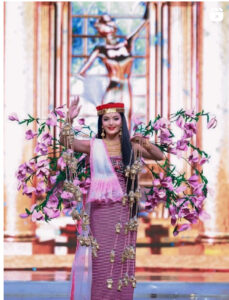
It was a referendum on identity, a cultural campaign, and a digital showdown that would reveal how a determined community could make its presence impossible to ignore. A Contest Beyond Crowns Unlike the main MUI crown, which is decided by panels of experts assessing talent, intelligence, and stage presence, the Miss Popular Award rests entirely in the hands of the public.
Followers are required to like, comment, and share official posts of contestants on the organizers’ Instagram accounts. In theory, it is a simple test of engagement. In practice, it became a storm. The numbers themselves tell the story. Nir upama’s profile photograph generated over 337,000 likes, 3.1 million comments, and 95.9 million shares.
Evelyn’s, even higher: 458,000 likes, 3.3 million comments, and 101 million shares. Yet, in a twist that still fuels heated debates online, Nirupama emerged the official winner of the Miss Popular Award. The deciding factor? Eligibility rules. Evelyn’s vast support base had shared her content prolifically but did not always follow the mandatory step of subscribing to the organizers’ Instagram accounts.
Nirupama’s camp, organized with almost military precision, ensured that her supporters followed every requirement to the letter. For Manipur, it was a moment of triumph. For Mizoram, it was a bittersweet outcome: overwhelming engagement, but no crown. And for the rest of India, it was a revelation of the raw, mobilized power of Northeastern fandom.
A Region Steps into the Spotlight The frenzy surrounding the Miss Popular Award cannot be understood without stepping back to consider the Northeast’s long and fraught relationship with mainstream Indian pageantry. While contestants from Manipur, Mizoram, Nagaland, and Tripura have consistently displayed talent and poise, the path to recognition has often been obstructed by biases – unconscious or otherwise – in jury decisions.
Beauty standards in national pageants have historically mirrored metropolitan ideals, leaving many regional representatives overlooked. The Miss Popular Award, based on public votes, offered something radically different: a level playing field. Here, representation was not mediated by judges in Jaipur or Delhi. It was decided by ordinary citizens, clicking on screens in Aizawl, Imphal, Kohima, and Agartala.
For the Northeast, this meant that collective pride could finally translate into measurable recognition. And in 2025, they seized it. The Powerhouses: Nirupama and Evelyn The Manipuri Force At 23, Sarangthem Nirupama was not a stranger to titles. She had already bagged the Mega Miss Northeast crown in 2023, where she built a reputation not just as a pageant contestant but as a voice for women’s and children’s rights.
A psychology student, she brought a blend of intellect and empathy to her advocacy, often speaking of the challenges faced in Manipur’s conflict-ridden landscape. Her Miss Popular victory was more than pe sonal. It was a collective assertion from a state still grappling with unrest since 2023. In the voting campaigns, her face became a symbol of resilience.
Promotional | North East Integration Rally
Community organizations, student groups, and Manipuri diaspora networks abroad rallied around her, urging followers to “vote not just for Nirupama, but for Manipur.” If Nirupama was resilience, Evelyn Zachhingpuii was representation. With a master’s degree in Sociology, Evelyn had become known in Mizoram as a custodian of cultural heritage.
At every opportunity, she showcased her state’s music, craftsmanship, and values, reframing them as treasures for a modern India. Her campaign became a carnival. Local musicians composed jingles. Schools held awareness drives. Young Mizos in Delhi and Bengaluru launched Ins tagram reels. When her posts crossed 100 million shares, it felt like a collective celebration – Mizoram speaking loudly and proudly in the national arena.
Though she ultimately missed out on the Miss Popular crown, Evelyn’s presence ensured that MUI 2025 could not be written without Mizoram at its centre. Not Just Two States: Tripura and Nagaland Join the Surge Manipur and Mizoram dominated the headlines, but two other Northeastern contestants underscored the scale of regional participation. Khumjhar Debbarma, a 21-yearold from Tripura, tied her campaign to environmental activism under the banner “Clean and Green Northeast.”
Her insistence that pageantry could coexist with social advocacy resonated deeply. From Nagaland, Kelulu Dawhuo, a proud Chakhesang woman and former Miss Kohima 2024, emphasized heritage and confidence. With her articulate stage presence, she stood as an embodiment of modern Nagaland – proud, vocal, unafraid.
Both drew tens of thousands of votes – dwarfing the figures of many contestants from larger states. It was a reminder that the Northeastern presence in the contest was not an outlier, but a growing force. The Miss Popular Award was designed by th organizers as an engagement tool. But in 2025, it became something far more powerful.
On Instagram, the official MUI accounts swelled to 650,000 followers, with daily posts receiving unprecedented interactions. Nearly 200 million shares were generated by just Manipur and Mizoram supporters. Hashtags like #VoteForNirupama and #EvelynForMissPopular trended not just regionally but nationally.
The mechanics of fandom were fascinating to watch. Student unions coordinated block voting at designated hours. Diaspora groups created tutorials on how to ensure votes were eligible. Influencers lent their platforms to the campaigns. It was, in every sense, a movement.
And while the organisers profited from the surge in visibility, they also faced uncomfortable questions: Was it fair to confine such massive engagement to just one winner? Did the rules sufficiently recognise effort? When the crown for Miss Popular was placed on Nirupama’s head, Manipuri fans celebrated with fireworks, rallies, and social media storms.
Evelyn’s supporters in Mizoram, meanwhile, felt robbed. Though their candidate’s numbers had outstripped Nirupama’s, technicalities had denied her the title. The discontent was not limited to Mizoram. Supporters of Khumjhar and Kelulu argued that the single-winner format overlooked their contributions too.
For them, it wasn’t just about fairness – it was about respect for their mobilization. One viral tweet summed up the frustration: “If 200 million shares and thousands of votes from Tripura and Nagaland don’t count for more than one title, maybe the format needs to change.” Beyond the debate over numbers, MUI 2025 signaled a deeper shift in what beauty pageants mean in contemporary India.
The contestants from the Northeast did not shy away from difficult issues. Nirupama used her platform to speak of social trauma in Manipur. Evelyn highlighted Mizo traditions as living, evolving cultures. Khumjhar reframed pageantry through environmental stewardship .
Kelulu brought Nagaland’s tribal pride to the centre of a national stage. For an audience accustomed to seeing beauty pageants as glamorous but apolitical, this was a revelation. Here was beauty repurposed as advocacy, resilience, and cultural assertion. Lessons for the Organisers For the organisers, the Miss Popular frenzy was both a triumph and a challenge.
It gave the pageant unprecedented visibility and credibil ity in a digital-first world. But it also exposed structural limitations.Restricting the award to a single winner left vast constituencies unacknowledged. Unlike the Best National Costume subtitle, which allows multiple recognitions, Miss Popular seemed stuck in a binary.
The Northeast’s surge showed why that approach is outdated. Experts suggest tiered recognition – perhaps a Top 3 Popular Winners list, or regional breakdowns. Such innovations would not only ensure fairness but also sustain the enthusiasm of fans who now see their role as integral to the event. The story of MUI 2025 cannot be confined to pageantry alone.
It is part of a larger transformation in Indian entertainment – the rise of digital fandom as a political, cultural, and commercial force.If Bollywood once measured success in box office tickets, the new metrics are likes, shares, and trending hashtags. The same energy that fuels K-pop fandom wars or global music awards has now reached Indian beauty pageants.
In this sense, Nirupama and Evelyn’s campaigns were not just about crowns. They were about testing how communities can mobilize online, how digital identity can amplify cultural identity, and how the margins can move to the centre through collective action. As the curtains closed on Jaipur’s glittering stage, the legacy of MUI 2025 was already clear.
Manipur celebrated its victory; Mizoram, despite disappointment, claimed a moral triumph through sheer digital power. Tripura and Nagaland proved that even without a crown, they could outshine larger states through collective effort. In the end, MUI 2025 was not just a beauty contest.
It was a cultural referendum. It showed that beauty in India today is inseparable from advocacy, from pride, from digital mobilization. It reminded organisers that every voice matters, every vote counts.And most of all, it revealed that the Northeast, often overlooked, now commands a stage that no spotlight can ignore.