


Warning for India
 KRC TIMES Desk
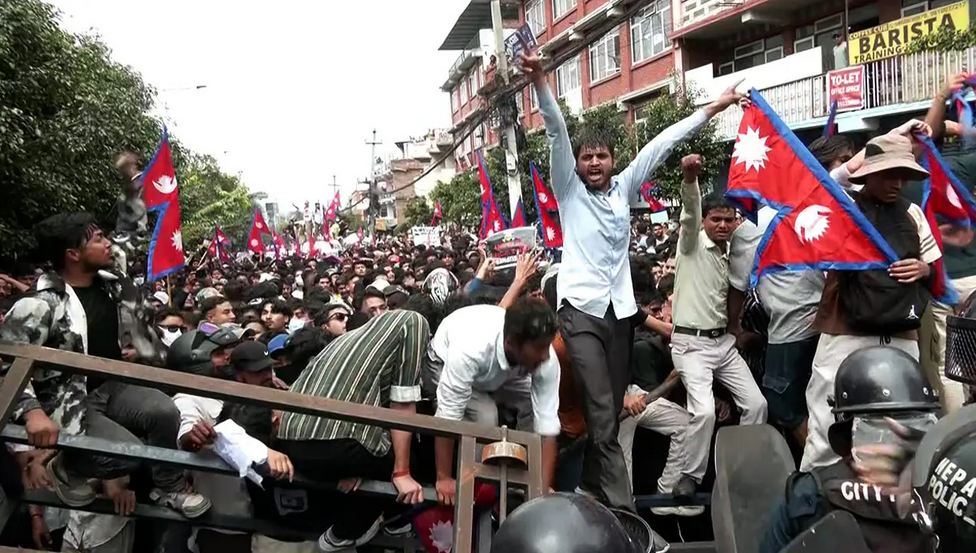
Violent rumblings from across the eastern Himalayan ranges are causing widespread concern among those observing the alarming developments in Nepal through prime-time broadcasts and social media. What began as protests by ‘Generation Z’ against nepotism, corruption, and unemployment appears to have been hijacked, transforming into frightening anarchy and mayhem that have placed
Nepal on the boil and on the brink of an unfathomable disaster.
The presence of unruly mobs, blood on the streets, widespread lawlessness, the burning of the presidential palace and parliament, the resignation of the Prime Minister, and the flight of the Nepalese Cabinet to safety paint a deeply dismal picture of a beautiful Himalayan country more commonly associated with serene, tranquil tourist destinations and people with an unhurried and relaxed attitude.
To describe the situation as grim and worrisome would be an understatement.From the days of absolute monarchy to the eventual transition to a constitutional monarchy and finally to a federal republic, Nepal’s relations with India have traditionally been warm and friendly.
Irrespective of political shifts including the recent communist government, which understandably leaned towards China the two countries have enjoyed strong, historically unique military ties built on cooperation and mutual respect.
This defence partnership forms a crucial pillar of the broader bilateral relationship. From the fearless Nepali soldiers serving in the Gurkha regiments of the Indian Army to the practice of conferring honorary army chief titles on each other’s military leaders, Indo-Nepal defence ties remain legendary.
The causes of the mass unrest, which culminated in extreme violence by an overly energised and agitated mob causing serious harm to life and property, require careful analysis, particularly because the events are occurring in India’s immediate neighbourhood. While political analysts may point to missteps by policymakers, opposition parties, or flawed government initiatives, it is equally important to examine the implications of this turmoil for India’s security.
Although it may be far-fetched to suggest that another front has opened on the Indo-Nepal border, the possibility of the border being exploited to stoke unrest in eastern India cannot be dismissed. For years, the open-border policy has facilitated legitimate movement between the two countries but has also gained notoriety as a safe haven for Indian criminals and as an entry point for terrorists and anti-national elements infiltrating India with malicious intent.
Despite the presence of the Sashastra Seema Bal (SSB), which is tasked with securing India’s borders with Nepal and Bhutan, the Indo-Nepal border has not attracted the same degree of public or political attention as the Indo-Pakistan, Indo-China, or even Indo-Bangladesh and Indo-Myanmar borders.
Yet, no international border can be fully secured to the last inch, and the Indo-Nepal border is no exception. Historically seen as a symbol of ease of movement for citizens engaged in travel, trade, and business, this frontier is now at risk owing to Nepal’s mass unrest, sudden absence of governance, and violent uprising.
It is for analysts to draw parallels between Nepal’s current crisis and recent events in Sri Lanka, the Maldives, Bangladesh, Myanmar, and Pakistan, and to deduce which actors benefit from orchestrating violent mass protests to topple governments.
Nonetheless, it is imperative for India to learn lessons and take precautions to prevent similar developments within its own borders. Almost all recent upheavals in neighbouring countries have been fuelled by the rapid circulation of malicious ‘toolkits’ on social media.
These toolkits typically combine portrayals of societal grievances such as corruption, unemployment, lawlessness, abuse of authority, nepotism, and religious divides with subtle instructions on how and where to ignite protest. Such movements are then carefully manoeuvred so that sparks escalate into uncontrollable infernos, engulfing entire nations before authorities can respond effectively.

While smaller countries, with limited geography and more homogenous populations, may be especially vulnerable, larger and more diverse nations like India are not immune.
From a security standpoint, more effective oversight of social media platforms is urgently required, as they remain the primary vehicle for disseminating such toolkits at speed and scale.
The Government should establish dedicated expert agencies to monitor social media chatter, track public sentiment, analyse the rhetoric of influencers, and trace funding sources of potential protest leaders.
This calls for constant vigilance and round-the-clock monitoring so that sparks can be extinguished before they grow into intractable fires.
Similarly, the liberal use of drones and unmanned aerial vehicles (UAVs) should be encouraged to monitor affected border areas, detect infiltration, and identify suspicious activity. Large-scale production of low-tech tactical drones will be necessary for deployment at the local level, complemented by human intelligence and other forms of surveillance. In matters of national security, no degree of vigilance can be considered excessive.
Equally significant is the need to monitor institutions such as colleges and universities, which often serve as fertile grounds for recruiting protestors who later become the willing foot soldiers of faceless mobs.
Academic administrators must be sensitised and trained to identify early warning signs and to prevent external influencers from exploiting student populations for destabilising purposes. Although the situation in Nepal continues to evolve, and there is hope that peace and stability will eventually be restored, the lives lost and the destruction of governance, law, and property cannot be reversed.
Rebuilding Nepal will demand considerable effort and resilience. For India, the lesson is clear: the people and the Government must remain alert and responsive to any warning signs that may foreshadow similar turbulence within its own borders.
The writer is an Indian Army veteran with over three decades of service in the Corps of Engineers. He has served extensively in Jammu and Kashmir and Northeast India during periods of insurgency.