


The political economy of taxation guarantees that every industry will vigorously advocate for inclusion in the lower tax bracket
 KRC TIMES Desk
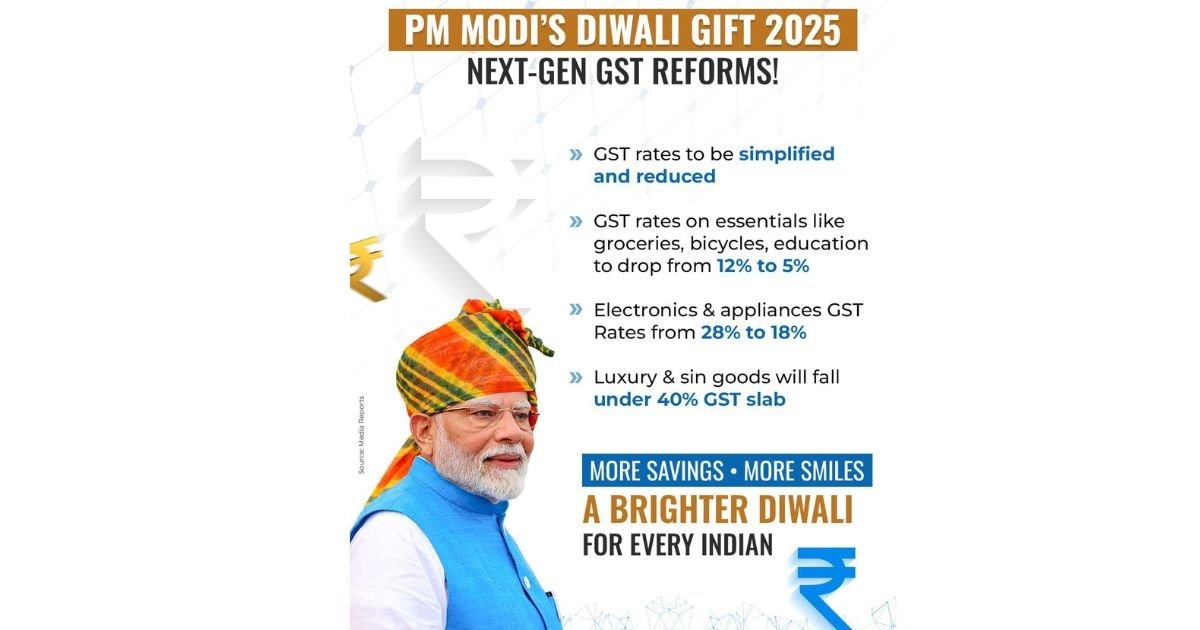
The Prime Minister’s announcement of “next-generation reforms” in the Goods and Services Tax framework marks a critical juncture in India’s economic journey. Since its launch in July 2017, GST has been hailed as a landmark step toward creating a unified tax regime, replacing a patchwork of indirect taxes that burdened businesses and consumers alike.
Yet, over the years, its complex structure-comprising multiple tax slabs, exemptions, and ambiguities-has created distortions and hampered the very objectives of ease of living and ease of doing business. The move to overhaul GST with two primary slabs-5% for essentials and 18% for most other goods-signals a long-awaited correction aimed at restoring efficiency, fairness, and consumer confidence.
GST operates across five main slabs: nil, 5%, 12%, 18%, and 28%, with additional rates of 0.25% and 3% for specific items like precious metals. This fragmentation has complicated compliance, confused consumers, and distorted the economy.
For instance, essential items such as educational materials or health-related products often attract disproportionately higher taxes, while luxury goods like diamonds enjoy concessional rates. Equally problematic is the 28% “sin tax” slab, which, although meant for luxury and demerit goods, has ensnared several categories that cannot reasonably be classified as luxuries. In any economy, a 28% indirect tax is burdensome, regressive, and counterproductive to growth.
The Government’s recognition of these distortions is timely. While GST collections have consistently risen month after month-reflecting robust compliance and better enforcement-private consumption, the real engine of economic growth, has shown worrying stagnation.
Rising tax revenues coupled with declining consumption are not signs of a healthy economy; rather, they indicate that consumers are tightening their belts, spending less even as they shoulder higher indirect tax burdens.
The tax on health insurance at 18% has particularly angered the middle class, discouraging families from securing financial protection. Similarly, higher taxes on educational services or learning materials undermine the long-term goals of a knowledge-driven economy.
Against this backdrop, rationalising GST into just two slabs promises several benefits. First, it will greatly simplify the tax regime, making it easier for businesses, especially small and medium enterprises. Second, it will reduce the effective tax burden on the average household, leaving more disposable income in the hands of consumers.
This, in turn, can spur higher spending, especially in a festive season like Diwali, which traditionally witnesses a surge in retail, automobile, real estate, and gold purchases. The Government is hoping for a double dividend: consumer-friendly goodwill and a demand-led revival of the economy.
However, implementation will not be without challenges. A critical factor will be whether businesses pass on the benefits of lower GST rates to consumers or adjust their base prices upward to protect margins. Another point of concern will be the final categorisation of items into the 5% and 18% slabs.
The political economy of taxation guarantees that every industry will vigorously advocate for inclusion in the lower tax bracket. Striking the right balance-ensuring that essentials remain affordable while luxury items bear a fairer share of taxation-will be crucial for the credibility of GST 2.0.
The timing of these reforms is also geopolitically significant. The recent decision by Washington to impose a 25% tariff on all Indian imports, followed by an additional 25% levy effective August 27, threatens to create billions of dollars’ worth of surplus goods stranded within India.
This will depress export-orientated industries, risk job losses, and add to economic stress. In this context, domestic demand becomes even more vital to absorb excess production and cushion the impact of shrinking export markets. Rationalised GST rates can help kick-start consumption, providing an internal buffer against global shocks.
Viewed holistically, GST reforms are more than a fiscal adjustment-they represent a conscious policy shift to reignite growth and build trust among citizens. The road ahead will demand vigilance, clarity, and political will. The reforms could usher in a renewed cycle of consumption and investment, helping India navigate external shocks and march with confidence toward its developmental aspirations.
Promotional | North East Integration Rally