Crowd journalism refers to the production and circulation of news by the masses rather than by professional journalists
 KRC TIMES Desk
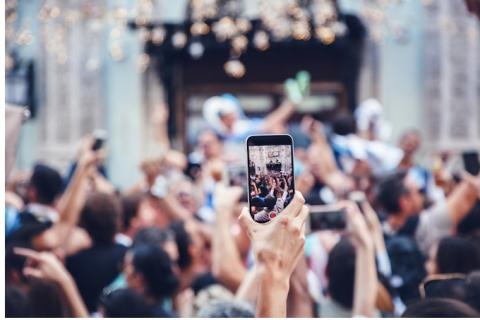
In the digital age, journalism is undergoing a fundamental transformation. The traditional newsroom, once the primary authority over information, is no longer the sole source of news and interpretation. With the rapid expansion of smartphones, social media platforms and digital networks, ordinary citizens have emerged as powerful producers of news and narratives.
This phenomenon, may be described as crowd journalism, marks a significant shift in the structure of public communication and the nature of democratic discourse.
Crowd journalism refers to the production and circulation of news by the masses rather than by professional journalists. From videos recorded on mobile phones to eyewitness accounts shared on social media, the crowd increasingly shapes what society sees, believes and debates.
This transformation carries the promise of greater participation and inclusivity, but it also raises serious questions about truth, ethics and accountability in contemporary media culture.
Historically, journalism was governed by professional norms such as verification, editorial oversight and ethical responsibility. News organisations functioned as gatekeepers, filtering information through standards of accuracy and public interest.
The rise of crowd journalism has disrupted this model by weakening institutional gatekeeping and enabling information to circulate horizontally, often without editorial mediation. While this shift has opened space for voices that were previously marginalised, it has also blurred the distinction between verified information and opinion, between evidence and emotion.

One of the defining features of crowd journalism is the emotionalisation of public discourse. Unlike professional journalism, which traditionally sought to prioritise rational analysis, crowd-generated content thrives on affective impulses such as anger, fear, pride and outrage. Digital platforms amplify emotionally charged content because it attracts attention and engagement.
As a result, public debates increasingly resemble spectacles of sentiment rather than reasoned deliberations. Complex social and political issues are reduced to polarised narratives, and the crowd does not merely report reality but performs it through emotions.
The most profound consequence of crowd journalism is the erosion of epistemic authority. In the absence of institutional mechanisms of verification, misinformation and rumours spread with unprecedented speed.
The boundary between truth and falsehood becomes fragile, and public trust in established institutions weakens. In this environment, society appears to be moving towards a post-journalistic condition in which professional journalism competes with millions of unregulated voices, each claiming legitimacy.
Crowd journalism also transforms the nature of moral judgment in the public sphere. Social media often functions as a digital court in which individuals are accused, judged and condemned without due process.
The moral authority of the crowd is volatile, driven by ideological biases and emotional impulses rather than careful scrutiny. This phenomenon reflects a broader shift in democratic culture, where public opinion increasingly takes the form of instant reactions rather than reflective judgment.
Despite its apparent spontaneity, crowd journalism is not free from power structures. Digital platforms are governed by corporate interests and opaque algorithms that determine what becomes visible and what remains invisible.

While the masses generate content, corporations control its circulation and monetisation. Political actors, too, have learned to harness crowd journalism as a tool of mobilisation and polarisation. The crowd thus becomes not only a source of expression but also a resource for ideological competition.
The challenge posed by crowd journalism is therefore not merely technological but ethical and democratic. Suppressing citizen voices is neither possible nor desirable, yet unregulated mass communication threatens the foundations of informed public life.
What is required is not a return to the old hierarchies of media authority but the cultivation of a new ethical culture that combines freedom of expression with responsibility, participation with verification and emotion with reason.
Professional journalism, in this context, faces the task of redefining its role. Rather than competing with the crowd in the race for speed and sensationalism, it must reaffirm its commitment to accuracy, depth and public accountability. At the same time, societies must invest in media literacy and critical thinking so that citizens are better equipped to navigate the complex information environment.
Crowd journalism is one of the most consequential phenomena of contemporary society. It embodies both empowerment and disorder, participation and manipulation, openness and vulnerability. The crowd has become a journalist, but without the discipline of journalism.
The future of democratic life will depend on how societies negotiate the tension between mass participation and epistemic responsibility. The question is no longer whether the crowd should speak, but how it can learn to speak with truth, restraint and ethical awareness.