


India’s High-Stakes Reset with the United States
 KRC TIMES Desk
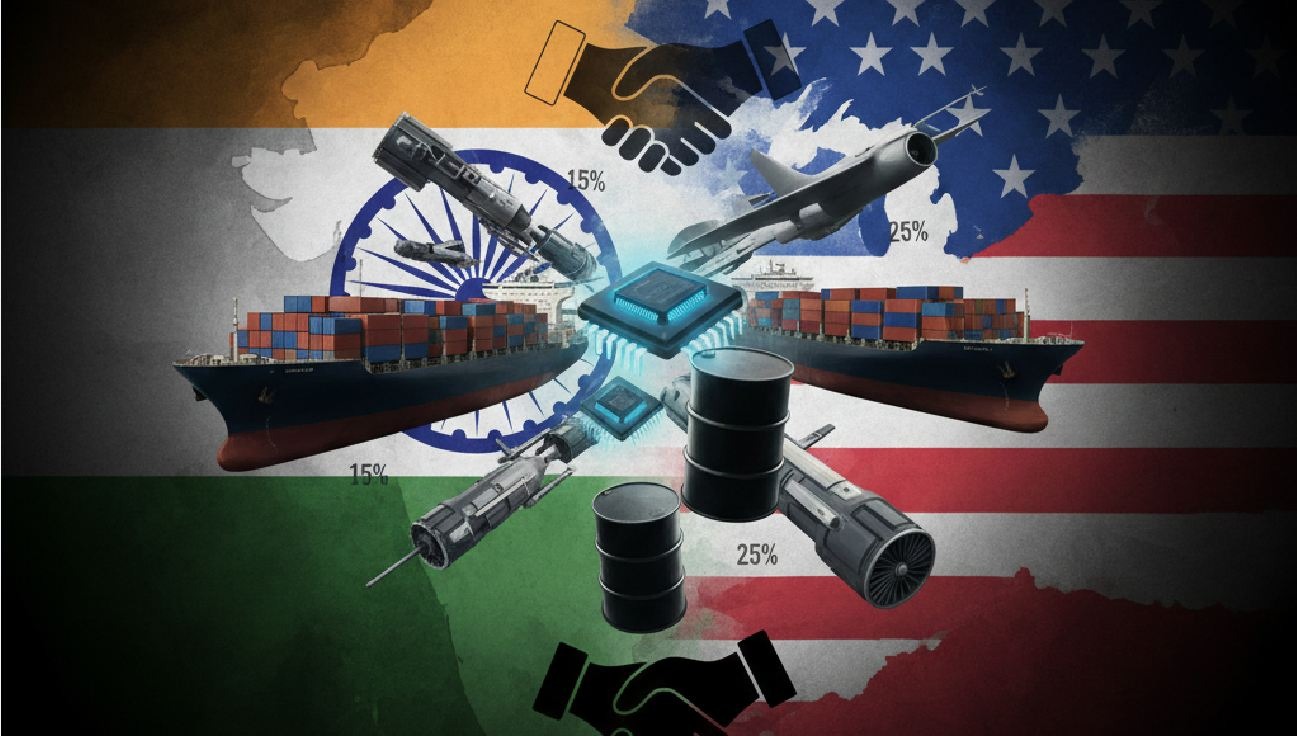
On February 9, 2026, the administration of Donald Trump released a fact sheet from the White House heralding what it described as a “historic trade deal” with India. The announcement, accompanied by a joint statement, promised to ease tariff tensions, deepen market access, and inaugurate a fresh chapter in economic cooperation between the world’s two largest democracies.
Within days, however, the celebratory rhetoric collided with domestic political reality in New Delhi. Opposition leaders decried the agreement as a capitulation. Farmer organisations warned of rural distress. Street protests followed. And as the fine print began to circulate, it became clear that what had been unveiled was not a final treaty but a provisional framework-an interim understanding still subject to negotiation, revision, and eventual signature.
What India has secured is real but conditional: significant tariff relief in exchange for selective market openings, substantial purchasing intentions, and subtle recalibrations in geopolitical alignment. It is a strategic wager-one that offers short-term economic oxygen but demands careful management of long-term sovereignty and domestic stability.
Tariff Relief: Oxygen for Exporters
The most immediate and tangible outcome of the February framework is relief for Indian exporters battered by the tariff escalations of 2025. Over the past year, many Indian products entering the American market had faced a combined effective duty of nearly 50 percent. This comprised a 25 percent “reciprocal” tariff layered atop an additional 25 percent levy tied explicitly to India’s continued imports of discounted Russian crude oil.
Under the new arrangement, that combined burden falls to 18 percent across key labour-intensive sectors-textiles, apparel, leather goods, footwear, chemicals, and certain machinery. For export clusters in Tiruppur, Ludhiana, Surat, and Agra, the shift is dramatic. Orders that had begun drifting toward Vietnam, Bangladesh, and Mexico are reportedly returning. Margins that had thinned dangerously are stabilising. The rupee, under pressure for months, has found some respite.

For Indian pharmaceuticals, gems and jewellery, and auto components, the framework hints at further preferential access as negotiations toward a comprehensive bilateral trade agreement continue. Non-tariff barriers-often more consequential than duties themselves-may be streamlined.
The United States remains a $30-trillion market. Restored competitiveness there is not a minor gain; it is a lifeline. In a global trading system increasingly fractured by geopolitical blocs, the ability to secure access to American consumers strengthens India’s claim as a manufacturing alternative to China.
The Agricultural Flashpoint
Yet tariff relief does not come free. In return, India has agreed to eliminate or sharply reduce duties on a range of American industrial goods and a politically sensitive basket of agricultural products. These include distillers’ dried grains and red sorghum for animal feed, tree nuts, fresh and processed fruits, soybean oil, wine, and spirits.
The government insists that core sensitivities-dairy, major cereals, pulses, and meat-remain shielded through quotas and exclusions. Officials emphasise that no unrestricted floodgates have been opened. But scepticism runs deep in the countryside.
Indian agriculture is dominated by smallholders with thin margins and limited state support compared to heavily subsidised American agribusiness. Farmer organisations warn that even targeted liberalisation could depress prices in vulnerable sectors such as horticulture and oilseeds. Apple growers in the Himalayan belt, citrus farmers in the Northeast, and edible oil producers in central India fear import surges that domestic supply chains may not withstand.
Memories of the 2020 farm law protests remain fresh. Opposition parties have seized upon the issue, portraying the agreement as a replay of earlier reform attempts that triggered mass mobilisation. Whether these anxieties crystallise into sustained agitation will depend on implementation-especially on safeguards, quotas, and income support measures that New Delhi ultimately deploys.
The $500-Billion Question
Equally contentious is the declaration that India “intends” to purchase up to $500 billion in American energy products, aircraft, advanced technology, and coking coal over the next five years.
The language is telling. Early drafts reportedly used the word “commitment,” which would have implied binding procurement targets. Following Indian objections, the phrasing was softened to “intention.” Yet the scale of the figure remains eye-catching-effectively doubling current import levels from the United States in the specified sectors.
Supporters argue that much of this represents reorientation rather than expansion. Oil imports, for instance, could shift partially from Russia to American or other suppliers without significantly increasing overall energy expenditure. Aircraft purchases align with the expansion plans of Indian carriers. Technology acquisitions dovetail with India’s digital and semiconductor ambitions.

Critics, however, warn of new vulnerabilities. Large purchase expectations can translate into political leverage. Failure to meet informal targets could invite renewed tariff threats. The bilateral trade balance, already tilted in India’s favour, may narrow sharply-altering negotiating dynamics in future disputes.
In effect, the $500-billion figure functions less as an accounting forecast and more as a strategic signal: India is prepared to anchor its economic future more firmly within the American orbit.
Russian Oil and Strategic Autonomy
The most geopolitically charged dimension of the framework concerns energy sourcing. The initial fact sheet from the White House suggested that the rollback of punitive tariffs was recognition of India’s “commitment” to cease purchasing Russian oil. That phrasing quickly generated unease in New Delhi.
Indian officials have avoided confirming any explicit pledge. The joint statement contains no direct reference to halting Russian crude imports. Moscow, while publicly restrained, has signalled cautious concern.
Since 2022, discounted Russian oil has played a significant role in stabilising India’s inflation and refinery margins. Beyond energy, the defence relationship with Russia remains structurally entrenched. Legacy platforms across India’s armed forces depend on Russian spare parts and maintenance. Joint ventures, including the BrahMos missile programme, illustrate a depth of cooperation unlikely to be unwound swiftly.
Yet the episode underscores a narrowing strategic corridor. Access to the American market now appears tied-implicitly if not formally-to closer alignment on Russia policy. India continues to invoke “strategic autonomy,” but autonomy in a polarised world carries rising opportunity costs.
Balancing discounted energy security with geopolitical signalling will test New Delhi’s diplomatic agility. A precipitous break with Moscow would be disruptive; visible defiance of Washington could reawaken tariff pressures.
Digital Trade and Regulatory Space
Beyond goods and energy lies the less visible but equally consequential terrain of digital trade. The framework speaks of “robust bilateral rules” to address “discriminatory or burdensome practices.” Such language echoes longstanding American concerns about data localisation mandates, cross-border data flow restrictions, and India’s digital services tax.
While revisions to the fact sheet have softened some of the more sweeping claims, the direction of travel is evident. As negotiations toward a full bilateral trade agreement advance, pressure may intensify to align India’s digital regulatory regime more closely with American preferences.

For a country that has sought to build its own data governance architecture-balancing privacy, innovation, and national security-the stakes are high. Regulatory flexibility in the digital domain intersects with issues of taxation, competition policy, and the ability to discipline global technology giants.
Concessions here may not trigger street protests in the manner of agricultural reforms, but they carry long-term implications for technological sovereignty.
China in the Background
No discussion of the February framework is complete without acknowledging the strategic shadow of China. Though not explicitly named in every clause, the subtext is unmistakable. Provisions on supply-chain resilience, rules of origin designed to curb third-country trans-shipment, and economic-security cooperation all reflect a shared American and Indian concern about “non-market policies.”
For India, which seeks to position itself as an alternative manufacturing hub in a fragmenting global economy, deeper economic integration with the United States serves both practical and symbolic functions. It signals reliability to Western investors. It reinforces the Quad’s economic pillar. It diversifies supply chains away from excessive Chinese dependence.
Yet this alignment must be managed without foreclosing engagement where interests overlap. India’s economic ties with China remain substantial despite border tensions. An overly rigid bloc mentality would constrain India’s room for manoeuvre in Asia.
Thus, the February framework sits within a broader reconfiguration of global trade-a shift from universal multilateralism toward selective, geopolitically aligned partnerships.
Interim, Not Irreversible
Crucially, the February announcement is not a finished product. It is an interim framework-subject to negotiation, clarification, and political scrutiny. The rapid edits to the initial fact sheet-softening language on agricultural access, modifying references to energy commitments, and omitting explicit mention of Russian oil cessation-demonstrate fluidity.
This interim status provides New Delhi with leverage. Indian negotiators can seek stronger safeguards for vulnerable farmers, clearer language insulating defence cooperation with Russia, and digital provisions that preserve regulatory autonomy.
The coming months will determine whether tariff relief translates into durable manufacturing gains or remains a temporary reprieve. Will export growth catalyse investment in value addition and employment? Will agricultural openings be paired with infrastructure upgrades and income support? Will geopolitical alignment be calibrated to avoid alienating indispensable partners?
Implementation, not announcement, will define success.
Pragmatism and Protest
Domestically, the framework straddles pragmatism and protest. The ruling party frames it as a masterstroke-defusing a damaging tariff spiral and securing access to the world’s largest consumer market. It argues that economic integration with the United States enhances India’s global stature and fortifies its strategic position against China.
The opposition counters that sovereignty has been bartered for short-term gains. It warns that rural livelihoods are being risked to buoy urban export sectors. It questions the scale and transparency of the $500-billion purchase intentions.
Both narratives contain elements of truth. Trade policy invariably involves trade-offs. Market access abroad often requires market openness at home. Strategic partnerships demand alignment on contested global issues.
The February framework exemplifies such a trade-off. India purchases stability and renewed competitiveness in exchange for policy adjustments and geopolitical signalling. Whether this bargain proves farsighted or fraught depends on execution and communication.
A Calculated Gamble
At its core, the February reset is neither capitulation nor triumph. It is a calculated gamble shaped by economic necessity and strategic ambition.
India’s growth trajectory depends increasingly on export dynamism, supply-chain integration, and technology partnerships. Simultaneously, its geopolitical environment grows more complex, with intensifying US-China rivalry and persistent tensions with Pakistan and China along contested borders.
In this context, closer economic ties with Washington offer insurance and opportunity. They also impose constraints.
If New Delhi consolidates tariff gains, protects vulnerable constituencies, and sustains diversified diplomatic ties-including with Moscow-the February framework could inaugurate a more mature, interest-driven partnership with the United States.
If, however, domestic backlash intensifies, safeguards falter, or geopolitical balancing fails, the agreement may be remembered less for tariff relief than for the vulnerabilities it exposed.
The headlines of February 2026 capture only the overture. The symphony-of negotiation, implementation, and political theatre-has just begun.