


Hasina fled Bangladesh on August 5, 2024, as a wave of youth-led protests under the banner of Students Against Discrimination (SAD) brought her Awami League (AL) government to its knees
 KRC TIMES Desk
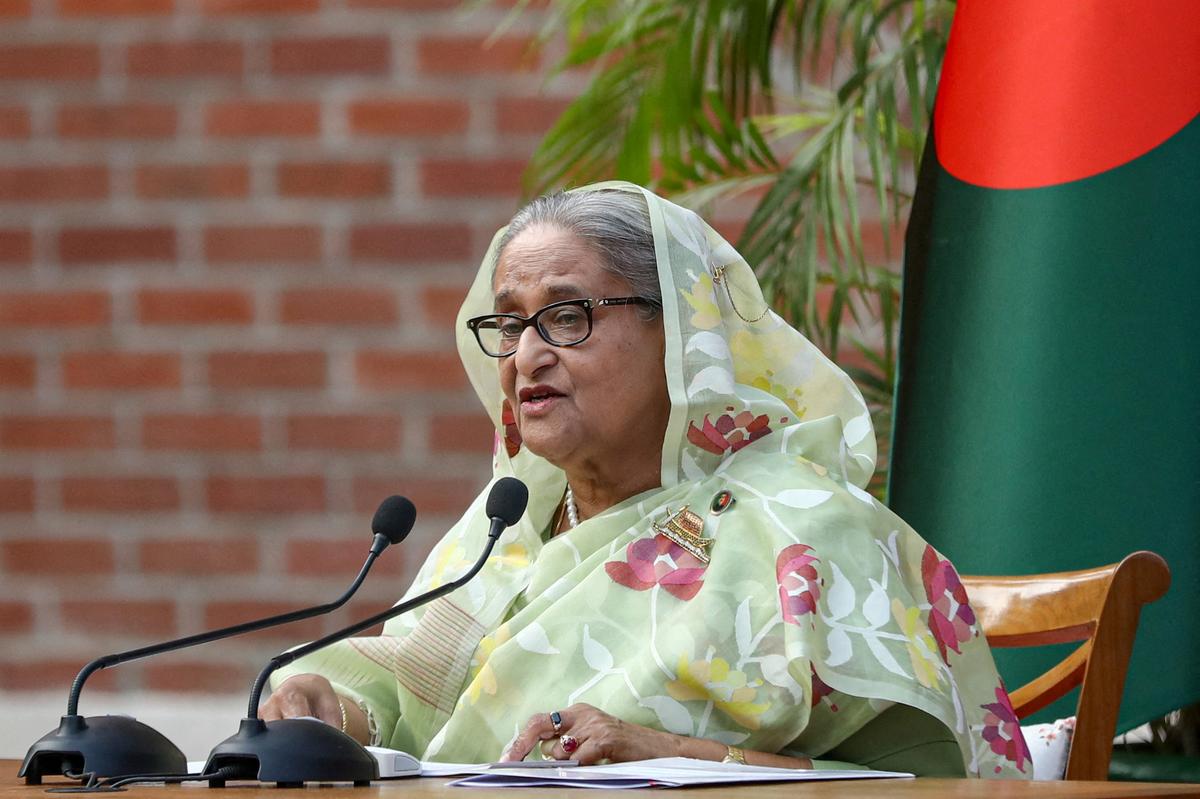
In a dramatic twist of political fate, Bangladesh finds itself witnessing the extraordinary: Sheikh Hasina, daughter of the nation’s founding father Sheikh Mujibur Rahman and the longest-serving prime minister in the country’s history, is now on trial for crimes against humanity by the very tribunal her father once set up to deliver justice to war criminals of the 1971 Liberation War. The symbolism is heavy, the ironies stark, and the implications far-reaching.
The International Crimes Tribunal (ICT), originally constituted to provide long-delayed accountability for atrocities committed during the independence struggle, now plays host to proceedings that could permanently upend Bangladesh’s political trajectory.
Hasina’s trial held in absentia, alongside former Home Minister Asaduzzaman Khan Kamal and ex-Inspector General of Police Chowdhury Abdullah Al Mamun comes amid a highly volatile political backdrop, marked by violent regime change, social upheaval, and ideological contests that stretch back generations.
Hasina fled Bangladesh on August 5, 2024, as a wave of youth-led protests under the banner of Students Against Discrimination (SAD) brought her Awami League (AL) government to its knees. The anger had been simmering for years but boiled over with fury last year, when accusations of state repression, cronyism, and constitutional manipulation reached their crescendo.
Her government’s controversial crackdown on student demonstrators triggered by resistance to the country’s job-reservation system left over 1,400 people dead in just a few weeks. These events are now central to the charges being examined by the ICT.
It is both politically significant and symbolically jarring that the charges against Hasina are being brought by the very mechanism of justice that had once set her apart from other South Asian leaders a tribunal she and her party had championed as part of a moral high ground.
It was under Hasina’s leadership that the ICT gained momentum in the 2010s, successfully prosecuting leaders of Islamist parties such as Jamaat-e-Islami for war crimes. These trials, while domestically popular, were also dogged by criticism both locally and internationally for alleged procedural flaws, politicization, and selective justice.
Now, as the political winds have shifted, Hasina herself stands accused. The Chief Prosecutor, Tajul Islam, has described her as “the nucleus of all crimes,” calling for the harshest sentence possible under Bangladeshi law. Her allies Kamal, currently in exile with her in India, and Mamun, now cooperating with prosecutors in hopes of leniency are similarly accused of orchestrating the state-led crackdown that preceded the collapse of the AL government.
The political theatre unfolding in Dhaka today is as much about justice as it is about power. This trial cannot be divorced from the broader context of Bangladesh’s ongoing political convulsions. With the Awami League in disarray and the student-led uprising fracturing under pressure, the vacuum is being swiftly filled by the Bangladesh Nationalist Party (BNP) and its affiliated conservative and radical Islamist factions.
This is where the Indian angle becomes pivotal.““Hasina’s current residence in India places New Delhi in a delicate position. The interim government of Nobel laureate-turned-political caretaker Muhammad Yunus has formally requested her extradition.
Yet, India has so far declined to act, possibly viewing her as a bulwark against the return of pro-Pakistan elements and extremist forces in Bangladesh. New Delhi has long regarded Hasina as a reliable partner, especially in matters of regional counter-terrorism, cross-border insurgency, and trade connectivity. Her ouster engineered largely by a leaderless student movement—has created strategic uncertainty.
It is hard to imagine that India will willingly extradite someone it considers an ally, particularly at a time when the democratic forces that replaced her are now under siege by precisely the factions Hasina had kept at bay.
Even within Bangladesh, questions are being raised about the trajectory of the post-Hasina order. While the SAD movement initially energized the country’s youth, its lack of political structure has allowed better-organized, ideologically driven forces to fill the void. The BNP, with its historical antipathy toward India and ambiguous ties to religious hardliners, is rapidly gaining ground.
This precarious transition invites both introspection and concern. For Hasina’s many critics, the trial is long-overdue reckoning for a leader who increasingly exhibited autocratic tendencies in her final years. It is true that during her later terms in office, she concentrated power within her inner circle, often muzzled dissent, and oversaw a security apparatus accused of human rights abuses.
The job-reservation protests sparked by frustration over limited opportunities and state patronage became a flashpoint precisely because they reflected wider disillusionment with her governance.
Yet, it is also true that Hasina’s political career was never an easy path. She governed in an environment of perpetual opposition hostility, inherited a nation still recovering from the trauma of partition and genocide, and faced an ever-present threat from radical elements that continue to view secularism as an anathema. Under her leadership, Bangladesh saw dramatic economic growth, improved public health indices, and consistent efforts at regional cooperation. For many, she symbolized stability.
What this trial ultimately represents is a nation struggling with its own history—unsure whether to embrace continuity or rupture. Is Hasina being made a scapegoat for structural failures that span decades? Or is she finally being held accountable for grave abuses of power? The answer, unfortunately, may be neither clean nor simple.
Legal experts have already raised concerns about the legitimacy of trying a former head of government in absentia, especially in a tribunal with a deeply politicized history. While trials in absentia are permitted under Bangladeshi law, they are often viewed with suspicion internationally, especially when tied to high-profile political figures. Moreover, there is the risk that this trial, rather than healing wounds or setting democratic precedents, may deepen divisions and push Bangladesh further into a cycle of retributive politics.
Indeed, the fate of Sheikh Hasina now seems intertwined with the broader fate of Bangladesh’s democratic project. If her trial becomes a means to settle political scores, it risks delegitimizing the very institutions it seeks to empower. If, however, it can rise above partisan agendas and be conducted with transparency, fairness, and due process, it could offer the nation a moment of genuine reckoning.
The coming months will be crucial. India’s decision on extradition will signal the direction of regional geopolitics. The actions of the interim government in Dhaka will determine whether Bangladesh walks the path of restorative justice or authoritarian vengeance. And the people of Bangladesh particularly its young citizens who once cheered Hasina and later rose against her must decide whether their struggle ends with the removal of a leader or with the rebuilding of a republic.
In the end, history is not only cyclical it is layered. Sheikh Hasina, like her father before her, has now become both architect and casualty of a nation’s turbulent journey. Whether her trial becomes a cautionary tale of power, a symbol of accountability, or merely a political vendetta will depend not just on judges and prosecutors, but on the conscience of a country still searching for itself.
Promotional | Subscribe KRC TIMES e-copy