

By Prof. Madan Mohan Goel, Published by Eye View Enterprises, New Delhi
Price: Rs.250 | First Edition 2025 | ISBN: 978-81-979021-6-1 Pages 176
 Biswadeep Gupta
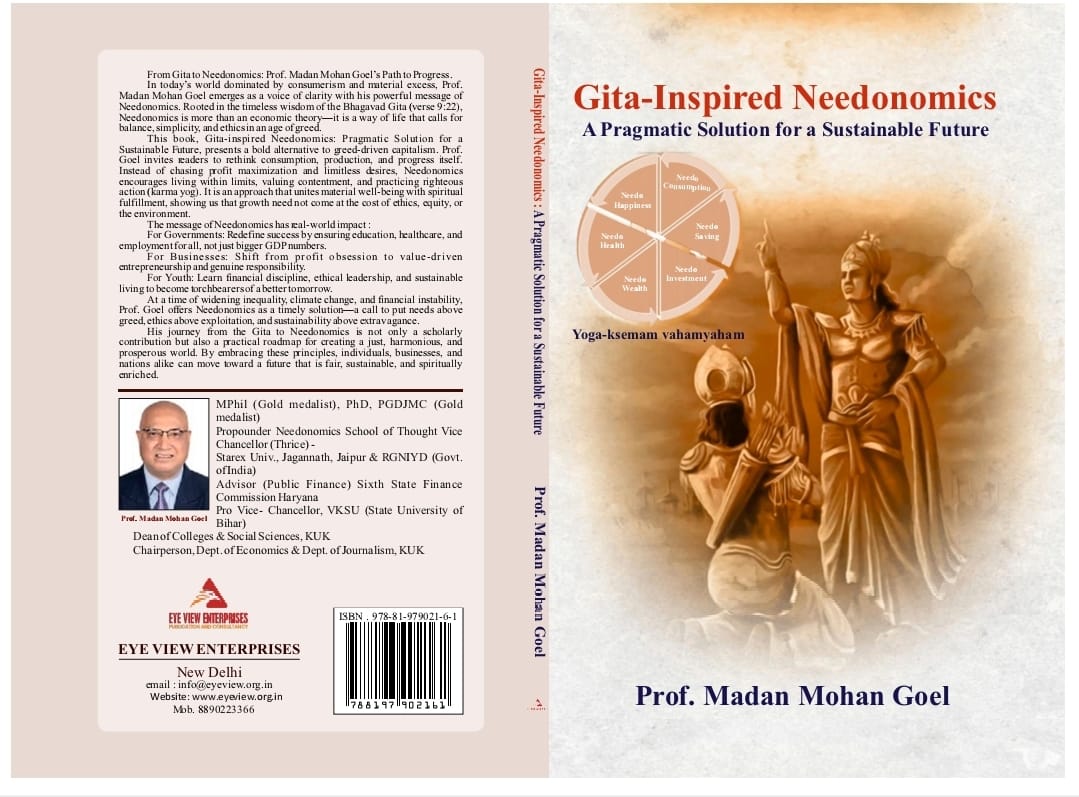
The latest work of Prof. Madan Mohan Goel, Gita-Inspired Needonomics: A Pragmatic Solution for a Sustainable Future, is a timely and thought-provoking contribution to contemporary economic discourse. At a moment when the global economy is grappling with climate crises, widening inequality, resource depletion, and pervasive consumerism, this book offers a refreshing alternative rooted in ethical, sustainable, and value-based living.
As the propounder of the Needonomics School of Thought (NST), Prof. Goel presents an integrative framework that draws deeply from the Bhagavad Gita while engaging with modern economic realities. The outcome is a compelling intellectual blend—at once philosophical, practical, and visionary.
A Value-Based Alternative to Greedonomics
The central thesis of the book challenges the dominant paradigm of Greedonomics—an economic mindset driven by excessive accumulation, limitless wants, and the exploitation of people and the planet. Prof. Goel posits that the world’s current crises—climate change, economic volatility, social disorder, and moral erosion—arise from systems that have normalised greed.
In response, he proposes Needonomics, an economics of needs rather than wants, which emphasises sufficiency, balance, ethical conduct, and sustainable development.
Grounded in the teachings of the Bhagavad Gita, Needonomics seeks to align human aspirations and economic activities with righteous duty (swadharma), moderation, and harmony. It emphasises “simplicity without deprivation,” advocating a middle path where consumption, production, governance, and development are guided by what is necessary, just, and sustainable.
Structure and Scope: A Comprehensive Framework
The book is divided into six sections, comprising twenty-six well-curated chapters that systematically explore the philosophical foundations, sectoral applications, and policy implications of Needonomics.
Section 1: Foundations of Needonomics
This section lays the conceptual groundwork by connecting Gita’s eternal wisdom with the modern relevance of Needonomics. Prof. Goel reinterprets wealth, welfare, and human purpose through a lens that counters materialism. The chapter on Greedonomics critiques the growth-at-any-cost model, while the SWOC analysis offers an honest evaluation of Needonomics—its potential, limitations, opportunities, and challenges.
Section 2: Consumer and Market Perspectives
The chapters here are particularly useful for understanding how Needonomics can recalibrate the behaviour of stakeholders across market systems. With concepts such as “Needo-Consumption” and ethical supply chains, the author shows how consumers, producers, distributors, and traders can adopt need-based decisions to restore balance in global markets. The analysis is grounded in real-world insights and provides policy-relevant recommendations for ethical and equitable trade.
Section 3: Governance and Policy
Prof. Goel extends the NST framework to governance structures, arguing for “Needo-Governance” that is transparent, efficient, and rooted in public welfare. Chapters on the knowledge-based economy, the 16th Finance Commission, Indian Systems of Medicine, and global institutions like the IMF and World Bank demonstrate how Needonomics can enrich both national and international policymaking. This section makes a strong case for integrating ethical values into public policy and global economic governance.
Section 4: Sector-Specific Implications
This section is one of the book’s strengths, as it operationalises Needonomics in specific sectors—agriculture, manufacturing, and services. By offering practical pathways for food security, labour-intensive growth, and service-sector ethics, the author illustrates the versatility of Needonomics. The chapter on teachers and researchers is a valuable addition, urging academic stakeholders to shift from careerism to purpose-driven scholarship.
Section 5: Needonomics and Indian Thought
Prof. Goel bridges Needonomics with the economic philosophies of prominent Indian thinkers such as Dattopant Thengdi, Kautilya, Deendayal Upadhyaya, and Dr. B.R. Ambedkar. These comparative analyses not only enrich the theoretical depth of Needonomics but also demonstrate its coherence with India’s civilizational heritage. The synergy between the Arthashastra’s statecraft and the Gita’s spiritual guidance is particularly illuminating.

Section 6: Future Vision and Roadmap
The concluding section outlines a transformative vision for Viksit Bharat @ 2047, integrating Sustainable Development Goals (SDGs), national priorities, and the ethical foundations of Needonomics. The comparison with Schumacher’s Small is Beautiful and Dr. J.K. Mehta’s wantlessness expands the philosophical breadth of the text. The roadmap offered is ambitious yet grounded in ethical realism, reflecting Goel’s conviction that India can be a lighthouse nation for sustainable global development.
A Blend of Philosophy, Economics, and Practical Ethics
What sets this book apart is its ability to connect the transcendental wisdom of the Bhagavad Gita with contemporary economic challenges. Prof. Goel does not merely reinterpret scripture; he transforms its teachings into actionable principles for consumers, producers, policymakers, and academicians. His approach is normative yet pragmatic, philosophical yet empirical. The book’s emphasis on balance—between growth and ecology, consumption and restraint, rights and duties—mirrors the Gita’s own ethos of equanimity.
Relevance to India and the World
At a time when India aspires to reach developed-nation status by 2047, Gita-Inspired Needonomics offers a value-oriented blueprint for holistic progress. The framework resonates with India’s cultural ethos while addressing global concerns such as climate change, sustainable agriculture, ethical markets, and equitable finance. The book also positions Needonomics as a potential contribution to global economic thought, inviting economists worldwide to reconsider models built solely on GDP growth and profit maximisation.

Strengths of the Book
An interdisciplinary approach blending economics, ethics, governance, and Indian philosophy. Clear articulation of Needonomics as an alternative to both classical and modern capitalist models.
Sector-wise practical applicability makes the model relevant to real-world decisions. Integration of Indian thinkers to contextualise economic development within indigenous intellectual traditions.
Forward-looking roadmap for national and global sustainability.
Areas for Further Exploration. While comprehensive, the book could stimulate future research in:
Quantitative models based on Needonomics principles. Comparative international case studies. Integration with behavioural economics. Tools to measure Needo-Happiness or Needo-Efficiency
These are natural extensions that scholars may build upon.
Conclusion
Gita-Inspired Needonomics: A Pragmatic Solution for a Sustainable Future is a significant intellectual contribution from Prof. Madan Mohan Goel. It challenges mainstream economic thought and offers a refreshing, ethical, and sustainable alternative rooted in India’s timeless wisdom.
The book is indispensable for policymakers, economists, educators, students, and socially conscious citizens seeking a balanced path between material progress and moral responsibility. In a world dominated by excess and exploitation, Prof. Goel’s Needonomics shines as a guiding light—inviting humanity to rethink prosperity, redefine progress, and rebuild the future with integrity, balance, and compassion.