


A Soldier’s Reflections on the Birth of Bangladesh
 KRC TIMES Desk
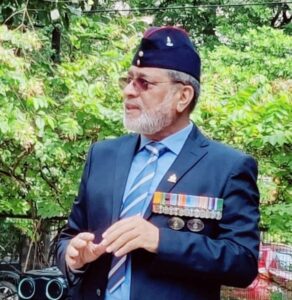
Col (Dr.) AKS Machhral, M-in-D, VSM (Retd)
The night of 3 December 1971 remains etched in my memory not just as a date in history, but as a turning point that shaped my understanding of duty, sacrifice, and the price of freedom. I was only 13 years old, a school-going boy who had just been moved with my family to Jalandhar, considered a “safe place.” Yet nothing felt safe that night. A storm was rising, and India was being pushed into a war that was not only inevitable, but necessary.
My father, a seasoned soldier who had witnessed the 1965 War in Leh – Ladakh and later in Ferozepur, was deployed right on the edge of the border that very night. While we took shelter away from danger, he stood exactly where the nation needed him calm, steady, and ready. Even as a child, I understood one thing, some men stand between the country and chaos.
Over the years, as life unfolded, that boy grew into a man in uniform. I would go on to spend 37 years serving the nation, fight as part of the Indian Peace Keeping Force (IPKF) in Sri Lanka, participate in Kargil (Op Parakram), rise as an officer, and see war with my own eyes far closer than I ever imagined as a child in 1971. Today, both my sons also serve the nation.
This journey has taught me something simple yet profound, war is war never a slogan, never entertainment, never a political tool. It is blood, sacrifice, and the last test of human endurance.

When Innocence Was Under Siege.
In East Pakistan now Bangladesh millions of unarmed Bengali civilians were being slaughtered, women rights were violated, families uprooted, entire villages erased by the Pakistani military. The genocide forced nearly 10 million refugees into India.
India did not jump into battle; India was pulled into a humanitarian tragedy. This was not a war for conquest, it was a war for conscience, justice, and humanity.
Leadership That Redefined Military History.
At the helm of India’s Eastern Command was Lieutenant General Jagjit Singh Aurora. Alongside him, the brilliant strategist Major General Subeg Singh trained thousands of Bengali youths into the fearsome guerrilla force the Mukti Bahini.
Facing them was Pakistan’s Eastern Commander, Lieutenant General A. A. K. Niazi. With Gen Aurora’s bold, precise, multi-directional strategy, Indian forces encircled the Pakistani Army from all sides. Meanwhile, Gen Subeg Singh’s well-trained Mukti Bahini struck deep behind enemy lines, collapsing Pakistan’s internal control.
I had the privilege of meeting Major (Later Inspector General of Police) U. C. Chhabra of the Mahar Regiment, a daring and brilliant young officer who operated deep inside enemy territory in civilian clothes alongside the Mukti Bahini.
When he narrated his experiences from Bangladesh especially the mission in which he helped save the family of Sheikh Mujibur Rahman, it sent shivers down my spine. Listening to him, one could feel the weight of history in every word he spoke.
I also had the honour of serving as ADC (Aid-de – Camp) under the legendary Maj Gen R. K. Suri, VrC the saviour of Fazilka and a hero revered by the masses. He had commanded a unit in the Western Sector during the war and was grievously wounded, yet he continued to fight with unmatched grit and leadership.
Hearing the stories of 1971 directly from him from the horse’s mouth was like touching history with my own hands. His courage, resilience, and clarity of purpose remain a guiding light for every soldier who served under him, including me.
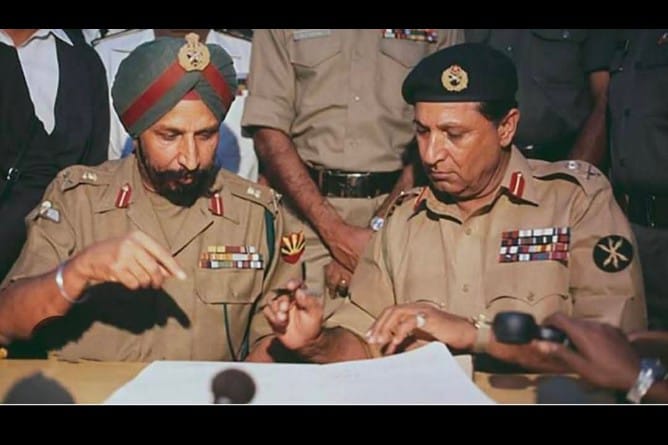
India’s Air Force destroyed Pakistani air capabilities, and the Navy blocked Pakistan’s sea routes. Within less than two weeks, Indian soldiers were marching into Dhaka. 16 December 1971 – The Moment the World Watched in Awe. At the Ramna Race Course, Dhaka, Gen A. A. K. Niazi surrendered before Gen Aurora.
With that single act: 93,000 Pakistani soldiers laid down their arms, marking the largest surrender since World War II.
And giving birth to the sovereign nation of Bangladesh.That historic ground was later renamed Suhrawardy Udyan, a symbol of freedom and courage.
My Journey as a Soldier – And the Harsh Truth.
Having worn the uniform for decades, having fought in IPKF, having lived through ambush, uncertainty, fear, and duty, I can say with conviction: only a soldier truly understands what war means.
For politicians, war is often a game of power. For followers, it becomes a step towards a political ticket or influence. But for a soldier, war is duty beyond duty, a commitment to protect the nation’s boundaries, even at the cost of one’s own life.
And yet, the saddest part remains, those who fight are often not looked after by the very politicians and bureaucrats who depend on them. Why does this happen? I still do not know. I leave this uncomfortable question to the readers.
Because visiting a forward post, waving to soldiers, taking photographs means nothing if a soldier’s rights are not protected, if his family is left unattended, if his future remains uncertain. Only those who stand guard at night know the true cost of freedom. A War That Had to Be Fought. India does not fight for territory.India fights for truth.
The birth of Bangladesh stands as one of the greatest victories of moral conviction in modern history. Looking back, from son of a solider, 13-year-old child to battle-hardened soldier to father of two serving sons, I can say with clarity:
1971 was not India’s war, 1971 was humanity’s war. And India fought it with honour.
Author’s Note (By Ashk Machhanvi)
As a soldier’s son, a soldier myself, a veteran of 37 years of service, and a father of two serving sons, I write this not to glorify war but to remind readers of its terrible price.
We celebrate victories, but we must also honour the men and families who carry the burden long after the guns fall silent. The nation must rise above politics, remember its defenders, and ensure their dignity and rights are never compromised.