


Golden Langurs as Early-Warning Indicators in India’s Northeast
 KRC TIMES Desk
Ashk Machhanvi
India’s Northeast represents one of the most complex internal security and ecological theatres in the world. Dense forests, porous borders, insurgent mobility, illegal timber extraction, wildlife crime, and difficult terrain limit the effectiveness of conventional intelligence tools such as drones, satellites, and static surveillance.
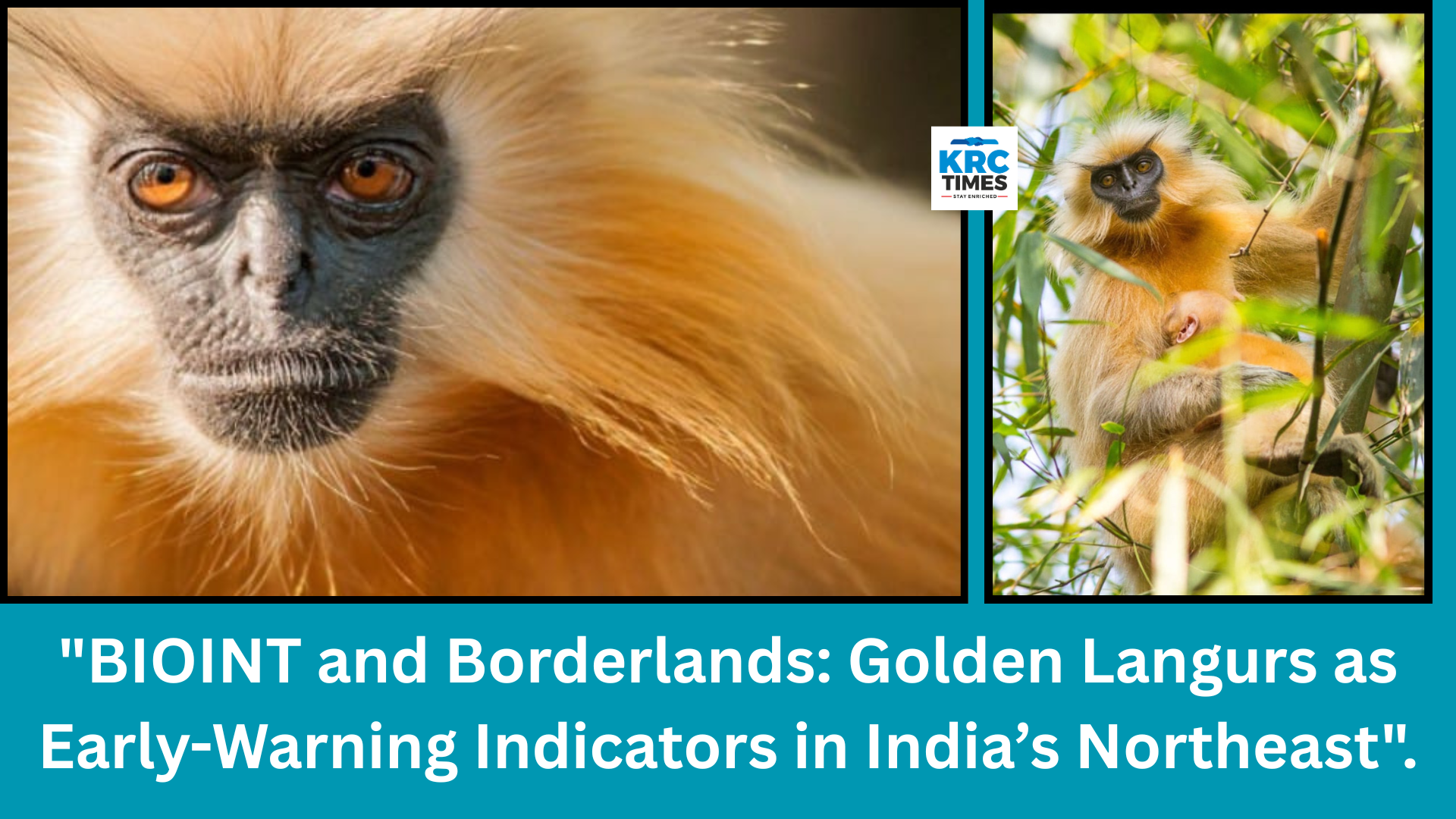
This article introduces BIOINT (Biological Intelligence Indicators) as a complementary intelligence domain and explores the Golden Langur (Trachypithecus geei) a Schedule (I), endangered primate as a non-invasive, ethical, and legally compliant early-warning indicator.
By studying and integrating naturally occurring behavioural cues of Golden Langurs with HUMINT, IMINT, and ELINT, India can enhance forest security, counter-insurgency awareness, and border management without violating wildlife protection laws.
- Introduction: Intelligence Gaps in Forested Borderlands
The forests of western Assam and adjoining borderlands with Bhutan and Bangladesh are not merely ecological spaces, they are operational environments. These jungles are routinely exploited by,
insurgent groups for concealment and transit,
organised forest-theft networks,.cross-border smugglers and infiltrators,
and anti-national elements seeking sanctuary beyond conventional reach.
While modern surveillance technologies have transformed intelligence collection, they face severe degradation in tropical forest conditions as under:-
(i) Dense multi-layered canopies,
(ii) Persistent cloud cover,
(iii) High humidity,
(iv) Limited line-of-sight,
(v) Electronic noise.
This compels a reassessment of ground-truth intelligence, especially indicators that operate continuously, silently, and organically.
- The Golden Langur: Ecology, Distribution, and Legal Status.
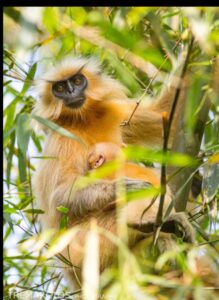
The Golden Langur (Trachypithecus geei) is endemic to a narrow ecological belt between the Manas and Sankosh rivers in western Assam and southern Bhutan.
Key Habitats in India
Chakrashila Wildlife Sanctuary, (Kokrajhar–Dhubri).
Kakoijana Reserve Forest (Bongaigaon).
Manas National Park (Western Range).
Raimona National Park (Indo-Bhutan border).
Umananda Island (introduced population).
Conservation Status
IUCN: Endangered
CITES: Appendix I
India: Schedule I, Wildlife (Protection) Act, 1972.
Estimated Population: 6,000 – 7,000
Golden Langurs are among the most legally protected species in India. Any intelligence framework involving them must therefore be strictly non-intrusive, observational, and science-led.
- Cultural and Civilisational Context.
For communities in western Assam and the Bhutanese foothills, the Golden Langur is regarded as sacred, often associated with Hanumanic symbolism. This cultural reverence has historically ensured community protection and offers a crucial advantage: local cooperation.
Unlike technological surveillance often viewed with suspicion ecology-based monitoring rooted in cultural respect enjoys social legitimacy, a critical factor in long-term intelligence sustainability.
- BIOINT: Defining Biological Intelligence Indicators.
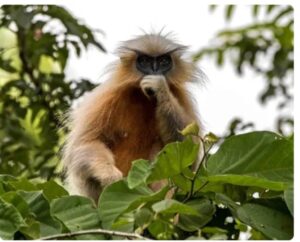
BIOINT does not imply training, deploying, or manipulating animals. It refers to the scientific interpretation of naturally occurring biological behaviour as an indicator of environmental anomalies.
In forest ecosystems, primates function as
highly sensitive disturbance detectors,
canopy-level observers,
and continuous environmental monitors.
Golden Langurs respond sharply to:
(i) Unusual human movement,
(ii) Metallic sounds and weapon handling,
(iii) Smoke and fire,
(iv) Night-time activity,
(v) Unfamiliar odours and vibrations.
Such responses manifest as:
Abrupt troop migration,
Repetitive alarm calls,
Abandonment of feeding zones,
Abnormal clustering or silence.
These behaviours are ecological signatures of intrusion.
- Why Golden Langurs Can Outperform Drones
In dense jungle conditions.
Drones are weather-dependent and detectable.

Satellites provide periodic snapshots, not continuity.
Sensors are vulnerable to sabotage or interception.
Golden Langurs, by contrast can
operate 24×7, all-weather,
cannot be jammed or spoofed,
adapt instantly to terrain changes, and cover micro-corridors inaccessible to humans.
They act as living early-warning systems, particularly effective in areas where militants establish temporary jungle camps or forest thieves operate cyclically.
- Forest Department as the Nodal Authority
Under the Indian Forest Act and Wildlife (Protection) Act, 1972, the Forest Department must remain the lead agency.
Its role includes the following:
(i) Long-term behavioural mapping,
(ii) Bio-acoustic libraries of alarm calls,
(iii) Habitat disturbance databases and
coordination with academic institutions.
This ensures legality, ethics, and ecological balance.
- Police, CAPF, and Border Security Applications
Police and CAPF (CRPF, Assam Rifles, BSF, ITBP) can benefit indirectly through:
(i) Early alerts on illegal timber movement,
identification of forest-thief corridors,
(ii) Detection of infiltration routes along the Bangladesh border,
(iii) Night-time movement indicators beyond human patrol range.
(iv) Golden Langur behaviour can function as a natural trip-wire, allowing forces to focus patrols and reduce ambush risk.
- Military and Counter-Insurgency Relevance.
In counter-insurgency environments where
sustained troop presence is risky,
intelligence grids are thin,
and militant camps are transient.
BIOINT indicators when fused with the following:-
HUMINT (local sources),
IMINT (targeted satellite or UAV imagery),
ELINT (communication spikes),
can drastically reduce search areas and improve decision-making cycles.
This is not substitution, but intelligence multiplication.
9.HUMINT- IMINT- ELINT- BIOINT, Fusion Model.
The proposed model positions BIOINT as a supporting intelligence layer, feeding into existing systems.
Golden Langurs thus become,
sentinels, not assets,
Indicators, not instruments,
protected species, not tools.
Such fusion offers India a low-cost, high-credibility, deniable intelligence advantage, particularly suited to forested borderlands.
- Legal and Ethical Safeguards.
Any implementation must ensure the followings:-
Zero captivity or relocation,
No invasive tagging,
no coercive conditioning,
Oversight by State Wildlife Boards,
transparency with MoEFCC and MHA.
This framework aligns with:
Article 48A (environment protection),
Article 51A(g) (citizen’s duty),
Wildlife (Protection) Act, 1972.
- Strategic Implications.
If responsibly adopted, this approach can
prevent crores of rupees in forest theft,
enhance border security in Assam – Bangladesh belt,
reduce troop casualties,
Strengthen civil- military- forest coordination,
and evolve a uniquely Indian intelligence doctrine rooted in ecology.
To sum up in an era of visible, expensive, and vulnerable surveillance, India’s forests offer an older, subtler intelligence advantage. The Golden Langur endangered, sacred, and perceptive stands as a reminder that nature observes before technology reacts.
BIOINT, when ethically integrated, does not militarise wildlife, it civilises intelligence.
About the Author.
The author is a retired senior officer of the Indian Army with over four decades of operational experience in the field of Intelligence, specialising in Imagery Intelligence (IMINT), he had served as a HOD & Senior Instructor Military Intelligence Training School. He has been directly involved in and led numerous successful intelligence-based operations in India and abroad, contributing significantly to mission planning, target analysis, and strategic assessment.
A recognised authority in IMINT, he has authored multiple analytical papers and professional articles on intelligence, surveillance, and national security. He has served as a Visiting Faculty at the National Remote Sensing Agency (NRSA), Hyderabad, and later headed an academic faculty specialising in intelligence studies.
His distinguished service includes postings in the Cabinet Secretariat and the Police Department, reflecting rare civil-military intelligence integration experience. A recipient of a Gallantry Award, the Vishisht Seva Medal (VSM), and multiple commendations, his professional journey represents a sustained contribution to India’s national security, intelligence doctrine, and institutional capacity building.
Promotional | North East Integration Rally