


A Forgotten Mahabharata Chapter
 KRC TIMES Desk
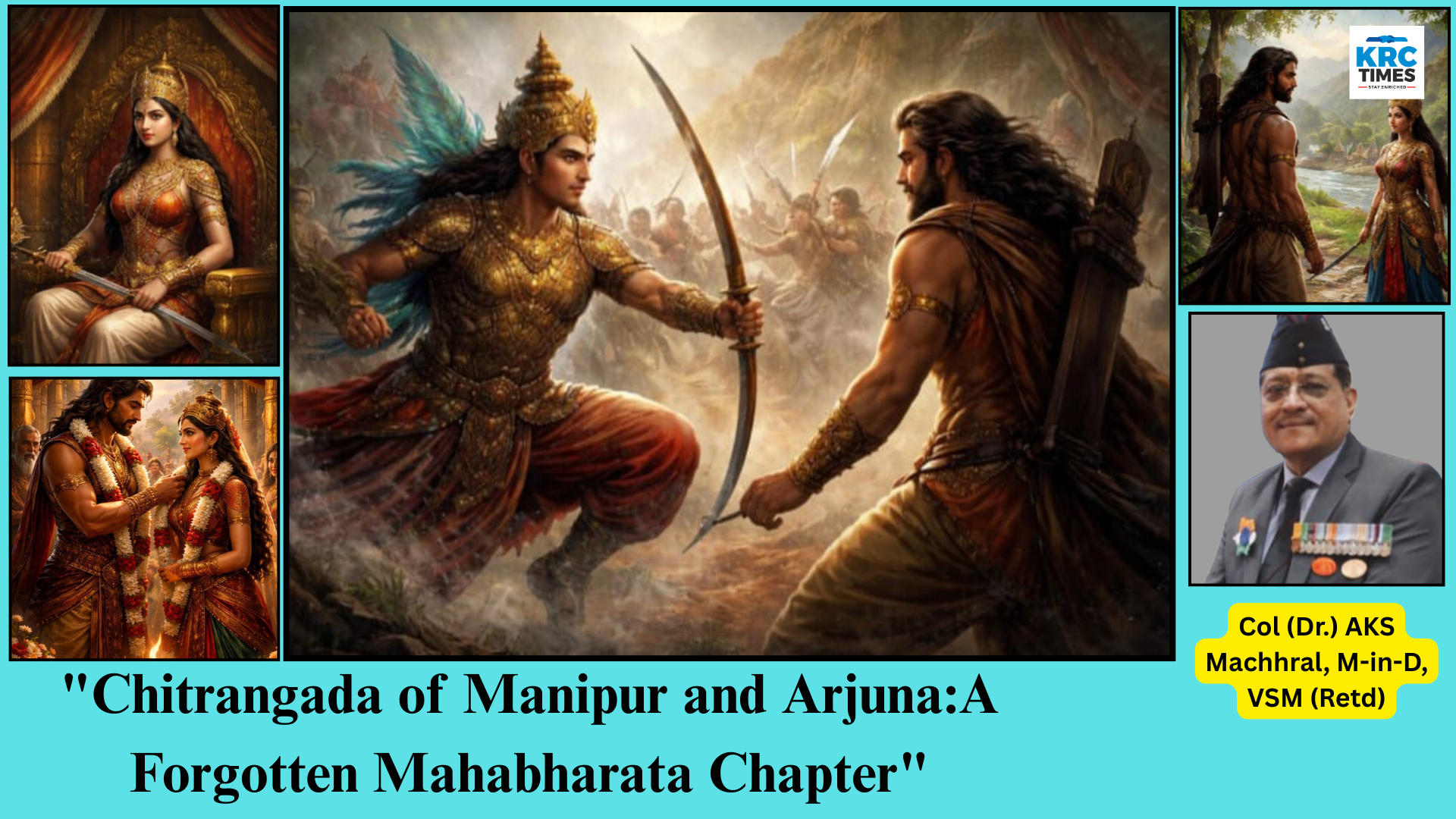
This article examines the lesser-studied episode of Arjuna’s sojourn in Manipur and his marriage to Princess Chitrangada as narrated in the Mahabharata. Moving beyond romanticised retellings, the study situates the episode within the ethical framework of dharma, political sovereignty, and cultural integration in ancient India.
Through close reading of relevant Parvas and interpretive scholarship, the paper argues that the Arjuna – Chitrangada narrative offers enduring insights into restraint, partnership, lineage, and India’s plural civilisational structure insights that remain relevant in contemporary cultural discourse.
(i) Mahabharata, Chitrangada, Arjuna, Manipur, Dharma, Cultural Integration.
The Mahabharata is not merely an epic of war but a compendium of ethical dilemmas, social norms, and civilisational memory. While the Kurukṣetra war dominates popular and scholarly attention, several peripheral episodes reveal equally significant dimensions of dharma and polity.
Among these is Arjuna’s encounter with Princess Chitrāngadā of Manipur, an episode dispersed across Parvas and often treated as marginal. This paper revisits the narrative to demonstrate its importance for understanding ancient India’s cultural plurality and ethical imagination.
(ii) Arjuna’s Exile and the Ethics of Self-Imposed Austerity
Arjuna’s journey to Manipur begins with his voluntary exile following his inadvertent intrusion upon Yudhiṣṭhira and Draupadī. Although absolved by his elder brother, Arjuna insists on adhering to the agreed condition of exile, reflecting a profound commitment to personal accountability (svadharma) rather than juridical punishment.[^1] The exile thus functions as a tīrtha-yātrā—a pilgrimage of self-discipline and ethical refinement.
(iii) Manipur in the Epic Imagination.
In the Mahābhārata, Manipur (Manipura) appears as a sovereign eastern kingdom, governed by King Chitravahana. Its inclusion within Arjuna’s travels underscores the epic’s awareness of India’s geographic and cultural expanse.
Far from being portrayed as peripheral, Manipur is shown as politically autonomous and culturally integrated into the broader dharmic world. This challenges later notions that position the northeastern regions outside the core of ancient Indian civilisation.
(iv) Chitrangada: Sovereignty and Womanhood.
Princess Chitrangada is introduced as a warrior-trained heir, raised to rule in the absence of a male successor. Unlike stereotypical portrayals of royal women as passive figures, Chitrangada embodies political authority and martial competence. Her agency complicates modern assumptions regarding gender roles in ancient Indian society and invites a re-evaluation of women’s sovereignty within epic traditions.
(v) Marriage as Dharma Without Possession.
The marriage between Arjuna and Chitrangada is formalised under a critical condition set by King Chitravahana, the son born of the union shall inherit Manipur, and Arjuna shall claim no dynastic or territorial rights.
Arjuna’s acceptance of this condition represents an ethic of restraint and non-possession, aligning with the Kṣatriya ideal of responsibility without annexation. This model of marital alliance stands in contrast to conquest-driven unions and offers an alternative paradigm of partnership.
(vi) Babruvāhana and the Question of Lineage.
From this union is born Babruvahana, destined to rule Manipur. Arjuna’s departure without asserting paternal authority underscores a crucial ethical stance, lineage does not necessitate control. The epic thus distinguishes between biological legacy and ethical responsibility, a distinction often overlooked in dynastic narratives.
(vii) The Ashvamedha Episode: Karma and Reckoning.
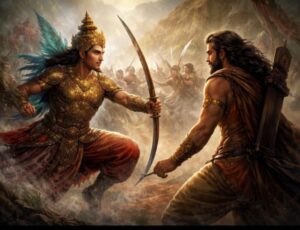
The narrative reaches its culmination during Yudhiṣṭhira’s Aśvamedha Yajna, when Arjuna enters Manipur and is challenged by Babruvahana, who remains unaware of their kinship. Arjuna’s defeat and death at his son’s hands, followed by revival through divine intervention symbolise the inescapability of karma. The episode reinforces the Mahabharata’s central thesis, no individual, however heroic, stands above ethical causality.
(viii) Contemporary Cultural Relevance
The Arjuna–Chitrāngadā episode holds significant implications for contemporary India. First, it affirms the historical integration of the Northeast within India’s civilisational narrative. Second, it presents a model of gendered sovereignty grounded in dharma rather than antagonism.
Third, it offers a critique of unrestrained power, advocating leadership tempered by self-limitation. In an era marked by cultural fragmentation, these insights warrant renewed engagement.
To conclude Chitrangada’s story is not a marginal footnote but a vital thread in the Mahabharata’s ethical tapestry. Through restraint, partnership, and respect for sovereignty, the Manipur episode exemplifies a plural and humane vision of civilisation. Reclaiming this narrative enables a deeper appreciation of India’s epic heritage and its relevance for present cultural and ethical debates.
Author’s Note
This study is informed by a combination of textual engagement with the Mahabharata and long-term professional exposure to India’s eastern regions. Experience gained through service in the Northeast provided especially Manipur sustained opportunities to observe local cultures, social structures, and historical consciousness as they exist beyond textual representations.

Such exposure underscores that Manipur and the wider Northeast are not merely strategic or administrative spaces, but regions possessing deep civilisational continuity. Indigenous traditions, oral histories, and lived cultural practices encountered in the region resonate strongly with themes preserved in Itihasa, particularly those related to sovereignty, duty, and cultural integration.
The present work adopts a cultural historical approach, seeking to situate Manipur firmly within the epic imagination of ancient India. The intention is to restore scholarly attention to a narrative that reflects India’s plural civilisational structure and ethical depth. By revisiting the Arjuna Chitrangada episode, the study contributes to a more integrated understanding of epic tradition and regional history.
The views expressed are personal and based on open-source historical and traditional narratives.