

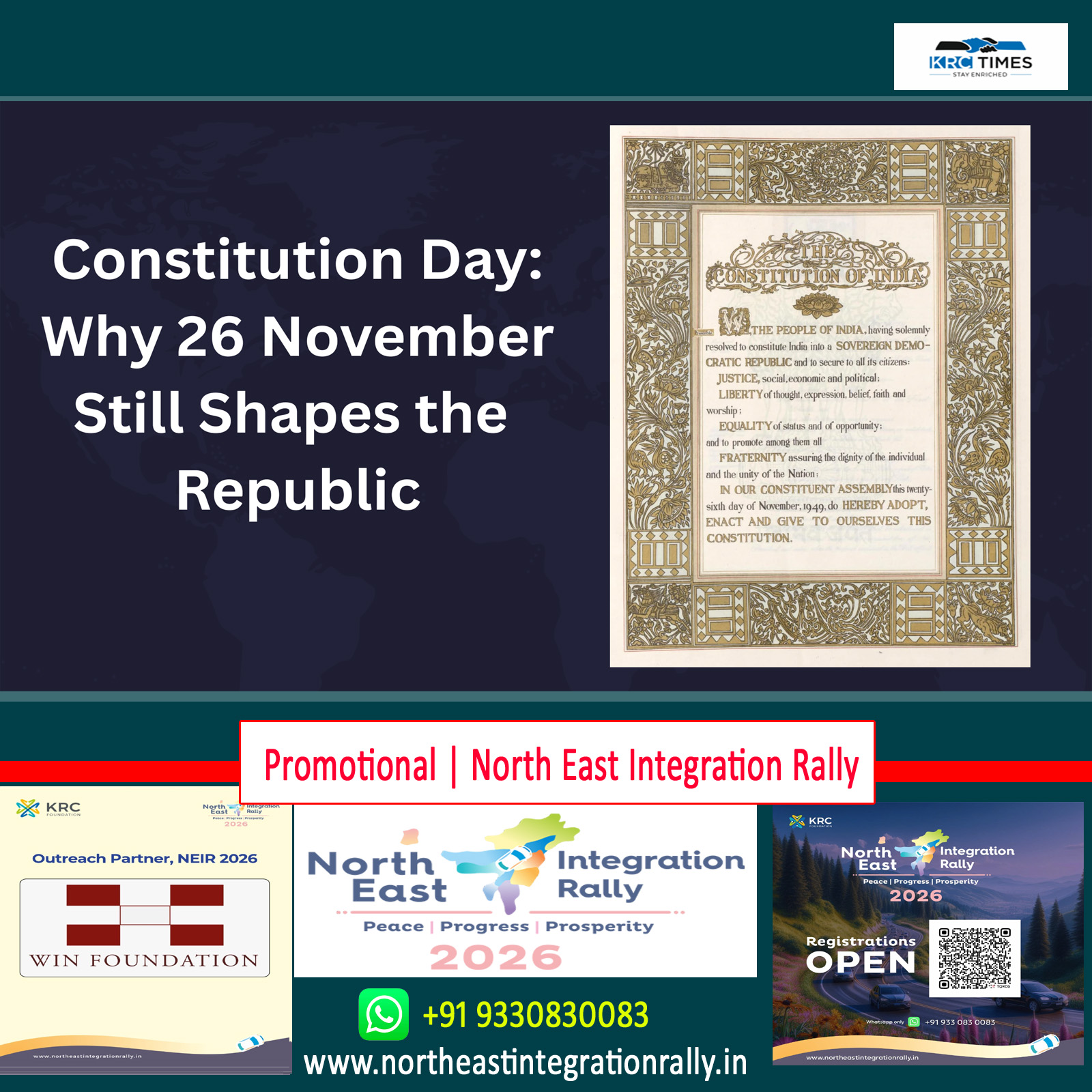
Why 26 November Still Shapes the Republic
 KRC TIMES Desk
Rajkummar
Every year, 26 November asks us to pause for a moment and look at the document that quietly guides the Republic. Constitution Day isn’t wrapped in spectacle. It doesn’t have the colors of Independence Day or the ceremony of Republic Day. But it carries a deeper kind of weight because it reminds us where the country’s democratic journey truly began.
Here’s what matters. Before 26 January became the date everyone remembers, 26 November 1949 marked the moment the Constituent Assembly finally said yes to the Constitution. After almost three years of debate, drafting, argument and compromise, India had a framework for a diverse, stubborn, hopeful nation. The document wasn’t just a legal manual. It was a social contract for a country still learning what freedom meant.
The people who worked on it knew how fragile that freedom was. The scars of Partition were fresh. The economy was weak. The idea of India itself was still taking shape. Yet the Assembly chose rights, checks and balances, and democratic participation as the foundation. That wasn’t an obvious choice at the time. It was a courageous one.

Let’s break it down. The Constitution didn’t simply describe the government. It tried to secure dignity for every citizen. Fundamental rights, affirmative action, federalism, independent institutions, and a commitment to justice, liberty, equality, and fraternity were built into the system. These weren’t slogans. They were instructions for a new nation, telling it to aim higher than the divisions it inherited.
For decades, 26 November lived mostly in history books. That changed in 2015 when the Ministry of Social Justice and Empowerment formally announced that the date would be celebrated as Constitution Day. The idea was simple: people should engage with the Constitution not as something they studied in school but as something that shapes their daily rights and responsibilities.
Since then, the day has slowly grown into a space for reflection. Schools hold readings of the Preamble. Institutions revisit debates on justice and equality. Courts use the moment to highlight the importance of rule of law. None of this is ornamental. In a democracy as loud and contested as ours, the Constitution often becomes the only shared reference point.

What this really means is that Constitution Day belongs to citizens more than to institutions. It is a chance to ask whether the promises made in 1949 still guide us, and whether we still believe in the values stitched into that document. It also asks tougher questions. Are we living up to our commitment to equality. Do we understand our rights. Do we practice our duties.
The beauty of the Constitution is that it expects citizens to be active, not passive. It expects disagreement. It expects evolution. It expects participation. The drafters knew they were writing for a country that would change, argue, push back and reinvent itself. The amendment process they designed reflects that trust.
Bottom line: Constitution Day isn’t a ritual. It is an invitation to revisit the compact that holds 1.4 billion people together. In a society where politics often divides, the Constitution remains the one thing meant to unite. Reading the Preamble for two minutes may seem small, but it reminds us of a simple truth: democracies survive not because of the machinery of the state, but because citizens choose to uphold shared values.
Seventy-five years after its adoption, the Constitution is still a living text. Courts interpret it, governments test it, and citizens defend it. Its endurance is proof that the founders didn’t just draft a document. They set up a moral compass for a restless, ambitious nation.
So when 26 November arrives, it is worth taking a moment to think about the journey from that day in 1949 to the country we see today. The Constitution gave India its direction. The responsibility to keep it meaningful still rests with us.
Promotional | North East Integration Rally