


Bangladesh’s Minorities and the Price of Political Upheaval
 Sangram Datta
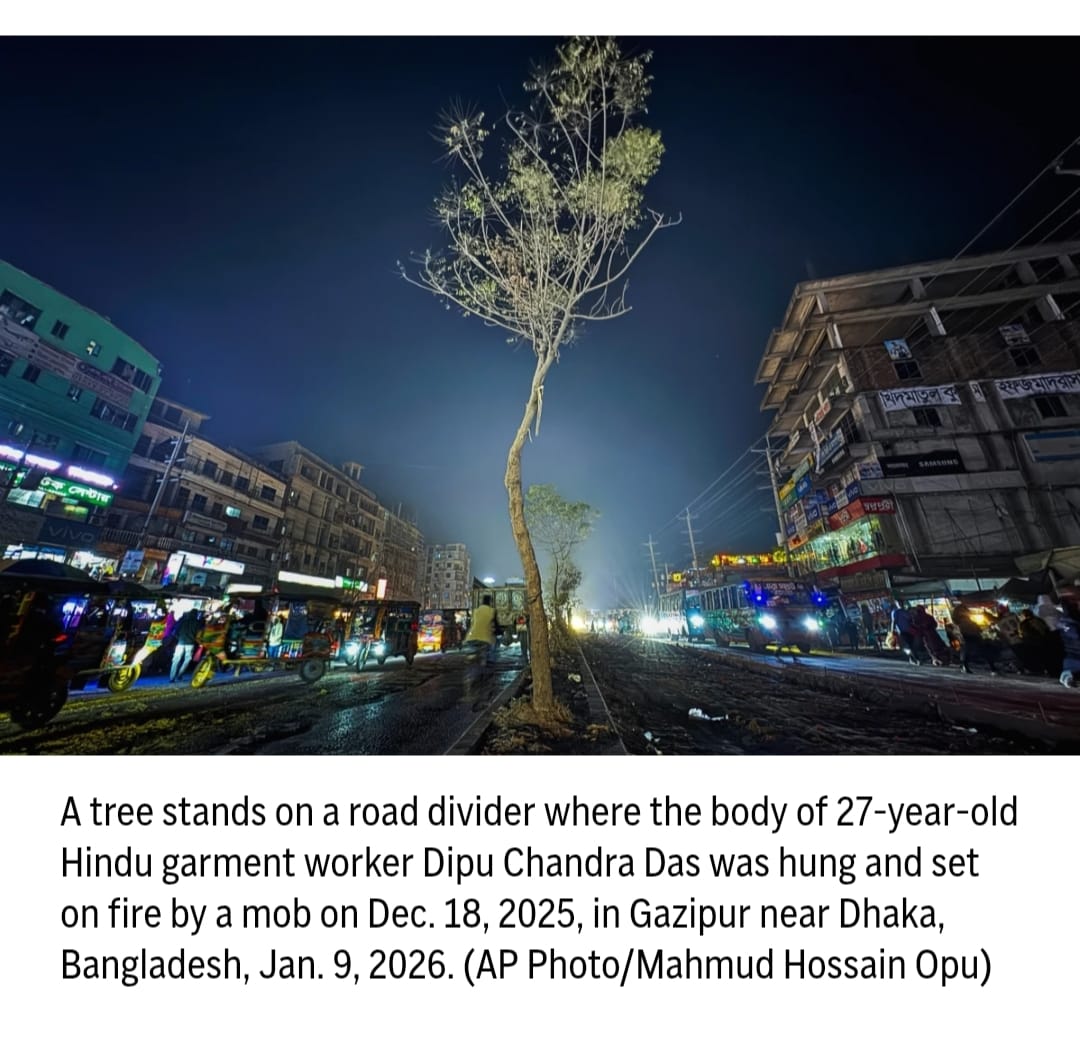
In the days leading up to Bangladesh’s national election scheduled for 12 February 2026, a series of international media reports has drawn renewed global attention to the insecurity faced by the country’s religious minorities. On 5 February 2026, the Associated Press published a report titled “Bangladesh’s Hindu minority in fear as attacks rise and a national election nears.”
Similar coverage appeared in The Washington Post on 4 February 2026 under the same headline, and Australia’s ABC News echoed the concern in its own reporting that day. Taken together, these accounts do more than document isolated tragedies—they illuminate a recurring pattern of fear, vulnerability, and political uncertainty that has shadowed minority communities across decades of the region’s history.
At the center of recent attention lies the killing of Dipu Chandra Das, a 27-year-old garment worker accused of making derogatory remarks about the Prophet Muhammad. According to international reporting, the accusation triggered mob violence that ended in his death.
Images circulated widely, deepening anxiety among Hindu communities already uneasy amid intensifying political competition. Protests demanding justice followed, and authorities announced arrests and an investigation. Yet human rights advocates and minority leaders argue that the incident reflects a broader surge in attacks rather than a singular eruption of violence.

Bangladesh’s demographic reality underscores the stakes. Hindus constitute roughly 8 percent of a population of about 170 million, while Muslims account for the overwhelming majority. Minority advocacy organizations report thousands of incidents of communal violence since the political upheaval of August 2024 that removed former Prime Minister Sheikh Hasina from power. Documented cases include killings, assaults on women, and attacks on places of worship.
Government officials dispute claims of systemic failure, insisting that many incidents stem from personal or political disputes rather than religious hostility. This divergence in interpretation between official reassurance and minority fear forms the core tension of the present moment.
History lends weight to that fear. Communal violence in Bengal did not begin in the twenty-first century; it has repeatedly resurfaced during periods of political transition. The Noakhali riots of 1946 left deep scars on collective memory. In the early years of Pakistan, Law Minister Jogendra Nath Mandal ultimately resigned and left for India following violence against vulnerable communities he felt powerless to protect.
The 1971 Liberation War produced one of the largest refugee movements in South Asian history, with millions many from minority backgrounds crossing into India amid widespread devastation. Subsequent decades witnessed recurring outbreaks of communal tension, from idol vandalism in the 1970s to major disturbances in 1989, 1990, 1992, 2001, and the Ramu violence of 2012. Each episode reinforced a perception among minorities that political turbulence often translates into personal insecurity.

Elections, in particular, have long been flashpoints. Minority voters are frequently perceived fairly or not as aligned with specific political camps. Such perceptions can heighten vulnerability in polarized environments, especially when law enforcement responses are viewed as inconsistent.
Analysts also highlight land disputes as an underlying driver of violence: displacement during unrest can make property easier to seize, blending communal tension with material incentive. When accountability appears uncertain, fear becomes self-perpetuating.
The present electoral cycle unfolds amid shifting political alliances and the reemergence of Islamist parties once pushed to the margins. Some parties now emphasize inclusivity and minority outreach, nominating minority candidates and pledging institutional protections.
Critics, however, describe these gestures as largely symbolic, arguing that meaningful security depends less on rhetoric than on impartial governance, credible investigations, and consistent prosecution of perpetrators.
Regional geopolitics further complicates the picture. Attacks on minorities in Bangladesh have sparked criticism from India, while Bangladeshi authorities accuse New Delhi of politicizing the issue. Diplomatic friction has spilled into visa policies and even sporting relations, illustrating how communal insecurity within one nation can reverberate across borders.
For vulnerable families, however, geopolitical debate offers little immediate comfort; their concerns remain grounded in safety, justice, and survival.
What emerges from the convergence of historical memory, contemporary violence, and electoral uncertainty is not simply a minority issue but a democratic test. The protection of vulnerable citizens is among the clearest measures of institutional strength. Where minorities feel secure, rule of law is credible; where they live in fear, governance itself is questioned.
Bangladesh stands at a consequential juncture. The approaching election will determine political leadership, but it will also signal whether the nation can break from cycles that have repeatedly endangered its most vulnerable communities.
Ensuring accountability for violence, safeguarding places of worship, protecting property rights, and affirming equal citizenship are not concessions to minorities they are prerequisites for democratic stability.
International attention, as reflected in the February 2026 reporting by the Associated Press, The Washington Post, and ABC News, should not be viewed merely as external scrutiny. It is also an opportunity: a reminder that the world is watching, and that the credibility of democratic institutions depends on their ability to protect every citizen, regardless of faith.
For Bangladesh’s minorities, the hope is simple yet profound that fear will no longer precede the ballot, and that citizenship will carry equal meaning in moments of calm and crisis alike.