

Mission Bwiswmuthi 2.0 Highlights:
* Over 47,000 indigenous landless families will be directly benefitted through Mission Bwiswmuthi 2.0
*Close to 9,000 small tea-growers and rubber farmers will instantaneously benefit from the flagship mission
*Before the end of 5-year term, the BTR Government has taken another significant step ahead towards Prime Minister Modi vision for a Viksit Bharat @ 2047
 KRC TIMES Desk
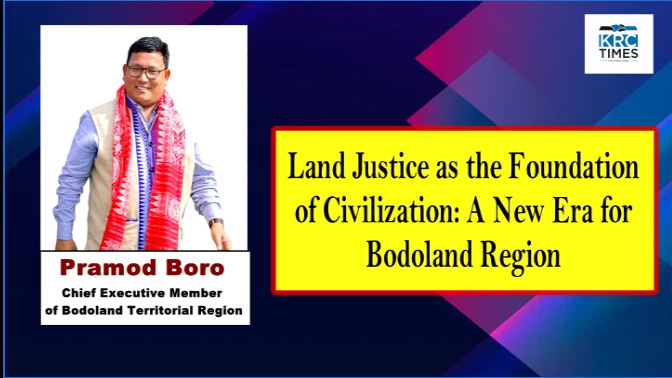
Pramod Boro
In every chapter of human history, land has served not merely as territory but as the foundation within which societies, cultures, ideas and idealsare forged. Land is the ground on which civilizations have risen, emplaced cultures, and redefined identities over time, space, and social landscapes.
The Bodoland Region, rich in diverse cultures and traditions, finds itself at a historic crossroads where a long-overdue reformation in land administration is now paving the way for renewed dignity, empowerment, and sustainable development through a series of reforms.
Even after India celebrated its independence in 1947, a critical sector that should have underpinned rapid national progress—land reform—continued to struggle with deep-rooted challenges in the Bodoland Region. Governed by the stringent provisions of Chapter X of the Assam Land and Regulation Act of 1886, vast tracts of land within and around Bodoland languished under neglect and non-implementation.
In the 47 designated tribal belts and blocks within the present Bodoland Territorial Region (BTR), along with an additional 19 areas lying outside its ambit, land disputes festered. Over decades, significant segments of land fell prey to encroachment and alienation, often through mechanisms of usury and fraud, leaving many of the indigenous and tribal communities disenfranchised and exposed to exploitation.
The decades-old mismanagement of land records, disputes, and settlements has not only disrupted economic growth but has also deeply affected the social fabric of the region. Land, being an essential need of human dignity, the people were robbed of its promise as a secure anchor for families and communities as their livelihoods, heritage, and identity.
Recognizing the intrinsic link between land and human dignity, the present BTR Government has embarked on a comprehensive reform agenda that is as visionary as it is practical. Today, every bonafide citizen of Bodoland Territorial Region —irrespective of caste, community, or historical disadvantage—is being extended the promise of secure land rights, under both the amended provisions of Chapter X of the Assam Land and Revenue Regulation, 1886, and the spirit of inclusion as envisioned in the Sixth Schedule to the Constitution (Amendment) Act, 2003.
Over the past four and a half years alone, the BTR government has reached a significant milestone by providing land rights to more than 26,775 families within revenue villages. Further, 32,798 Individual Land Title Distribution and 1161 Community Land Title Distribution have been completed till date under Forest Rights Act 2006.
In parallel, various land-related services delivered through both offline and online platformshave benefitted approximately 3,23,178 individuals. This hybrid approach—merging traditional mechanisms with modern technology—is creating a resilient ecosystem for land governance, geared to overcome the inertia of centuries-old practices and catapult the region into a future of transparency and fairness.
Mission Bwiswmuthi: The Engine of Transformation
At the heart of these transformative changes is the flagship initiative, “Mission Bwiswmuthi1.0.” The outstanding results of Mission Bwiswmuthi 1.0 will now be followed by the launch of Mission Bwiswmuthi2.0. In the first phase, the mission streamlined administrative procedures, secured land rights for citizens, and enhanced trust in government services across the region.
The project offered fourteen pivotal land-related services to the local population through online mode. These services included processing mutations by inheritance and deed, facilitating land partitioning, and reclassifying properties up to one bigha. Additionally, the initiative enabled conversions of land categories, and allowed for correcting area and name inaccuracies.
The project updated mobile numbers and provided certified copies of essential documents, including the Jamabandi and Chitha. It also issued Land Holding Certificates and updated the Records of Rights (RoR/Jamabandi) after direct settlements.
Under Mission Bwiswmuthi 2.0, six more additional settlement services are being introduced to allow eligible holders to secure their rights. It will offer settlement on government lands for individual small tea growers and for groups such as NGOs and cooperative societies.
It will also provide services for individual settlers and institutions on various government lands, benefitting small tea growers and rubber farmers among others. Additionally, eligible occupiers will benefit from the settlement of transferred lands, while online certified copy mapswould be made available to verify property boundaries.
For instance, it is a known fact that agriculture remains the key component of Bodoland’s economy, with small tea gardens and rubber plantations dotting the landscape. Approximately 8,000 small tea gardens, covering an area of 2239.04 hectares, now stand to gain directly from the initiatives under Mission Bwiswmuthi 2.0.
These gardens, a vital source of livelihood, collectively produce nearly 9,95,92,875 kilograms of green tea leaves annually—an economic force that not only contributes to local growth but also boosts the region’s integration with national and global markets.
This Mission Bwiswmuthi 2.0 is designed to streamline the process of land settlement by reducing administrative delays and enhancing service transparency. As a result, families who have long waited for the promise of a secure livelihood on their ancestral lands are now poised to receive timely benefits.
The mission is not merely about issuing documents; it symbolizes the BTR Government’s commitment to rectifying historical inequities and restoring dignity to every corner of the region.
Yet another significant step in the last two years has been that surveys have been successfully conducted in 36 previously unmapped non-cadastral villages across BTR, particularly those nestled along the border with Bhutan.
For 77 years—since India’s independence—these communities had been deprived of formal land recognition. Leveraging modern drone technology, the Department of Land Revenue & Disaster Management has meticulously surveyed these areas, initiating the process of land records preparation and subsequent patta distribution.
Central to Bodoland’s renewed vigor in land administration is the modernization of the institutional framework governing land records. A state-of-the-art central record room, complete with an advanced record tracking and management system, is now operational.
Complementing this is a well-equipped Geographic Information System (GIS) laboratory, which plays a pivotal role in accurately mapping the region’s territoryand ensuring that land records are updated in real time.
This digital transformation—integrating land services onto online platforms—has not only streamlined administrative processes but has also instilled greater public confidence in the system. Continuous capacity-building programs for officials ensure that the latest technology is effectively harnessed to provide reliable and prompt services.
As disputes over land ownership diminish, the resultant clarity and transparency are fostering an environment of trust and collective progress. The modern digital backbone of land services is a testament to the region’s commitment to redefining governance for a sustainable future.
These sweeping reforms in the Bodoland Region resonate deeply with the integrated vision of growth as articulated by the Prime Minister of India Narendra Modi . His universal call to “Sabka Saath, Sabka Vikas, Sabka Vishwas, Sabka Prayaas” is the approach that our BTR Government has tried to embody with sincerity and commitment. This inclusive development model will surely lead us to achieve the vision of a Viksit Bharat @ 2047.
Land is not to be seen only as a commodity; it is the bedrock upon which the dignity of a community is built. In so doing, BTR Government has helped secure land rights for every eligible family, effectively reducing long-standing disputes, restricting unauthorized encroachments, and minimizing instances of land fraud.
This in turn has had far-reaching socioeconomic implications. Thus,communities have been assured of their fundamental right to the land they have historically depended upon. This is already ensuring a ripple effect across education, health, and economic productivity in our region.
Restored land rights have enhancedconfidence, mutual trust and a deep sense of healing, thus, paving the way for peace, harmonious co-existence and sustainable local development. In BTR, families who previously grappled with insecure tenure are now empowered to invest in their properties, cultivate crops with renewed confidence, and contribute robustly to local economic initiatives.
The trust engendered by a transparent land governance system has uplifted entire communities, paving the way for a future where they are able to dream, see visions and co-exist where development is both inclusive and self-sustaining.
Bodoland’s advances in land reform underscore a commitment to crafting not only a secure present but also a resilient future. The comprehensive reforms have positioned the Bodoland Territorial Council as a pioneer among the various Sixth Schedule Councils across India.

The drive towards technological integration, when combined with an earnest effort to redress historical injustices, exemplifies a modern model of governance.This model is characterized by transparency in service delivery, an agile administrative framework, and an unflinching commitment to citizen empowerment.
As Bodoland envisages to become a model of “Peaceful, Smart and Green” development, the established institutions are continuously evolving to meet the dynamic needs of the population. These initiatives are not isolated projects but are interconnected facets of a larger vision—a vision that aims to secure land rights as a pathway to a dignified and prosperous future.
The evolution of land reforms in the Bodoland Region is more than an administrative exercise; it is a reaffirmation of human dignity and the timeless belief that every individual deserves a secure stake in the future.
By reimagining age-old practices through modern technology and inclusive policies, Bodoland is not only resolving historical inequities but is also laying down a robust foundation for a resilient socio-economic landscape.The journey has just begun, and to forge a future of enduring dignity, prosperity, and unity, BTR Government will leave no stone unturned in the coming days.
Promotional | Subscribe KRC TIMES e-copy