


How a New Approach to India-China Border Could Usher in Peace
 KRC TIMES Desk
S. BHATTACHARJEE
A Midnight Phone Call and a Familiar Idea Late in the evening of August 22, 2025, as I prepared to wind down for the night, the phone rang. On the other end was an old friend, a seasoned observer of India-China relations. He sounded both amused and excited. “Have you seen the communique?” he asked. “India and China have decided to tackle their border disputes sector by sector instead of pushing for a grand settlement all at once.
They’re calling it an early-harvest approach to build confidence. Isn’t this exactly what you had proposed years ago with your ‘Line of Amity’ idea?” He was right. What had once been dismissed as an eccentric suggestion-shifting focus from an all-or-nothing boundary resolution to incremental confidence-build- ing-seemed to be finding resonance in the corridors of power.
For me, it was déjà vu. Origins of the “Line of Amity” The “Line of Amity” was an idea I had first floated in 2014, during a Track II dia- logue with Chinese counterparts. The prop- osition was deceptively simple: if both sides were unwilling to yield ground in a compre- hensive settlement of the 3,488 km-long In- dia-China frontier, why not begin with small steps in less contentious sectors?
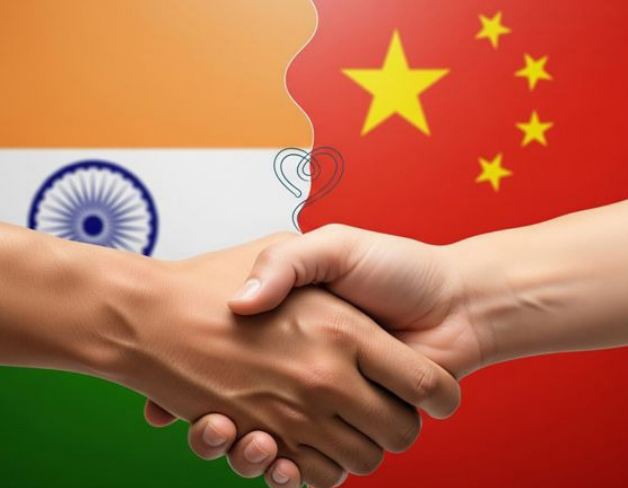
Instead of clinging to the militarized and adversarial term “Line of Actual Control” (LAC), which carries the baggage of decades of mistrust, why not rename it the “Line of Amity”? Semantics may seem trivial in geopolitics, but words shape perceptions. A nomenclature that signals goodwill could nudge mindsets toward accommodation rather than confrontation.
The idea was ridiculed at the time. I was no soldier, critics said, merely an academic with “elementary” knowledge of Himalayan frontiers. My field travels across the East- ern Sector were brushed aside. But the more I studied the history of border conflicts, the clearer it became: disputes rarely dissolve overnight; they are chipped away at slowly, often beginning with symbolic gestures.
A Webinar Amid Crisis I tested this theory again in August 2020, when tensions were at their peak following the bloody clashes at Galwan Valley in Lada- kh. Organizing a webinar titled “India-Chi- na Boundary: An Eye to the Eastern Sector”, I brought together some of the sharpest minds and most experienced practitioners: former Foreign Secretary Shyam Saran, for- mer Eastern Command Chief Lt. Gen. J.R. Mukherjee, former Home Secretary G.K. Pillai, and several corps commanders and academics.
The timing was deliberate. If dialogue could be attempted at the lowest point of bilateral ties, I argued, imagine the possi- bilities during calmer times. My inspira- tion came partly from the Hollywood classic Crimson Tide, where the captain of a sub- marine insists on an “alert drill” at the very moment a fire breaks out inside his vessel.
“The worst of times,” he explains, “are an opportunity to test out the best.” Not everyone agreed. Many participants dismissed the “Line of Amity” as naïve. But I remained convinced that crises often carry within them the seeds of transformation. India-China: A Troubled History To understand why small steps matter, one must revisit the troubled history of India-China relations. Since 1962, when the two Asian giants fought a short but bitter war, the boundary has remained unresolved.
Numerous rounds of talks, from prime ministerial summits to military commander-level meetings, have produced little more than agreements to disagree. The Doklam standoff in 2017 and the Galwan clashes of 2020 highlighted how quickly tensions could escalate. Doklam, in particular, revealed the perils of miscalculation.
China had reportedly “informed” India about plans to extend a road near the Bhutanese plateau. India’s decision to intervene militarily was framed as defending Bhutan and securing the vulnerable Siliguri Corridor-the “Chicken’s Neck” that links India’s northeast with the mainland. Yet, as some analysts noted, a more pragmatic response could have been to secure alternate connectivity to the Northeast via Bangladesh, rath- er than risking escalation at the plateau.
China’s motives at Galwan were equal- ly layered. It wanted to remind the United States that India was not a reliable counterweight in Washington’s anti-China strategy, caution India’s smaller neighbors about relying on New Delhi, and tether India to its land frontiers to divert attention from its maritime ambitions. Beijing succeeded only partially, but the clash left deep scars. Clausewitz, Sun Tzu, and the Logic of Diplomacy Both Carl von Clausewitz, the Prussian strategist, and Sun Tzu, the ancient Chinese thinker, understood that war was not an end in itself.
Promotional | North East Integration Rally

Clausewitz wrote that war has its own grammar but must be guided by political logic. Sun Tzu argued that the supreme art of war is to subdue the enemy without fighting. These ideas converge in diplomacy. For India and China-two nuclear-armed neighbors with billion-plus populations-the cost of outright war is unimaginable. That is why words, symbols, and incremental agreements matter. They shift the grammar of relations from confrontation to cooperation.
From the LAC to the Line of Amity The Line of Actual Control, a term that emerged from the aftermath of the 1962 war, is more an absence of agreement than a boundary. It has never been formally demarcated on maps acceptable to both sides, and its ambiguity often leads to differing perceptions and standoffs. My proposal for a Line of Amity does not seek to redraw borders or alter legal claims.
It seeks to reframe the conversation. By renaming the LAC, we acknowledge the existing status quo without the combative undertones. More importantly, it could pave the way for piecemeal resolutions in less sensitive sub-sectors, building trust one step at a time. Take, for instance, the Thagla Ridge-Namka Chu sector in Arunachal Pradesh. The Chinese hold the ridge, the Indians the river south of it. Neither side is likely to concede.
But the LAC here closely approximates the McMahon Line of 1914, giving it a historical anchor. A symbolic rebranding to “Line of Amity” in such sub-sectors could set the tone for larger confidence-building measures. The Pragmatism of Piecemeal Solutions Grand settlements often collapse under the weight of expectations.
Piecemeal solutions, by contrast, create tangible results. The recent India-China decision to pursue sector-by-sector dialogue fits this logic. Instead of waiting for a once-in-a-century breakthrough, negotiators can deliver incremental progress-demarcating a few kilometers here, reducing patrol friction there, establishing joint verification in specific valleys.
Each small step becomes an “early harvest” that strengthens confidence. Such an approach also reduces the space for nationalist rhetoric, which thrives on the portrayal of compromise as surrender. By framing settlements as practical adjustments within a “Line of Amity,” governments can shield themselves from domestic criticism while quietly advancing peace.
Beyond Rhetoric: The Doklam Lesson The Doklam standoff remains a cautionary tale of how rhetoric often overtakes reason. Had India and China explored alternate connectivity to the Northeast-leveraging improved ties with Bangladesh-the standoff might have been avoided. Instead, both nations engaged in a costly show of force.
The lesson is clear: where solutions exist outside the battlefield, they must be seized. The Line of Amity embodies that philosophy, encouraging policymakers to think beyond the immediate confrontation. Why Now? Skeptics might argue that India-China relations are too poisoned for goodwill gestures. Yet, history suggests otherwise.
Som of the most innovative diplomatic breakthroughs-between the U.S. and Soviet Union, or Israel and Egypt-emerged at moments of maximum hostility. Today, after years of skirmishes from Galwan to Yangtse, both sides may finally be ready to test new ideas. China faces economic slowdown and international pushback; India is focused on growth and regional leadership.
Neither can afford perpetual Himalayan hostility. By adopting the language of amity, both nations signal a readiness to move past old grudges without conceding core interests.
Looking Ahead: Opportunities in Peace If pursued seriously, a Line of Amity framework could unlock several opportunities:
1. Stability in the Himalayas – Fewer standoffs would free resources for economic development in border regions.
2. Maritime Focus – India could devote greater attention to the Indo-Pacific, while China would find reassurance that India’s land commitments remain manageable.
3. Regional Confidence – Smaller neighbors like Nepal, Bhutan, and Myanmar would gain from reduced India-China rivalry in their backyard.
4. Global Signaling – A thaw between Asia’s two giants would send a powerful message to the world: that disputes can be managed without escalation. A Personal Vindication When I first suggested renaming the LAC as the Line of Amity, I was mocked as naïve.
Today, as reports suggest that New Delhi and Beijing are exploring piecemeal border settlements, I feel vindicated-not in personal terms, but in the belief that small steps matter. As Sun Tzu wrote, “In the midst of chaos, there is also opportunity.
Opportunities multiply as they are seized.” The India-China frontier has long been a theater of chaos. Perhaps it is finally time to seize the opportunity for peace. From Conflict to Confidence The Himalayas have witnessed war, standoffs, and endless rounds of sterile negotiations.
Yet they have also witnessed acts of resilience, pragmatism, and, occasionally, vision. The Line of Amity may seem like a mere change in vocabulary. But if words can soften hardened attitudes, if semantics can open doors where force has failed, then it is an idea worth pursuing.
India and China may never agree on every inch of their 3,488 km frontier. But they can agree to manage their differences with dignity, to replace suspicion with accommodation, and to turn the Line of Actual Control into a Line of Amity. For in that shift-from control to amity-lies the possibility of transforming not just a border, but the future of two civilizations.

